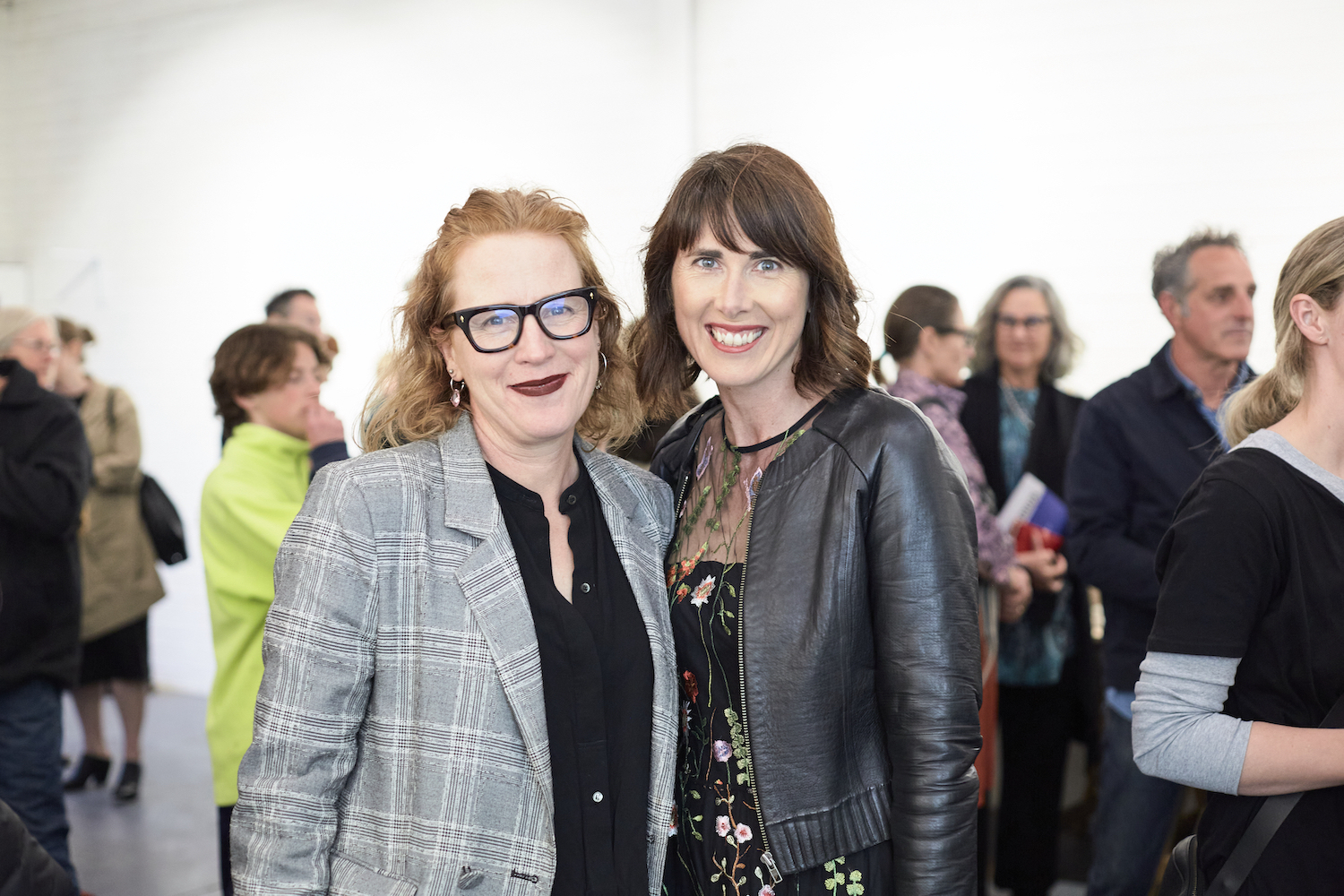
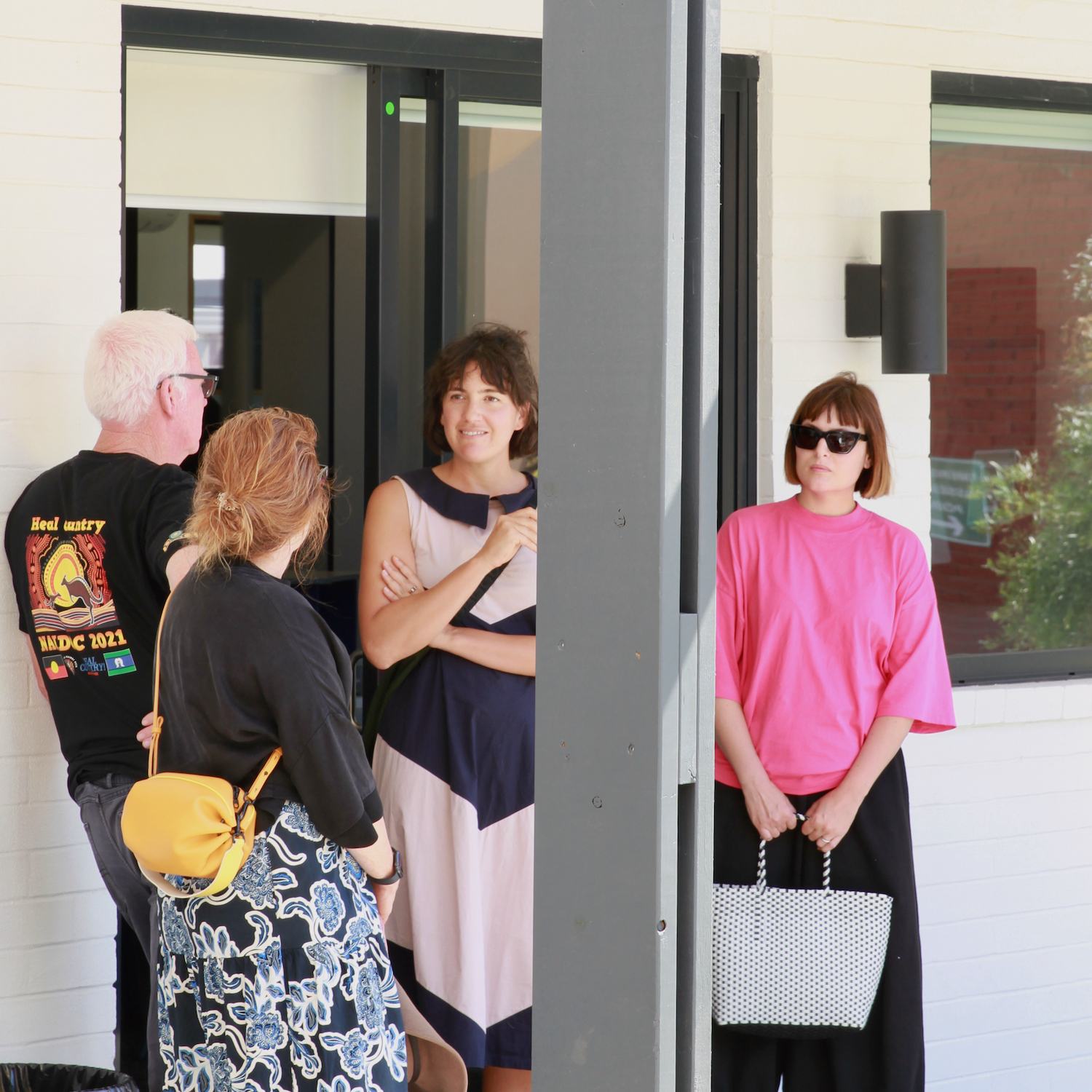
Emma Williamson and Fremantle Mayor, Hannah Fitzhardinge
Fremantle is home for most of us at
TheFulcrum.Agency
. We feel passionate about the city and committed to doing our bit to ensure it has a vibrant and sustainable future.
The
City of Fremantle
recently invited TFA Partner,
Emma Williamson
to share her thoughts on how the city centre could be improved:: “It’s really about looking for the levers that can encourage activation and a dramatic increase in the resident population.” Those levers according to Ms Williamson include social and low-income housing, subsidised housing for artists and performers, limits on short-term accommodation and mechanisms to ensure buildings are not left empty when there is a clear demand for accommodation.
These problems are not unique to Fremantle. Go
here
to read more.
Located in Victoria’s third most populous city, Nightingale Ballarat seeks to turn regional living on its head. Amelia Borg explores what happens when one of Melbourne’s most successful ethical developers brings their sustainable model to town.
Through innovative developments touted to address sustainability and housing affordability, Nightingale has gained an almost cult-like following within the Melbourne housing and architectural community. The Nightingale model was conceived to address a housing system that its founders saw as “inequitable, environmentally unsustainable and eroding the community it was meant to serve.
[1]
” The model promotes a triple bottom line approach to all developments prioritising financial, environmental, and socially sustainable outcomes. The founders had a vision for a new housing system; “It was about building homes, not real estate as a commodity. It was about fostering community to combat rising social isolation and designing buildings that positively tackled the issues of climate change rather than adding to the problem.”
[2]
Since its inception in 2007, the model and organisation have changed forms several times; however, these founding principles have remained, along with the motivation to remove what is seen as the exorbitant profit margins applied by developers. Homes are sold at cost price, with a 2.5% margin for Nightingale operations and access to purchasing apartments through a ballot system.
Response to the projects has been extraordinary, echoing a widespread hunger for new models of housing development. There is continuous popularity with potential homeowners while several Nightingale projects have received industry accolades, including National Architecture Awards for Housing and Sustainability. To date, Nightingale has delivered thirteen multi-residential developments, mostly in the inner-city suburbs of Melbourne, with another fifteen either under construction or in development. The model is gradually shifting beyond Melbourne, with soon to be completed projects in Marrickville (NSW), Bowden (SA) and Fremantle (WA). The first regional Nightingale has just been completed in Ballarat and was designed by Breathe Architecture.
This project came about through a desire to address the issue of urban sprawl through the Nightingale lens. Located 113km north-west of Melbourne, the current population of Ballarat is close to 116,000 making it the third largest city in Victoria. The city is undergoing huge growth, with the population projected to rise to 160,000 by 2040
[3]
. Up until now, this growth has been accommodated in newly formed suburbs sitting on winding streets on the outer fringes of the city, where new house and land packages of almost identical appearance are sprouting up on what was once agricultural land. Suburbia is springing up in all directions.
On top of this, the houses that are being built are much larger than they need to be; 65% of the households in Ballarat have a make up of 1-2 people, whilst less than 20% of the dwellings are 2 bedrooms or less
[4]
. This type of development has a significant impact on the environment and continued sprawl has exacerbated the reliance on cars for transportation. In response, the City of Ballarat created a comprehensive strategic plan to increase medium-density housing within the centre of town. The Nightingale project was to act as a test case, building appropriate-sized dwellings in the centre of town, whilst also having the job of changing community attitudes towards apartment living.
As suburban sprawl seems to continue unabated, it is examples such as this that will change attitudes in this type of context and accelerate the production of and access to more quality housing.
Back in the 1900s, the centre of Ballarat was bustling and vibrant. The gold rush began in Ballarat after the discovery of gold in 1851. For a time, Ballarat rivalled Melbourne in terms of wealth and cultural influence and continued its prosperity until the late 19th Century. During this time the city was lively and easily traversed by foot or public transport. At its peak in 1937, the Ballarat tramway network was the largest in Australia outside of a capital city and many people lived and worked in the centre of town
[5]
. Now the city is dominated by cars and the centre is made up of commercial and retail spaces with very few homes.
Located in the city centre, the Nightingale site is close to key amenities including the civic centre, hospital, library and train station. The site used to be a lawn mower factory and the immediate surrounds include low-rise industrial buildings with some residential neighbours to the west. The building responds to its context through generous and thoughtful setbacks. On the east, the frontage matches the height and materiality of a neighbouring heritage brick warehouse. Supersized brick archways punch into the facade providing a rhythmic second skin to the street and activation to the commercial tenancies on the ground floor.
Offering a total of 33 dwellings, the make-up of apartments is predominately two-bedroom. All apartments are organised around a large central void and courtyard, which is surrounded by a ring of open-air walkways. These internal streets not only provide fresh air and cross ventilation to each of the apartments but also act as a place for children to play and residents to encounter one another. Residents share a communal laundry and have access to a communal dining space and veggie garden. In all Nightingale developments, a portion of the apartments is allocated to a community housing provider. Here, five homes were pre-allocated to Housing Choices Australia and were designed with specialist accessibility features.
This building continues Breathes approach in the reduction of materials. Superfluous finishes are done away with, including the removal of all unnecessary plasterboard and other linings, concrete ceilings and floors are exposed, as are fire and hydraulic services. Materials were sourced locally where possible; the bricks came from a recently demolished nearby warehouse and the timber floorboards were also recycled and sourced locally. Local craftsmen were enlisted to make the windows, pre-cast metalwork and joinery.
The building has an impressive list of sustainable features. As with all Nightingale projects the building is carbon neutral in operation and has an 8+ NatHERS rating. All materials have a low embodied energy and toxic glues or adhesives were avoided. The building is 100% electric with the roof hosting a 27.65KW photovoltaic array, it has embedded Green Power and is completely gas free. A CO2 heat pump provides hydronic heating to apartments.
Consultation with the community happened throughout the process to ensure that the design response met the specific needs of a regional context. Apartments are generally larger than the city developments with the addition of separate study spaces. There are no studios, and more 3-bedroom types are offered than what would be in an inner-city context. Whilst most of the inner-city Nightingale developments cut out car parking altogether, in this context that would be a hard sell, so 14 car spaces were built and could be purchased separately to dwellings.
The previous inner-city Nightingales have been most popular with first home buyers looking for a home that is competitively priced to other apartments but offering principles of sustainability as well as a strong community. Interestingly and to the surprise of the project team, the demographic of those purchasing into Ballarat were predominately older couples who were downsizing and didn’t want the responsibility of upkeeping a block of land, as well as older single women who wanted to be part of a community.
This project acts as an exemplar model for medium-density housing in a regional context. It provides a refreshing alternative that champions environmentally sustainable living and the potential to build strong communities through responsible development. As suburban sprawl seems to continue unabated, it is examples such as this that will change attitudes in this type of context and accelerate the production of and access to more quality housing.
* This article was first published in our journal, Equity. Copies of Equity can be purchased at The
Fulcrum Press
, with all proceeds going to projects within First Nations communities.
The Fulcrum Agency is delighted to announce that our Co-Founder, Emma Williamson, has been awarded the
2023 Paula Whitman Leadership in Gender Equity Prize
by the Australian Institute of Architects. This prize acknowledges Emma’s outstanding leadership and contribution to the advancement of gender equity in architectural practice, education, and governance.
As she reflects in the film above, Emma’s career has been a study in two parts: contribution to practice through the founding of CODA Studio and then The Fulcrum Agency, two respected, ethical, and award-winning practices; and through her efforts as inaugural Chair of the AIA National Committee for Gender Equity and her advocacy on issues related to balancing
motherhood and work
, and
progressive business practices
.
At The Fulcrum Agency, we are thrilled for Emma and know her to be a compassionate and encouraging practice leader. She is ambitious and expects us to be the same. Most of us have worked with her for a very long time, which we see as a reflection of the warm, challenging, dynamic culture that she has created. Work/life with Emma is always exciting!
TFA Principal Nick Juniper was thrilled to be in Newman yesterday for the opening of Jirninyjarri Maya, an assisted living facility for Elders from the Parnpajinya community.
The project came about through the combined vision of two organisations – aged care and respite provider, East Pilbara Independent Support Incorporated (EPIS), who identified the need and the Pilbara Development Commission who were able to provide funding for the project. Lotterywest generously funded the courtyard and parkland landscape
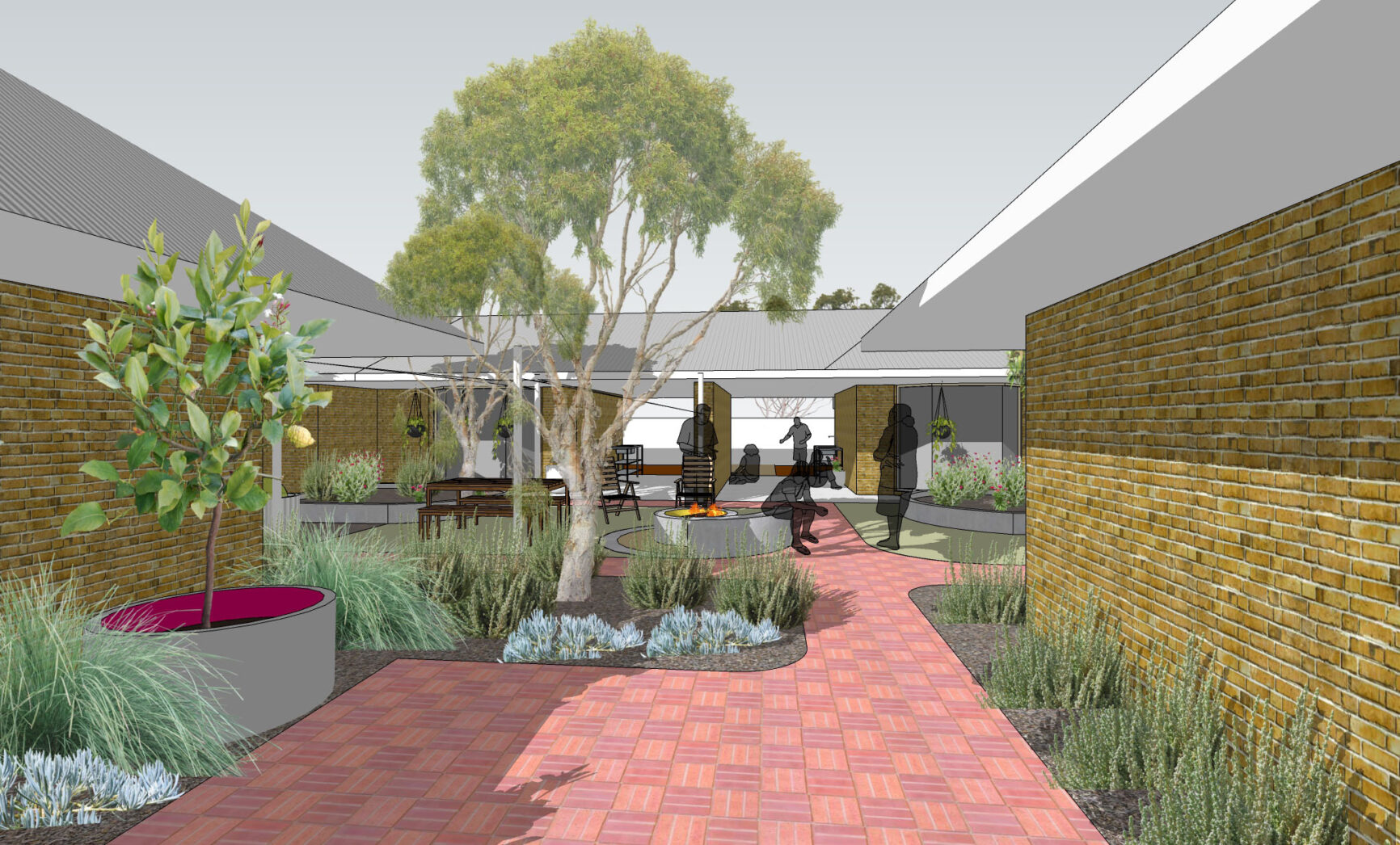
EPIS had been gifted eight houses in the town centre that were structurally sound but in need of a substantial upgrade. Our role was to provide co-design services, ensuring that the houses met aged care regulations whilst creating an inviting environment for residents and visitors. Residents had significant input into the colour scheme and landscaping.
Adding to the challenge was the need to accommodate different cultural groups within the village. Each group will occupy their own cluster of houses, while the courtyards are divided into a series of private, semi-communal and open space.
The design is affordable and environmentally responsible, making use of existing housing stock, and incorporating long-term cost saving devices including PV solar and bore water.
The impact of this project cannot be underplayed. Like Martuku Jikiku Maya does for secondary students, Jirninyjarri Maya will allow Elders to remain connected to family, culture and Country whilst accessing the health and social services they need.
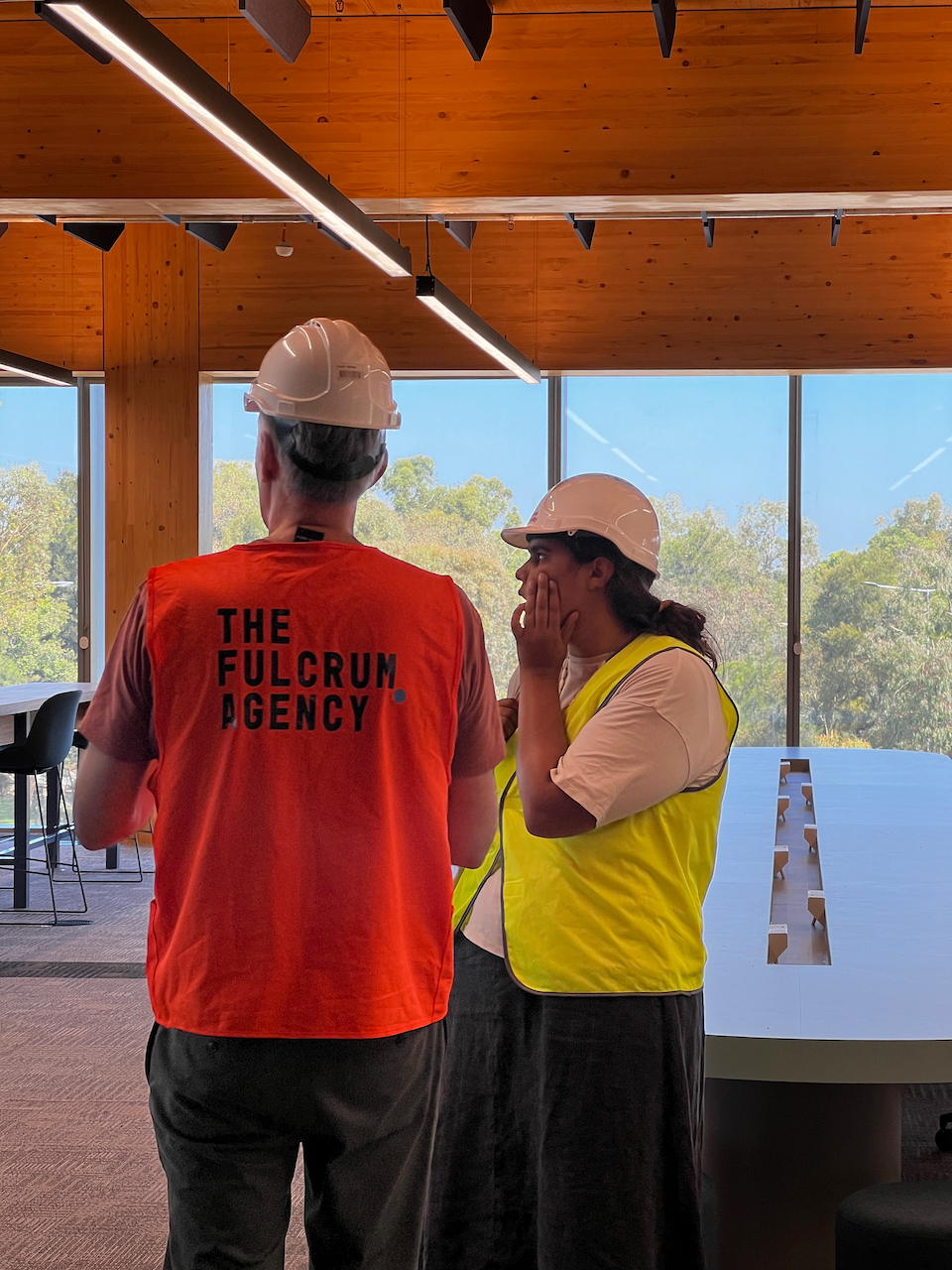
Last we donned our PPE to visit Boola Katitjin, the new academic building at Murdoch University offering 16000m² of contemporary collaborative learning space, informal peer-to-peer learning and academic workplace.
Our role on this project was to design the ‘welcome space’ that provides a joyful entry to the southern end of the building; and to develop the strategy that guides the digital artwork throughout.
The best part of the project was collaborating with some of our favourite creatives, including
Lyons
,
Officer Woods Architects
and
Remington Matters
.
For a group of people schooled through the 70s – 00s, it was wild to see how university has changed to become a much more dynamic learning experience!
It’s not often that we visit our projects together – most require two planes and a 4WD to get there! The visit was all the more special because we were joined by Andrew and Rosie from our Sydney studio and
Kevin Wilson
, who worked with students to create an artwork for the perforated metal screen.
While only one week into the school year, we loved hearing the positive impact that the new precinct is having on students and staff at this important school.
As a signatory to the 2017 Uluru Statement of the Heart, Dr Josie Douglas is deeply invested in its process and petition to the Australian people. In the latest edition of The Fatin Tapes*, Meri Fatin chats with Josie about her drive for social justice and the enormous potential offered by the Voice to Parliament for First Nations people.
Meri Fatin (00:00:00
Josie, it’s interesting timing talking to you in the middle of Reconciliation Week. It seems to mean different things to different people, even in terms of using the word “reconciliation.” What does it mean to you?
Dr Josie Douglas (00:00:42)
It (reconciliation) must start with settling the original grievance of Australia – that sovereignty wasn’t ceded. I want to focus on the Uluru Statement from the Heart and focus on that. Sequencing is very important. The Voice to Parliament is first and foremost, and then cascading from that is Treaty and Truth Telling. And that comes in under the establishment of the Makarrata Commission, which is a Yolngu word that means coming together after a conflict. I really do think that for substantial reconciliation for Australia as a modern nation, it needs to be led by the Commonwealth in settling the original grievance.
Meri Fatin (00:02:30)
On election night the Prime Minister stood up and started his victory speech by saying that he commits to the Uluru Statement from the Heart in full. What did it feel like to hear him say that?
Dr Josie Douglas (00:02:46)
It was pretty extraordinary. I think there were a lot of tears of joy shared around Australia by Aboriginal and non-Aboriginal people. I think there’s real hope but it needs to be delivered.
I was involved in developing the Statement through my work at the Central Land Council. It was an exhilarating process given the state of Aboriginal affairs and the lack of progress in terms of constitutional reform. We had five Prime Ministers, both Coalition and Labor, committing to constitutional reform but who kept kicking that can down the road.
And so now we’ve got a newly elected government, the 47th Parliament, and I think that Aboriginal leadership around Australia is really hoping Labor will deliver on its commitment to implementing the Uluru Statement from the Heart in its entirety.
There were a lot of tears of joy shared around Australia by Aboriginal and non-Aboriginal people. I think there’s real hope but it needs to be delivered.
Meri Fatin (00:06:34)
A friend pointed out to me that the word reconciliation implies that at some point the relationship was one of equals and that they just need to sort things out. And that’s not the truth, which is what you’ve spoken about with sovereignty not being ceded.
Dr Josie Douglas (00:06:57)
Yes, and that’s what the voice to parliament is seeking to address. It’s actually in the statement – I tend to quote it – it’s the powerlessness of our people. Even though in this election we’ve had the highest number of Indigenous people voted into Parliament, we’re still only 3% of the population and so it’s very difficult to influence policies and laws that are being made about Indigenous people.
Of course, we have our peak organizations. But there’s something much more fundamental to Aboriginal and Torres Strait Islander people having a voice and being able to influence the laws and policies that are made by Parliament. Indigenous people are tired of each new government coming into power, coming up with a different policy setting and different legislation for Aboriginal affairs. It feels that we take one step forward, two steps backwards. So, the voice to Parliament is about ensuring that those decisions that impact Indigenous people’s lives are taken out of the realm of politics, out of political ideology, and into the realm of Indigenous people having a say over matters that impact our everyday lives. And that’s whether you’re in a remote community in Central Australia or you’re in a metropolitan urban area. I think Aboriginal and Torres Strait Islander people really want to be able to provide advice to Parliament, not to government. And that distinction is important. Having a substantive amendment to the Constitution will compel Parliament to consult with us.
Josie Douglas and her sister Cass
Meri Fatin (00:10:38
You talk about it as a substantive change to the Constitution, and it’s interesting that Mr. Albanese has committed to the Uluru Statement of the Heart in full. Earlier iterations of what previous governments were willing to propose as a change to the Constitution were watered down versions of the full Uluru Statement. What do you think that interim period is going to be like for Indigenous people as that process begins of convincing people who don’t see a voice to Parliament as something that ought to happen?
Dr Josie Douglas (00:11:31)
I’m much more hopeful when it comes to the Australian people and where they’re at. I think finally government has stepped up to the plate and they’ve caught up to where society is at. What needs to happen between now and if we go to referendum in May 2023? I think it’s important to have an education campaign, so people really understand what the voice to Parliament is about, what the constitutional reform agenda is about, what it means and what it doesn’t mean. I think there’s also a lot of misinformation and misunderstanding within the Indigenous community over exactly what it means.
Meri Fatin (00:14:24)
What’s it been like dealing with the pandemic in Central Australia? How much agency have you had in being able to direct things the way they needed to be directed in your part of the world?
Dr Josie Douglas (00:14:38)
So I’m currently the General Manager for the Health Services Division at the Central Australian Aboriginal Congress, which is the largest Aboriginal community-controlled health provider in the Northern Territory and one of the largest in Australia. We cover the town of Alice Springs as well as five remote clinics. It has been challenging and difficult. We’ve had workforce issues, like there has been around Australia in terms of health professionals and staffing, but I think in terms of being community controlled, we’ve been able to respond quickly to people in need. It’s much more than just ensuring that people are getting their first, second, third, fourth vaccination. It’s the whole wraparound service ensuring that there’s food security, there’s energy security, that people aren’t missing out on benefits because they’re in isolation or they’re a close contact. So, it’s been about looking after the complete person and full complement of their needs as well as their needs in relation to the pandemic. It’s been a real feat and I think it comes back to Congress being able to respond in an agile and flexible way to the needs of community. And in responding to the pandemic as a primary comprehensive health service, we’re also mindful that there’s the health needs of our clients that we need to be managing including chronic disease and childhood immunizations. So, all that business of delivering comprehensive primary health care had to continue in our remote clinics and our town clinics. We had to make changes to how we were operating in early 2022 when there was the outbreak of COVID in Alice Springs. And that meant we had to pull staff back into one central clinic and focus our resources on responding to the pandemic.
Meri Fatin (00:19:27)
I read a news article from early 2022 where you were calling for the ability to put the communities into lockdown for a week. You were being overruled by the government. What happened there?
Dr Josie Douglas (00:19:53)
We wanted government to mandate lockdown for one week only. It was just to buy us time to get the supply in. Our supply was an issue at that time. We weren’t getting on top of the outbreak. It was spreading across town camps, across public housing in Alice Springs. And so the lockdown that Congress was calling for was to buy us time to slow the spread and to ensure that we could get adequate supplies of vaccinations, PPE, masks, you know, really important new medications that are available.
Meri Fatin (00:20:51
And did you succeed in that?
Dr Josie Douglas (00:20:56)
No, Government did not support our calls for a lockdown. So we just had to continue to do the best that we could. And I think Congress’s role in managing the COVID response in Alice Springs and remote clinics was exceptional.
Josie – keen trail runner!
Meri Fatin (00:20:51)
Josie, I’d love to hear a little bit about your story. About your mob and where you grew up and why you ended up doing this work?
Dr Josie Douglas (00:21:51)
Yeah, sure. I’m Darwin born and bred and I’m a Wardaman woman, that’s southwest of Katherine. So Northern Territory, Top End. I have been living in Alice Springs for thirty years. My husband is from Alice Springs, he’s a local Aboriginal fella. I love Alice Springs; it does get a bad rap at times, but it’s got such a strong sense of community. You come to Alice Springs, you hear language being spoken as you walk down the Todd Mall and you know that you’re on Aboriginal country and that you’re surrounded by Aboriginal people. It’s got a real sense of community, you know, Aboriginal and non-Aboriginal people. I like to think that Alice Springs is quite progressive, given the recent result of Marion Scrymgour, an Aboriginal woman winning the seat of Lingiari. You want to know a bit more about me? I’ve got four children and two grandies all Alice Springs born and bred. I suppose I’ve got a strong sense of social justice. Even as a little child, I was seeing things and questioning why? Why is it like that?
Meri Fatin (00:25:00)
Is there a story that springs to mind as an example of that?
Dr Josie Douglas (00:25:04)
I suppose as an Aboriginal kid in the seventies, just being very aware of the difference in how I was living, you know, the house that I grew up in, the extended family that was living in my house compared to some of my school mates. I think there’s a noticing. Noticing that’s an anthropological term, you know, noticing.
And I was I think, just noticing the differences from a very young age and always being curious about people and their stories.
My parents really shaped who I am. My mum Lorraine, was politically active combined with my Dad who had a really strong work ethic. Both growing up with not much but making the best of what they had. And I think my education was fundamental. It was always about ensuring that you got a good education so you could get a good job. Because I think not having a job in my family was like a sin. And that comes also from my Wardaman family – growing up working on cattle stations outside of Katherine and having a very strong work ethic despite the rations they were receiving.
Josie’s Children
Meri Fatin (00:28:43)
So obviously that noticing was felt deeply and it’s apparent across your career too.
Dr Josie Douglas (00:29:29)
What drives me to fight for social justice, both personally and professionally, is the social determinants. It is about housing. It is about access to drinking water. It is about having a better Community Development Program. It is about ensuring that all young people on remote communities are signed up to access the citizen entitlements that they’re entitled to receive and are not dependent on a great grandmother to financially provide for them. It’s all these social determinants of health that I strongly advocated for in my role at the Central Land Council.
Meri Fatin (00:31:23)
All of those components lead to the one outcome of good health and wellbeing.
Dr Josie Douglas (00:31:31)
Yeah, so now I’m at the pointy end of making operational decisions in terms of how health care is delivered. At Congress we have a strong CEO and Chair who are both advocating for policy changes to influence social determinants of health.
Meri Fatin (00:31:57)
I’m really interested in your doctoral research project. It was described in an article that you examined the lives of young Aboriginal adults and the role they fulfill in acquiring and transmitting Indigenous ecological knowledge. Tell me more about that, because this is a critical kind of moment where we’ve realized with human caused climate change, that we need to return to this kind of deeply known ecological knowledge.
Dr Josie Douglas (00:32:59)
Most of my working life has been within the cultural sphere. Whether it’s working at the Central Land Council, for an Aboriginal community-controlled health centre or many years ago at the Institute for Aboriginal Development. I’ve been lucky to be in Alice Springs, working with senior knowledge holders, particularly around language maintenance. People like M.K. Turner and Veronica Dobson, very senior knowledge holders, published authors and women held in high regard within the community for the depth and breadth of their traditional knowledge. So, over many years, I’ve heard the older generation talk passionately about keeping language and culture strong for future generations. And at the same time, the flip side of that is worry and despair that the younger generation weren’t interested in the old ways, that they were only interested in new ways. Senior Aboriginal people feel a moral imperative to pass culture on, which is the foundation to Aboriginal society, the continuity of Aboriginal culture going forward. So young people are seen as the heroes in terms of their role in that, but also the villains in terms of how they were undermining that. My PhD asked, where are the young people’s voices in all of this? It turns out they were missing.
The focus of my PhD was on the social and cultural practices of young Aboriginal people in relation to traditional and Indigenous ecological knowledge. Young people want to learn but my PhD reveals how things have been completely turned on its head in terms of the available time. People need to be out on Country to learn but that is being squeezed into school holidays. It’s not an iterative, daily learning process as it once was. It’s fitting it into a Western calendar. It’s fitting it into the availability of family members and senior family members.
There are genealogical gaps in the demographics of Aboriginal Australia. Families aren’t intact anymore. Generations aren’t intact anymore. So, young people aren’t born with culture, they grow up in the culture of their parents. My PhD unpacks the change the Aboriginal community has experienced over many decades and where young people see themselves in it. Young people want to learn, it’s just that they’ve got less time and less people to learn from. Fortunately, there’s been pragmatic and innovative approaches to the role of institutions in knowledge transfer. The role in Country visits, the role of school programs, the role of organizations like the Central Land Council in facilitating Indigenous ecological knowledge transfer. For instance, at the CLC young people and older people are involved in the ranger program, from a governance level through to doing the physical work on Country.
Meri Fatin (00:38:45)
What did you find was behind the perceived lack of engagement from young people?
Dr Josie Douglas (00:39:07)
It wasn’t about young people pushing it away at all. I think young people were desperate for more engagement, desperate to be doing more and learning more. But there’s so many challenges in the face of that. Young people are very interested in language and being out on Country. Young mums are interested in smoking their newborn babies and participating in different cultural practices. And I think engagement with traditional knowledge comes through in contemporary life, hunting, going out to collect bush foods or bush medicines. Beliefs and practices are still strong, it’s just that in a contemporary context it looks different. And it is different, but I think it’s still foundational to young people’s identities.
Sydney Peace Prize
Meri Fatin (00:41:26)
On the converse of that, you said part of the issue for young people is the fact that there aren’t as many people to teach them culture, there is the burden on senior Aboriginal people in the community and their responsibilities. What’s your observation on that?
Dr Josie Douglas (00:41:48)
I do write about this a lot in my Ph.D. that the responsibility does fall to a few. And that’s because of the mortality rate. It comes down to the life expectancy of Aboriginal men and women. There are genealogical gaps in Aboriginal families and that’s through early deaths. The situation is now that you have one old person in a culture camp or on Country teaching a group of 10 – 15 young people, and that within itself is new. That isn’t the traditional way of learning in terms of practice space, you know, that nexus between practice and belief.
Meri Fatin (00:43:39)
Would that ratio have been more one on one in the past?
Dr Josie Douglas (00:43:46)
One on one, plus you would have had a greater number of peers, of middle age people, of the older generation. You would have had a greater number wrapping around that little person from two, three years old and staying with them as they grew up. Whereas now what’s happened in terms of demographics is that you’ve got many more young people. You know, it’s a pyramid. Smaller numbers up top and more young people at the base. But there’s still peer to peer learning for young people. Some people will have grown up with grandparents and aunties and uncles who are very much going out bush, who are learning and knowledgeable, and they will teach their contemporaries, their peers. But, yeah, there were just many more people for young people to learn from whereas now it looks completely different. A lot fewer old people. The middle-aged generation is also missing and they’re crucial to knowledge transmission as much as the older people are.
Meri Fatin (00:45:25)
The two dates that have been potentially forecast for the referendum, May 27, 2023, and January 27, 2024. In the lead up, what would you really want to underscore in the public conversation?
Dr Josie Douglas (00:46:25)
Well, I think it is education. People need time to fully understand what the Uluru Statement from the Heart is, and what the voice to Parliament is. And to understand that you need a community education campaign at different levels, from the grassroots to corporate Australia.
Meri Fatin (00:49:45)
Thank you so much Josie. It’s been a real pleasure listening to your thoughts.
*Journalist Meri Fatin conducts the main interview in each edition of our journal, and always astounds us with her thoughtful, intelligent and kind approach to these conversations. Copies of Equity can be purchased at The
Fulcrum Press
, with all proceeds going to projects within First Nations communities.
The Fulcrum Agency will be open on Thursday 26th January and closed on Friday 27th January.
2023 will mark the seventh year that we have chosen to work on January 26th. This small gesture reflects our commitment to building a more reconciled Australia, where Aboriginal and Torres Strait Islander cultures are foundational to our national identity.
The Fulcrum Agency is delighted to welcome Rosina Baumann to our studio! Based in Sydney, Rosie is a Butchulla woman, final year architecture student at UNSW and joins us as part of our involvement with the CareerTrackers internship program.
These are Rosie’s thoughts on why she wanted to work with us:
My university experience has taught me that my interests and passions span across multiple industries, and through studying a Bachelor of Architectural Studies I have begun to realise that I can use this knowledge to work across multiple industries with a primary focus on the built and the design (I use these terms loosely).
Rosie Baumann
The majority of students who are at the same stage as me in their degrees have jumped into the machines that power the big corporations, that’s their starting point. I wanted the Fulcrum Agency to be my starting point given how I’d like to begin my career once I graduate.
The work that I’d seen produced by the Fulcrum Agency had some very key factors in this decision. Many companies are now working with remote Indigenous communities or at least attempting to, though they’re only doing it now after a background of ignorance. I first noticed the Fulcrum Agency as their work demonstrated growth from this ignorance, they actually worked with and for communities. This is the type of social justice action that I most resonate with. I find that many people want to tackle the big corporations to fight for First Nations rights. These people are doing the work, although I would rather work with the people, than for them. I found that this was a similar attitude appearing in The Fulcrum Agencies’ work and that really secured my decision to gain an internship here.
2022 was a pretty great year to attend Garma. It was equal parts electric and emotional. To be under the shade of a large tin roof, in view of the Gulf of Carpenteria, whilst the newly appointed PM outlined the referendum questions that would enshrine the Voice in our Constitution… it felt like a moment of sunshine after a long and challenging winter of silence.
I even got to ask a question on Q&A. According to my family it was career highlight, but in truth it wasn’t the question I had hoped to ask. I submitted two questions but the more pressing one wasn’t selected by the show’s producers. Missing from Garma’s forums and Q&A’s panel was any discussion around the impact of rising temperatures on culture and community and the viability of inhabiting Country across the north and at the centre of Australia.
After failing to get traction in my one shot on national television, I have been testing my concerns in smaller forums. Since returning from Garma, I have been talking with John Singer, Executive Director at Nganampa Health Service on the APY Lands. John has described the way in which cultural practice is changing to deal with the increasing heat; ceremonies and activities are either taking place in the evening, reduced in length, or not being done at all.
If the science holds true and the situation worsens, what is the future of cultural practice on Country that is being irreversibly changed as a result of the warming planet? John noted (with irony) our new Government’s acknowledgement of the impact of the climate crisis on our Pacific Island neighbours, without recognising the crisis that’s occurring in our own country – displacement, forced migration, loss of culture, community and the ability to care for Country. He questioned whether the Government would acknowledge that ‘climate refugees’ exist here in Australia right now
The standard definition of the term ‘refugees’ refers to people fleeing across national borders. People displaced
inside
a nation are generally not considered refugees under international law. If we think of Australia as a place more akin to Europe and made up of numerous nation states, then the movement of people across First Nations borders (with
Nations
being the critical bit) aligns more closely with the UNHCR definition of a refugee. That is, people moving across national borders as “persons displaced in the context of disasters and climate change.”
[i]
We need to acknowledge the multitude of nations that make up the continent we now call Australia, and the real and challenging impact of movement across these nation state lines for Indigenous people.
Human comfort is the result of the right mix of factors, in particular temperature and humidity. A critical measurement is known as the ‘wet bulb temperature’
[ii]
(shown in degrees
Tw
) and indicates the temperature of a thermometer after a wet cloth has passed its surface. With higher levels of humidity, less evaporation occurs to cool the surface. Humans rely on sweating to cool their bodies and wet bulb temperatures of 31.5Tw have been described as the upper limits of human survivability.
[iii]
Several places around the world have recently recorded wet bulb temperatures of above 31.5Tw and this includes two sites in Western Australia and the Northern Territory. So far, these temperatures are unprecedented (and brief in occurrence), but most climate experts predict that wet bulb temperatures above 31.5 will occur in more locations and for longer periods as vulnerable regions are increasingly affected by the climate crisis.
So, what is the link to ‘equity’ here? There are many – the first being the inequitable distribution and impact of the climate crisis on poor and vulnerable populations. Think here of the people without insurance in Lismore or displaced farmers in Pakistan flooded by unprecedented monsoonal rains. Our neighbours in the Pacific Islands are experiencing ongoing inundation and coastal erosion as well as the wildfire ravaged rural populations of Europe. Those with the least are being hit the hardest, and this, of course, includes many First Nations communities around the world.
Migration due to the climate crisis is happening across all populations, with many people in wealthier communities and populations around the world participating in what’s known as a ‘managed retreat’.
[i]
In Australia the search for better climates is often part of a midlife tree or sea-change, made easier by digital connectivity, improved regional infrastructure, the accumulation of wealth as a result of a suite of generous tax incentives focussed on housing.
Our government is acutely aware that many voters view Australia’s housing supply as a wealth creating asset, not as a human right or societal responsibility.
This is especially relevant to First Nations communities, where people have been dispossessed of land, ‘resettled’ into reserves, pushed off Country and had their traditional lands acquired, thereby denying them the means of inter-generational wealth accumulation through land ownership afforded to the settler state.
[i]
There is also vast inequity in infrastructure between Australia’s urban towns and cities and our regional and remote communities. Access to clean drinking water, reliable power, adequate telecommunications, safe roads, and appropriate waste removal varies significantly depending on where you live. The divide between remote communities and mainstream Australia is stark and well documented.
[ii]
And let us also consider the inequity of mobility. The movement of people due to seasonal, cultural, or social reasons, has always been seen as problematic by governments who like to be able to ‘see’ their subjects at a known fixed address. Tying a citizen to a parcel of land (and thus keeping them sedentary) certainly assists. It is interesting to contrast this problematising of mobility in Indigenous populations by the State, and the subsidisation of mobility in wealthier cohorts, such as holiday house owners through taxation systems and infrastructure investment.
So how can we address this lack of equity – and the combined impacts of a warming climate, poor infrastructure, and the requirement for mobility? And, perhaps more importantly, is there even the desire to do so? The sixth Assessment Report by the IPCC
[iii]
suggests that we only have a very small window to reduce our greenhouse gas emissions, and even then, substantial global warming is inevitable. For people already living on the edges of climate survivability, this has dire consequences, and it is not something we have started to meaningfully address.
For many First Nations communities, the predicted effects of rising temperatures do not need to hit the extremes of probability to make a real difference to the already over-stressed health system and individual vulnerabilities. Community infrastructure has been neglected for decades – power outages or disconnections are commonplace, air-conditioning often doesn’t work, insulation is lacking, buildings offer no shade or thermal control – all amplified by the negative impacts of crowding. It is an ecosystem of policy and delivery failure which demands urgent, system wide reform.
In Indigenous Affairs, reform has been a word rolled out across successive governments, Ministers, and bureaucrats. Despite this reformist zeal, genuine action and meaningful change has been glacial in pace. And thus, communities have become adept and skilled in the art of waiting. A large part of this waiting can be seen in the ‘testimony’ of housing adaptations. It is one of the few areas where agency is seen in the built environment in Indigenous communities. Building ‘hacks’ are commonplace, removal of louvres to install cheap wall air-conditioners, the use of tarpaulins, aluminium foil and shade cloth to protect inhabitants from climatic or privacy pressures, or the re-alignment of living/sleeping spatial norms most houses are designed to construct.
Governments have paid little heed to this testimony. While tenant involvement in Indigenous housing design is often recommended, it seldom takes place in practice. Demand for housing continues to outstrip supply, and in rental situations, it can be difficult for tenants to have much of a say about the design features that would improve their everyday living conditions. Each building hack holds clues that would help architects, planners, builders, and policy makers deliver new housing and refurbishments in harmony with tenant needs. Unfortunately, Indigenous tenants instead occupy the space between ‘take what you can get’ and ‘no money for appropriate designs.’
Despite research and community advocates who repeatedly recommend Indigenous-led housing design processes, Indigenous tenants in social housing are usually represented by organisational brokers, and if consulted directly, will be asked questions about their likely household composition/demographic profiles. These ‘briefing sessions’ reduce people’s agency to a function of bedroom and bathroom allocations. Tenancy Agreements forbid tenants from making any structural changes to their housing and design responses fail to address basic needs.
I was trained in the value of passive design – responding to a site’s climate by seeking opportunities for natural ventilation, effective shading to shield summer sun and welcome winter rays and orientation that assists all the above. Air-conditioning was seen as a design failure, an inability to design sensitively to your context, to ‘touch the earth lightly’. One could think of this approach as a kind of ‘thermal moralism’ – design judgments that believe natural systems are inherently better than mechanical (or man-made) ones. Design responses that took advantage of the site’s natural attributes, buildings that ‘breathe’, ensuring its occupants were in harmony with nature were celebrated as exemplars of the architectural discipline – positioning itself against the mindless housing of the mass market, which was closed and shockingly reliant on air-conditioning to maintain thermal comfort.
What is our design response when the temperature outside becomes lethal? Are we positioned as a profession to care about challenges such as cyclical maintenance, crowding and mobility, dust and corrosion that have left so many architect-designed ‘remote houses’ derelict without the ongoing maintenance support that is needed? Architects have ‘declared’ it’s a crisis, but in what ways are we acting?
And what then about the impending challenge of ‘managing the retreat’ of communities away from Country due to human-induced climate warming. Are we ready for the moral, ethical and logistical requirements to move people off Country, far away from their homelands? Again. Are our regional and peri-urban centres ready for this forced migration; places already feeling the squeeze of the housing crisis and impact of tree/sea changers? And how will we, as a nation, grapple with the shame of forced migration due to climate warming – an ideology of neglect – not only of the planet, but of the First Peoples who are disproportionately affected by it? Can governments and agencies adapt quickly enough to support seasonal or continuous mobility without penalty to tenants?
As always, there are pockets of hope. Places where communities are taking control, driving towards their own localised vision of community infrastructure, appropriate housing, responsive and culturally safe policy. There are innumerable advocates pushing for change – from Tangentyere Council delivering cogent arguments against government energy policy, or rental calculations, to practical demonstrations like Norman Frank Jupurrurla’s practical activism against energy poverty and for improving housing standards.
We need a massive investment in housing upgrades to make them thermally effective, to install air-conditioning, to change the system of power supply in community, and support ongoing planned and cyclical maintenance. We need new housing to be built in a way that is mindful of the impending future, to have climate boundaries drawn on maps not by policy makers seeking to simplify the lives of building certifiers, but in an accurate response to the changing climate. We need better tenancy policy to enable mobility, supporting people to move between regional centres and homelands. These are not issues of equality in housing supply for social housing tenants, and the likely comments sections of news sites calling out perceived unfairness for Indigenous peoples “being given two houses”. These are issues of equity, of justice and the re-distribution of the wealth.
This is complex, messy and challenging terrain. We must be open to this conversation, even as we argue for a Voice, for greater community control, for a handing back of land and assets. This must not be done as a way of retuning places devoid of liveability, the creation of a new form of
Terra Nullius
– a land nobody can survive in. John Singer and the countless others calling for a response cannot be left waiting any longer. For tens of thousands of generations, culture and community have not just co-existed, but thrived across this continent, nourishing through intimate connection to Country, ceremony and law. We are facing the very real possibility that this could be lost within the next two. The Uluru Statement called for Australians to walk together. I reckon we need to start running.
Footnotes
Oliver Prince Smith (October 26, 1893 – December 25, 1977) was a
U.S. Marine
four star general and decorated combat veteran of
World War II
and the
Korean War
. He is most noted for commanding the
1st Marine Division
during the first year of the Korean War, and notably during the
Battle of Chosin Reservoir
, where he said
“Retreat, hell! We’re not retreating, we’re just advancing in a different direction.”
[1]
He retired at the rank of four-star general, being advanced in rank for having been specially commended for heroism in combat.
[3] Wet Bulb Temperature: The Temperature of Evaporation
The wet bulb temperature Tw (or tw) or isobaric wet bulb temperature, is the temperature an air parcel would have if adiabatically cooled to saturation at constant pressure by
evaporation of water
into it, all latent heat being supplied by the parcel.
“As we acknowledge our First Peoples, I’d like to acknowledge two truths:
Firstly, that there is no inequality that climate change doesn’t make worse. This includes Indigenous disadvantage, whether it be people in sub-standard remote housing or the people of the Torres Strait dealing with the impacts of climate change on their beautiful island homes that I visited recently.
And secondly, First Nations people must be partners in charting the way forward. I was pleased that my state and territory Energy Minister colleagues agreed with me last week to the development of a First Nations Clean Energy Strategy that will be co-designed with First Nations people.
“
[8]
The IPCC finalized the first part of the Sixth Assessment Report,
Climate Change 2021: The Physical Science Basis, the Working Group I contribution to the Sixth Assessment Report on 6 August 2021 during the
14th Session of Working Group I and 54th Session of the IPCC
.