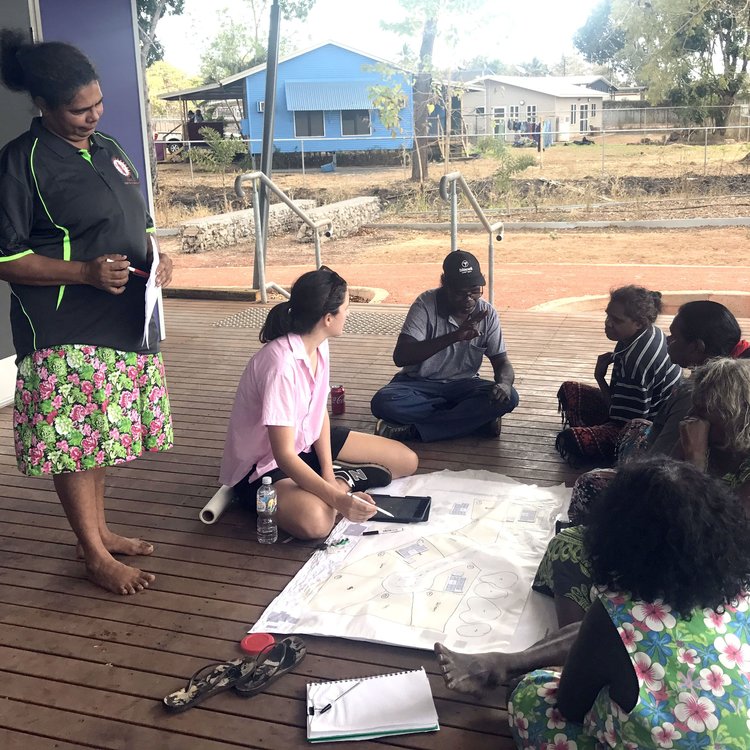
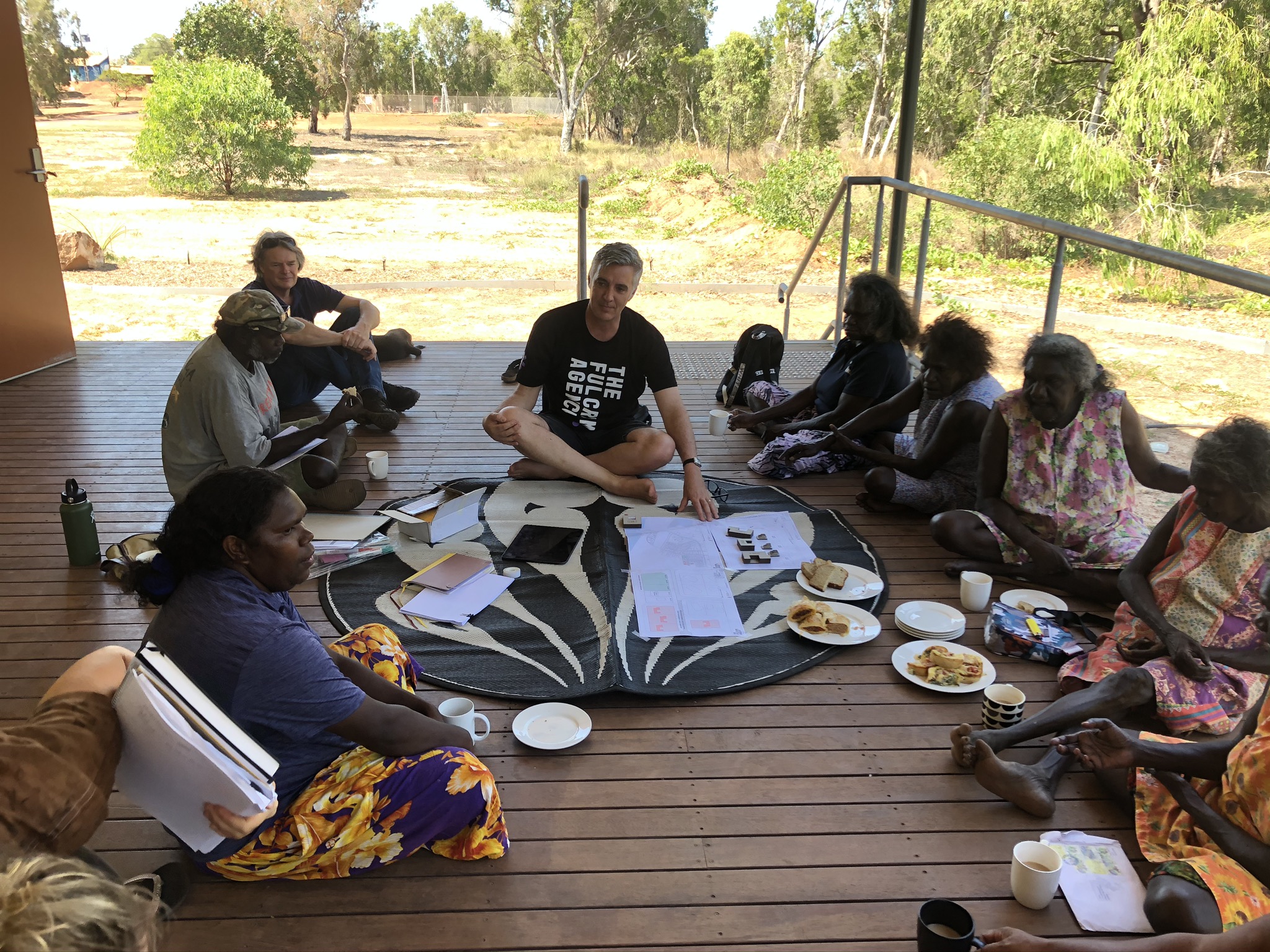
Nick Juniper in conversation with community on Groote Eylandt.
This morning started with the good news that we’d made the shortlist for the inaugural
ArchitectureAU
Award for Social Impact! Our work on Groote Eylandt conveys what this award is all about – ’empathy over aesthetics, extending the spatial possibilities of architecture to advance the discipline and to empower its users.’ We are chuffed to be included amongst a lineup of outstanding projects. Find out more
here
.
It’s not often that we visit our projects together – most require two planes and a 4WD to get there! The visit was all the more special because we were joined by Andrew and Rosie from our Sydney studio and
Kevin Wilson
, who worked with students to create an artwork for the perforated metal screen.
While only one week into the school year, we loved hearing the positive impact that the new precinct is having on students and staff at this important school.
Someone rightly made the point that our journal had not ever included content from anyone under 30. We didn’t have to look far to find Jemima Williamson Wong, law and sustainability student, climate activist and fledgling Instagram influencer . In Pain it Forward, Jemima asks her Gen Z followers a series of questions about their thoughts and fears for the future.
Equity the act of things being fair and just. Get Z, the Tik Tok generation, wasting too much time online. Money, the disparity between socio-economic levels, stress, luxury.
As a 20-something, I’ve found myself feeling a bit hopeless when it comes to my financial future. No matter how much I try to better my financial situation I worry I will never own my own house aka the predominant marker of success. I’ve also come to realise that these feelings are part of a broader attitude amongst Gen Z – it seems everyone is demoralized when they think about their financial future.
I know that I am privileged. My parents own property, I went to a private school, I’ve had help getting jobs, I was taught how to save and manage my money. I’ve had so many leg-ups and yet I still feel my financial future is bleak – and certainly won’t look anything like my parents. I’m 20 and I’ve already started saving for a house deposit – a house I probably won’t be able to afford for another couple of decades.
It’s an uncomfortable feeling carrying this concern about my own future, and at the same time, facing the boomer narrative that Gen Zs don’t work hard enough and choose smashed avocado on toast over saving for a house.
It’s hardly motivating to live frivolously when your entire news and Instagram feed is about the latest grim housing statistic. Or when every older family member you see lets you know they’ve been feeling worried that you may never be able to afford a home.
Through conversations with friends of a similar age, I noticed that I wasn’t alone in the way I was feeling. Three areas of concern had started to emerge: financial education, housing and wealth redistribution. To learn more, I put the following questions to my followers on Instagram (all 832 – I know, call me an #influencer).
Three areas of concern had started to emerge: financial education, housing and wealth redistribution. To learn more, I put the following questions to my followers on Instagram (all 832 – I know, call me an #influencer).
How do you feel about your financial future?
#worried
I feel like I have to work harder in my youth to be financially set up for uni years
A little worried tbh, I’m entering a pretty competitive area with my degree
Anxious and pessimistic
Feel like the cost of living and the pay rates are so drastically different to what they’ve been
Uncertain – but less worried than I feel like I should be
Not good! Prices for houses, cars, cost of living continue to fluctuate, and inflation is scary!
I reckon prices for things have gone up eg. housing and wages haven’t grown enough. Bit worrying.
Do you think there is financial fairness between generations?
No wayyy
That’s a tough one but no I don’t think there is fairness. Also depends on class
Nope! Unfortunately not
Noooope
Hell no
Lol no – my grandparents paid off the war. My parents nothing. I will pay off the results of Covid
I do not! I think it’s harder for younger generations to feel financially stable.
How do you feel about housing?
I will not have one probs
Worried that I won’t be able to afford one! And I’m in a privileged position which makes me think about those who are in a lower socio-economic bracket than me and those without the option of living with family as I am now
I feel like it is becoming very inaccessible and that scares me
Concerned…
Scared, the average cost of a house compared to the average income is insane. Even paying rent is hard to cover on minimum wage
Worried that I won’t be able to own my own home.
How do you feel about financial education (and how it’s impacted by social media)
Not enough of it! School did jack shit to teach us real life financial situations
Everyone seems to be financially comfortable on social media but it’s not real
We weren’t educated enough in school and e-com makes it look so easy to make money online.
Thoughts on wealth redistribution?
It is pretty important in my opinion. Everyone should be able to afford basic essentials!
I think it is important but it needs to be done right
Universal income ftw [for the win]
It makes me so sad to see the contrast between billionaires and those who have so little.
Any other thoughts?
There’s a lot that’s wrongly attributed to gen z’s work ethic or lack thereof
I think there’s a lack of understanding between generations.
Putting these questions online and reading the responses helped me to organise my own thoughts about this mess….
There is obviously a strong awareness about the inequity between the generations. We know that we will be inheriting trillions of dollars of government debt due to Covid, the climate crisis and all the other ‘unprecedented events’ that we are repeatedly experiencing. This cynical acceptance has fed into our attitude of hopelessness, pessimism, and anxiety about what our financial futures will look like.
It’s hard not to feel annoyed when I look at how older people view my generation as though we don’t work hard enough; if we spent less time on our phones we could get ahead.
I think there are two things at play here. First, there seems to be a lack of understanding about the way that social media has influenced our lives, and how it continues to shape different avenues of wealth creation. Successful influencers are the wealthiest people of our generation and they only got there because they hustled – on their phones.
Secondly, when I look around at my friends, I see a generation of hard-working hustlers. Of people trying to bring in money from multiple streams and yet are only just able to cover the cost of basic essentials.
As Gen Z influencer and media personality, Flex Mami put it: ‘the difficulty of Gen Z is that they have been touted to be these radical change-makers, and it is a lot of pressure for this environment we’ve built up. How do you be a change-maker when you have to pay your rent?
If we accept that the financial gap between generations will never be closed, why then do we continue to work towards the same financial aspirations as the generations before us? Because of this, I am starting to question the pursuit of financial security through property.
If we truly are the generation facing global catastrophe, owning a home and creating a wealth base through property hardly seems like a priority. Instead, would it be more prudent to focus on re-writing our expectations? To balance the need for a house and stability in a world marked by increasing volatility. Would there be more freedom, would we be happier if we could let go of this archaic pursuit of ‘to succeed in life’ you need to own a home and instead create a rental system that could provide stability?
This idea of balancing expectations is something I’ve come to after spending time trying to unpack the complicated mess of expectations, attitudes, reality, and stereotypes that surround housing and financial futures. I still haven’t resolved whether I’m willing to accept that my financial future and property ownership will look vastly different to my parents.
All I can ask from whoever is reading this, is that you take the time to think through my argument in light of your own context. No doubt many of you reading this will own investment properties. What we really need is better tenancy laws that will provide us with security while we get on with trying to fix the mess the generations before have made of the planet.
* Pain it Forward was first published in Equity, Issue 05 of our journal. Copies can be purchased at
The Fulcrum Press,
with all revenue going towards projects in First Nations communities.
** Hear more from Jemima via her Instagram account, @ourclimateconnection.
We’ve wanted to squeeze Andy into our journal for quite some time and in Equity we found the perfect spot! Here’s Andy’s thoughts on the word:
“Equity in common English conjures notions of inclusion and equal opportunity. In the making of cities it can often describe the precise opposite. Equity, in the financial sense, speaks of the command of resources that allows an investor to initiate the making of new city fabric. Equity brings control, ownership and by extension the privilege of agency. Equity investors can assert values, dreams and ethical ambitions, or can simply pursue the extraction and accumulation of private wealth. If we want to set the agenda of our cities in the context of climate and ecological crises we need to carefully reframe the rules which govern this source of investment.”
Copies of Equity can be purchased through the
The Fulcrum Press
with all proceeds going towards projects in First Nations communities. Link in profile.
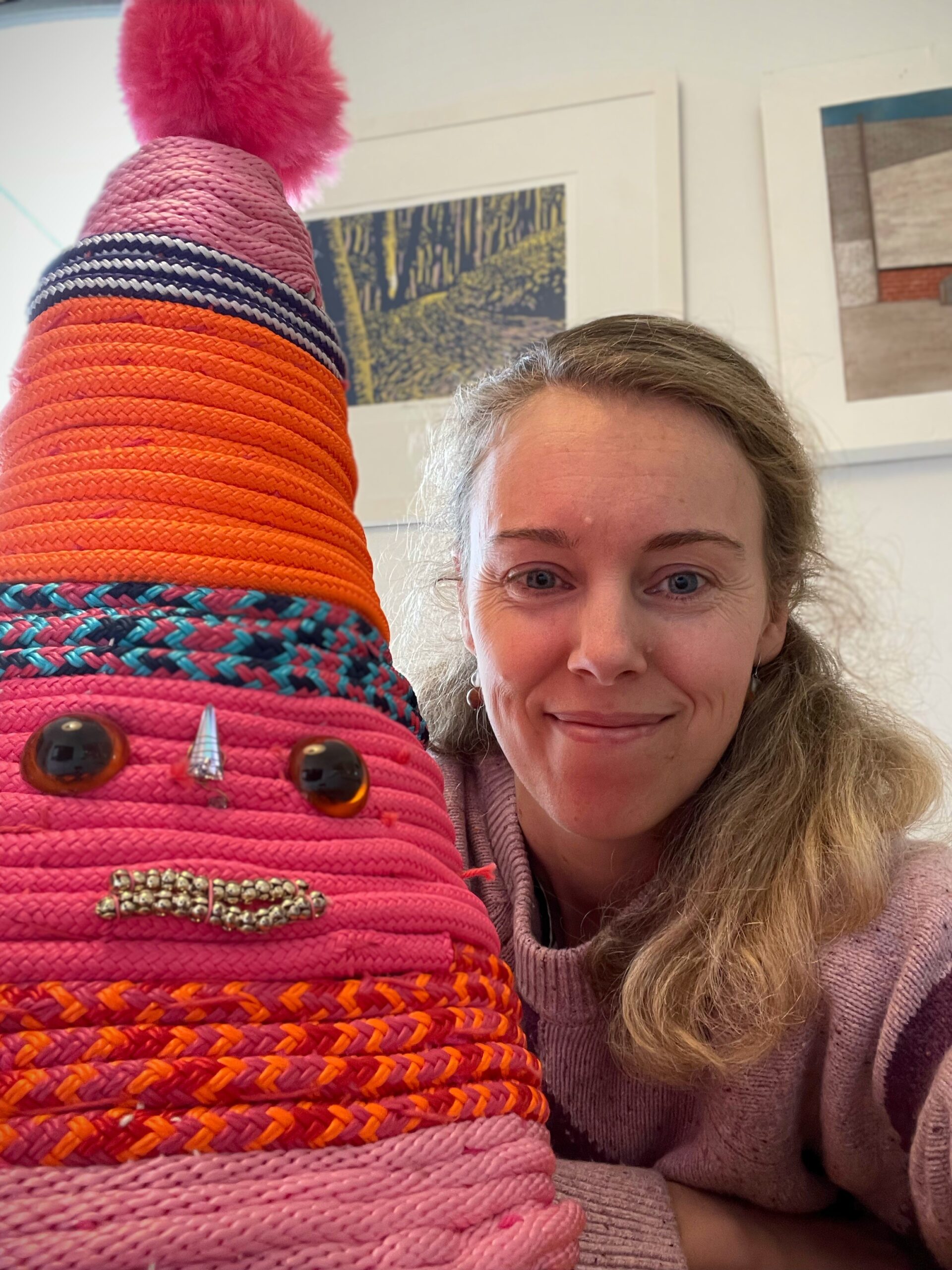
Akira Monaghan and friend (aka a textile sculpture by Carla Adams)
One of favourite bits of each journal is when we ask our friends and colleagues for their thoughts on our chosen word. This is TF.A’s Akira Monaghan on Equity:
Indulge me while I attempt a connection between ‘equity’ and poo.
A colleague recently had an unfortunate encounter with raw sewerage in his backyard. An inspection opening overflowed in what I visualize to be a type of chocolate fondue fountain, but less fun. The sewerage then flowed into his swimming pool. Not to worry though, it’s too cold to swim, and the poo breach was dealt with swiftly by the authorities, who treated the situation as the biological hazard that it was.
At TFA, we work on housing projects in remote Aboriginal communities. Raw sewerage in yards is commonplace, but unlike Perth, there is no rapid response from the authorities. A blocked septic tank can lead to the failure of health hardware such as toilets, hand basins, and kitchen sinks – thereby seriously inhibiting the ability of people to remain healthy.
I want to see infrastructure equity between urban and remote homes. I mean shit happens, but shit fountains shouldn’t!
* Copies of Equity are available for purchase through TheFulcrum.Press, with 100% of all revenue generated through journal sales distributed to First Nations community projects.
Our work on the Groote Archipelago Housing Programme (GAHP) won two awards at the prestigious
Australian Good Design Awards
in Sydney last Friday – the award for Social Impact and the Michael Bryce Patron’s Award!
The Patron’s Award is particularly special as it celebrates the best Australian-designed product, service or project and is awarded to the entry that has the potential to shape the future economic, social, cultural and environmental aspects of our planet.
The Good Design Awards Jury comment:
The great thing about these awards is that they celebrate two distinct aspects of this project:
+ our seven-years spent working with the Anindilylakwa people to improve life on the Groote Archipelago through
better designed housin
g. By working with community over several years, we were able to enhance built environment literacy and empower people to be proactively involved in the design of their housing.
+ in 2020, TF.A launched a series of evidence-based tools to measure a project’s social impact. By applying our
‘Social Return on Design Investment’
(SRODI) kit to this project, we confirmed that the shift towards Local Decision-Making enhanced feelings of community confidence, happiness and cultural safety.
The co-design process gave people the power to choose and the power to make decisions from their own mind and heart. Decisions we’ve never made before.
Cherelle Wurrawilya, Chair of the Anindilyakwa Housing Aboriginal Corporation
We were chuffed to see this review in Domain of a presentation that we gave at the Housing Futures conference in Melbourne last week. Thanks to journalist Jenny Brown for picking up on this important story.
“The slowest of the art forms, and one that generally starts with considering local context, community connections and subtle elements like site lines, is spun into a whole new dimension when architecture needs to consider the world’s oldest living culture, clan, inter-family and moiety relationships, and the ancient insider knowledge of songlines.
In the Groote Eylandt part of East Arnhem Land, and in an Australian-first project where traditional owners rather than a government agency have directly employed an architecture firm to deliver “culturally empowered housing”, Perth practice TheFulcrum Agency has been learning a great deal about “the ability to work slowly”.
To a wide-ranging architectural forum Housing Futures, convened in Melbourne last Friday by Architecture Media, Fulcrum Agency principal Kieran Wong explained that with all the cultural constraints of the project commissioned by the Anindilyakwa Housing Aboriginal Land Council (AHAC), he saw “working slowly as the great opportunity of the project”.
Engaging in years of meetings in which members of 14 local clan groups had explained why the prescribed housing solutions of the past had failed, and all the changes and adaptations that would actually maintain wellbeing and necessary traditions, Wong said what was being asked for was “very different to any masterplan the [NT] government had on file”.
“We don’t need to invent anything. What we need to do is what works; to do it properly and not to rush it,” Wong said.”
Indigenous housing projects, he said, had the tendency “of burning architects out in repeating cycles of failure”.
Instead of doing more of the same, the Groote Eylandt projects are modelling what happens when the directions come straight from traditional owners and the ultimate occupants like Gregson Lalara, founding chair of the Anindilyakwa Housing Co-operative and, therefore, Wong’s boss.
To the audience of mainly capital city architects, Lalara outlined cultural behaviours that were not only different to those of settler Australia, “but different to other Indigenous cultures in Australia”.
He said the new generation housing needed to be properly mindful “of different privacy structures” that could govern inter-action between neighbours and even members of the same family who occupied a single house.
At times and for reasons of correct (social or ritual) moiety relationships, various members cannot share what would be normally be common spaces such as bathrooms.
On the old standard-issue housing model, this has led to hot-climate houses being shrouded in shade cloth or tarpaulin screening – both within a single structure and to ensure that outward viewpoints towards neighboring houses were not inappropriate.
Even where there is a sea view, or an excellent potential for cross-breeze ventilation, conventional design can very clumsily contravene tradition. “Houses can also be facing the wrong way, or towards the wrong part of the country,” Wong said. “And this has led to all sorts of strange enclosures happening.”
With the current housing projects still under construction, and with a five to 10-year delivery schedule, the emphasis has been on “making the houses incredibly elastic because of the way occupancy patterns can change over time”.
“In the life of a house, events – say through marriage – can change family groupings quite dramatically.
“These are not Western nuclear families and the houses need to have multiple entry and exit points so ‘poisonous cousins’ and in-laws don’t encounter each other.”
The screening devices that will continue to be a big part of making a house flexible must therefore have adaptable fixing points that don’t, at the same time, impede healthy ventilation. For this, gable roof-lines are proving useful. “We need simple formats that can be flipped,” Wong said.
Because of the belief in nocturnal sorcery, Lalara explained the need for certain outdoor areas to be floodlit.
The myriad subtle differences necessary in the designing and delivering of housing that will be successful for the resident communities has, says Wong, “been an amazingly engaging project in which we’ve sat down and talked properly”.
Taking the directions from the local communities has been “a milestone”, he says. “To hand back decision-making to the people of Groote has been a process of listening and trying to understand.”