Our Sydney-based Principal, Andrew Broffman wrote this beautiful reflection for our journal Equity:
“There is a quietude on desert Country that permits stillness. It is a place where the busyness of life folds into the marks of geological history and creation. Here, human endeavour would seem to follow the cycles of time that govern the movement of the night sky, or the dry salt lakes that whisper of rains that have come and gone.
Yet we do much to shape this Country. We desperately cut the earth and scrape the soil. We choke the sky with a fine dust. We push water further from our reach. And the wealth that attaches to this extractive business is extraordinary.
At the same time, on the same Country, children sleep in broken houses while their parents squeeze the last few dollars of credit to keep the ceiling fans whirring against the summer heat.
On desert Country equity would describe a balance: an expansive horizon where we are not the shapers but the shaped.”
In the final article from Equity, art historian Melissa Miles the media portrayal of women in cities at night, and how these constructed images fail to capture the breadth of safety issues in public space. Miles argues that we need to look beyond white, middle class and heteronormative experience to develop cities in which all people feel safe.
Visually representing the anxiety experienced by many women, girls, particularly those who are members of the LGBTIQ community, when walking city streets alone at night involves contending with a weighty tradition. Decades of crime reporting, TV and visual culture have solidified into a set of visual tropes that are both pervasive and persistent.
The empty stretch of footpath. The young woman seen from the back, walking alone. Perhaps she’s looking over her shoulder. Harsh streetlamps creating disconcerting deep, dark shadows. Blurred neon or oncoming car headlights flaring on the camera’s lens, obscuring visibility. Grainy CCTV footage. The empty carpark. Misty roads and parklands. An imagined figure lurking in the dark. An abandoned shoe lying on its side. A handbag left in a lane. Flowers and candles transforming a street into a make-shift memorial. What geographer James Tyner describes as the ‘politics of fear underlying our representation of the street’ has been distilled over decades, from Jack the Ripper to crime films and more recently, news reports on the Claremont killings and Jill Meagher’s ‘final walk’.
[1]
HyperSext Exhibition; image: Brett Brown
Commercial stock photo archives like Getty Images and Shutterstock are indicative of the ubiquity of such imagery. These massive image archives trade in generic photographs for billboards, brochures, websites and magazines, forming what media theorist Paul Frosh refers to as the ‘wallpaper’ of cities and consumer culture.
[2]
Getty Images offers staged and documentary photographs of women in city streets after dark by the thousands. Yet four types of images overwhelmingly predominate: young, pretty ‘feminine’ women smiling and confidant when walking with their male partners or friends; young, pretty ‘feminine’ women standing alone but confident because they are connected to others through their mobile devices; young, pretty ‘feminine’ women isolated, unidentifiable or vulnerable when walking alone after dark; and sexualised young women walking alone and looking provocatively towards the viewer. The repetition of very limited tropes like these in news, entertainment and commercial media produces more than just ‘wallpaper’. It helps to create an ambient image environment that habituates members of the public to certain types of people in particular contexts and reinforces expectations about who is entitled to access certain types of spaces with confidence and who does not.
A Billion Views
This essay asks what is at stake in such representations of gender and safety in urban spaces, and how we might move towards more productive conversations. Imbued with very potent ideas about crime, fear, risk, race, responsible citizenry, and heteronormative and middle class norms, these images of urban threat, desire and safety are ingrained in us and inscribed into the spaces in which we live. Consciously or not, they inform where we walk, when we walk, how we walk and how we feel when we walk with others. Cumulatively and over time, these representations reinforce impressions of the urban spaces and conditions in which women and girls can reasonably have an expectation of safety and those which are sites of risk. For perpetrators of verbal harassment, physical intimidation and violence, they may also help to validate or legitimise abusive behaviours in certain types of spaces. Scholars have pointed out how the mass media’s disproportionate focus on a relatively small number of murders of young women by strangers also renders thousands of daily experiences of harassment and violence invisible.
[3]
Catcalling, unwanted sexual attention, objectification, stalking, harassment and physical violence form part of a spectrum of behaviours, which are the products of a culture that sustains heteronormativity and related constructions of masculinity and femininity.
[4]
The challenge for those seeking to address issues of safety and urban gender inequity visually, is that attempts to capture the public’s attention with imagery that already has currency risks inadvertently supporting the very problems they seek to overcome.
HyperSext City Graphic by Gene Bawden
In the geographies of risk mapped in popular representations of urban safety, the journey home is a particularly perilous terrain. The space between workplace or venue and home is a recurring trope in reporting of random attacks on women in public, where phrases like “just a kilometre from her home” and “walking towards her home in the early hours” are used strike a chord with readers.
[5]
Home is figured as the safe harbour in this problematic public-private divide. Although we know that that violence against women is most often perpetrated by someone they know, in the spectacularised culture of urban crime drama and reporting, the devil we don’t know looms far larger than the ones we do.
[6].
Police warnings and media commentaries supplement these narratives and images with cautionary tales. Victoria Police’s Acting Commander, David Clayton, controversially warned Melbourne women after the rape and murder of Eurydice Dixon in 2018: be ‘aware of your surroundings’, ‘walk in well-lit areas and if listening to music … consider using only one headphone in’.
[7]
For many of us, these and other behaviours taught by parents, authorities and peers to supposedly ward off the threat of violence and harassment in public are so normalised that we may not attach them consciously to a sense of fear. Walk with bravado – appear assertive. Don’t meander or dawdle. Don’t attract attention. Stick to the well-lit streets. Vary your route, but don’t take quieter paths. Be careful where you park your car. Carry your phone. Be aware of who is around you. Carry your handbag close. Tone down your look. Don’t show affection in public. Look out for your mates. Text a friend when you get home. Take a taxi. Behave like ‘a good woman’ and you’ll be ok.
[8]
Tell yourself it’s just anxiety. Don’t be hysterical. Tell yourself that women are more likely to be attacked or killed by someone they know by than a stranger in the street. Deny that the social relations, cultures, gender values, expectations, institutions and structures that give rise to and sustain domestic violence have any connection to acts of gender-based harassment, abuse and violence by strangers in public.
[9]
The unspoken flipside of these self-help crime prevention strategies (or myths) is highlighted by Elizabeth Stanko: ‘Women who do not follow the rules for prudent behaviour, it is presumed, deserve to be excluded from any benefits of public provision of safety, because
those
women fail to take appropriate measures to protect themselves from harm.’
[10]
Social geographer Alexandra Fanghanel points out the ultimate irony: ‘even the notion of personal security, of things that you could do to make yourself safer in order to avoid rape and sexual harassment, are ingrained in vernacular rape culture that fetishises safety at any price, and casts public spaces where these attacks are imagined to take place as inherently dangerous, from which women as always-already victim, should be excluded.’
[11]
Home is figured as the safe harbour in this problematic public-private divide
The offensive judgements implicit in recurring cautionary tales are not simply linked to certain self-regulating behaviours. As the plethora of stock photographs of women alone on the streets at night attest, there is a preferred cast in representations of fear and risk in urban spaces. The so-called ‘innocent victim’ is typically a cisgender woman, white, able-bodied yet apparently helpless, young, pretty and childless.
[12]
Scholars looking at news accounts of violence against women through an intersectional lens have shown the striking variability in reporting of the deaths of women based on the extent to which the victim aligns to these ideals. In their study of media coverage of the deaths of Irish woman Jill Meagher, Indian woman Jyothi Singh and Indigenous woman Lynette Daley, Chelsea Hart and Amanda Gilbertson show how some crimes are presented as more ‘grievable’ than others based on preconceptions about the race and class of the victim.
[13]
In popular representations of gendered risk in public, different lives seem to matter and different ways. Conversely, perpetrators of ‘grievable’ public attacks on women are commonly framed as deviant or disconnected from society due to mental illness, disability or other supposed outsider status, as was the case with Meagher’s, Dixon’s and Aiia Maasarwe’s killers. Media depictions of ‘evil’ criminals and abhorrent crimes troublingly ‘sustain the inaccurate myth that violence against women is rare and when committed, not reflective of society’s true values.’
[14]
It is clear that we need alternative ways of representing the experiences and risks of gender-based harassment and violence in public. We may use social media and public gatherings to reclaim the streets and the night, march against violence and hold vigils for peace. Tweet our rage, Insta empowering images, and Facebook our own stories. However, there is also a risk in unwittingly figuring urban space as the inert stage for violence and harassment, rather than the product of decades of non-gender-inclusive design produced by those with the privilege of feeling safe in public space. We must remember that gendered spatial inequity is not simply the product of harassment or violent acts that occur in public. Tyner puts it succinctly: ‘We need to recognize that violence not only
takes place
, but that violence is
part of place
, that violence and place are iterative. In other words, both that violence contributes to the production of place, and that place is foundational to the practice of violence.’
[15]
HyperSext City Opening Night
The ability to occupy and traverse urban spaces free from harassment and violence is the product of privilege. And when cities are designed as though this privilege is the norm experienced by all, spatial inequities quietly persist. As Michael Kimmel writes in his study of masculinities: ‘The processes that confer privilege on one group and not another are often invisible to those upon whom that privilege is conferred. Thus, not having to think about race is one of the luxuries of being white, just as not having to think about gender is one of the “patriarchal dividends” of gender inequality’.
[16]
Privileges also function by degrees. To suggest that spatial inequity and injustice operate according to dualistic gender categories is to deny intersectional experiences and gender diversity. When ‘public spaces are (over)coded as androcentric, heterocentric, ableist, transphobic, racist, [and] classist’,
[17]
they perpetuate inequity, hinder engagement and delimit full participation in urban space in myriad ways. For LGBTIQ+ communities, unsafe spaces can be spaces that are heterosexualised through the prevalence of advertisements and displays showing images of happy heterosexual couples and nuclear families. Such spaces can create a sense of being out of place and act as reminders of vulnerability to harassment, verbal abuse, intimidation and physical hate crimes.
[18]
In her study of the experience of architectural space for trans and gender diverse people, Simona Castricum also notes: ‘Trans people who live with different aspects of marginalization as well – through race, class, ability, or a combination of these – experience compounding effects; this is one reason why particularly trans women of colour endure disproportionate amounts of extreme violence and murder rates in their communities.’
[19]
Monash University XYX Lab, 2021
We can choose to turn away from exclusionary images altogether and let the numbers speak loudly to the scale, breadth and complexity of the problem. The Australian Bureau of Statistics, the Australia Institute and Plan Australia tell us that ‘90 per cent of women in Australia have experienced catcalling or sexually aggressive comments, and more than half were still children the first time it happened.’
[20]
While 80% of Australian men report feeling safe while walking alone at night, a 2019 Community Council for Australia report notes that only 50% of women say the same. This gap between the perceived safety of women and men in Australia is the largest of all OECD countries, and is growing wider in Victoria where women’s perception of safety is diminishing.
[21]
While the particular experiences of trans women were addressed in this report,
The 2018 Australian Trans and Gender Diverse Sexual Health Survey
found that 53.2 percent of trans and gender diverse people had experienced sexual violence, compared to 13.3 percent of the broader Australian population.
[22]
According to the 2020 Australia’s National Research Organisation for Women’s Safety report
Crossing the Line
, trans women from culturally and linguistically diverse (CALD) backgrounds report more frequent instances of sexual harassment by a stranger than other groups of women.
[23]
Data is power, but it is also partial and says more about effects than their cause. While shocking data like this can form a compelling call to action, it does not show the way forward.
Criminologists, geographers, philosophers, feminists and social scientists have spent decades studying women’s experiences of public space, yet gendered experiences of sexualised harassment and violence persist. These are complex issues – too complex to solve with a silver bullet. Single propositions, whether they be design or policing strategies, queer practices or feminist imagery and analysis, will not be able to compete with the cumulative effects of decades of news coverage, popular culture, gender norms, classism, homophobia and transphobia, racism and deeply ingrained intergenerational anxieties. Like any long-term systemic change, we need to come together and be in it for the long haul. Intersectional dynamics will be a source of strength. We need to talk and to listen;
really
listen, sensitively and respectfully. Only through a comprehensive, interdisciplinary and intersectional practice can we create shared understanding and a common vision for change. People from across the spectrums of age, class, gender, profession, experience, interests and skills can together activate new pathways and forge new spaces, and through a multitude of small, complementary actions, can help edge closer towards long-overdue change.
[1]
James Tyner,
Space, Place and Violence
(New York: Routledge, 2012), 102. For examples of this representation of the city as site of risk see: Candace Sutton, ‘Shadowed by a killer: Jill Meagher’s final walk’, news.com.au, 4 May 2017.
https://www.news.com.au/national/victoria/shadowed-by-a-killer-jill-meaghers-final-walk/news-story/ebe461b014086b7a31c6c8d47d5ee0cf
; ‘Three women were murdered in Claremont. This is why it took two decades to reach a verdict’,
SBS News
, https://www.sbs.com.au/news/three-women-were-murdered-in-claremont-this-is-why-it-took-two-decades-to-reach-a-verdict.
[2]
Paul Frosh, “Is Commercial Photography a Public Evil? Beyond the Critique of Stock Photography,” in
Photography and Its Publics
, ed. Melissa Miles and Edward Welch (London: Routledge, 2020), 195.
[3]
Janine Mary Little, “Jill Meagher CCTV,”
Feminist Media Studies
15, no. 3 (2015): 407. For a compelling account of incidents of domestic violence in just one day in the UK, see Elizabeth Stanko, “The Day to Count: Reflections on a methodology to Raise Awareness about the Impact of Domestic Violence in the UK,”
Criminology and Criminal Justice
1, no. 2 (2001): 215-26.
[4]
Alexandra Fanghanel,
Disrupting Rape Culture: Public Space, Sexuality and Revolt
(Bristol: Bristol University Press, 2019), 8.
[5]
See, for example, Bill Hosking, ‘Anita Cobby murder: ‘Everyone in the car that dreadful night had a passport to doom’’,
The Guardian
, 20 March 2017, https://www.theguardian.com/australia-news/2017/mar/20/anita-cobby-everyone-in-the-car-that-dreadful-night-had-a-passport-to-doom; Aisha Dow, ‘Murder of Jill Meagher was ‘preventable’, Victorian Coroner finds’, the Age, 27 May 2016,
https://www.theage.com.au/national/victoria/murder-of-jill-meagher-was-preventable-victorian-coroner-finds-20160527-gp5y0w.html
; ‘Eurydice Dixon’s killer stalked her for 5km before murder in Melbourne park’,
The Guardian
, 15 August 2019, https://www.theguardian.com/australia-news/2019/aug/15/eurydice-dixons-killer-stalked-her-for-5km-before-in-melbourne-park
[8]
Elizabeth Stanko, “Safety Talk: conceptualizing women’s risk assessment as a ‘technology of the soul’,”
Theoretical Criminology
1, no. 4 (1997): 486.
[9]
For more on these systemic issues, see Geraldine Connon Becker and Angel T. Dionne, eds.,
Rape Culture 101: Programming Change
(Ontario: Demeter, 2020).
[10]
Stanko, “Safety Talk: conceptualizing women’s risk assessment as a ‘technology of the soul’,” 486.
[11]
Fanghanel,
Disrupting Rape Culture: Public Space, Sexuality and Revolt
, 12.
[12]
Stanko, “Safety Talk: conceptualizing women’s risk assessment as a ‘technology of the soul’,” 483.
[13]
Chelsea Hart and Amanda Gilbertson, “When does violence against women matter? Gender, race and class in Australian media representations of sexual violence and homicide,”
Outskirts
39 (2018): 1-19. See also Jay Daniel Thompson and Rebecca Louise, “Sexed Violence and its (Dis)appearances: Media Coverage Surrounding the Murders of Jill Meagher and Johanna Martin,”
Outskirts
31 (2014).
[14]
Hart and Gilbertson, “When does violence against women matter? Gender, race and class in Australian media representations of sexual violence and homicide,” 3.
[16]
Michael Kimmel, “Foreword,” in
Masculinities Matter! Men, Gender and Development
, ed. Frances Cleaver (London: Zed Books, 2002), xi-xii.
[17]
Fanghanel,
Disrupting Rape Culture: Public Space, Sexuality and Revolt
, 13.
[18]
Karen Corteen, “Lesbian Safety Talk: Problematizing Definitions and Experiences of Violence, Sexuality and Space,”
Sexualities
5, no. 3 (2002): 260.
[19]
Simona Castricum, “When Program is the Enemy of Function… Gender- Nonconforming Experiences of Architectural Space,”
Architecture and Culture
5, no. 3 (2017): 378.
[20]
Jane Gilmore, ‘If you don’t believe the harassment statistics, listen to these women’,
Sydney Morning Herald
, 10 May 2019, https://www.smh.com.au/lifestyle/gender/if-you-don-t-believe-the-harassment-statistics-listen-to-these-women-20190509-p51lp2.html
[21]
Community Council for Australia,
The Australia We Want
, Community Council for Australia (Canberra, 2019), 32-33, https://www.communitycouncil.com.au/sites/default/files/Australia-we-want-Second-Report_ONLINE.pdf.
[22]
Denton Callander et al.,
The 2018 Australian trans and gender diverse sexual health survey: Report of findings
, The Kirby Institute (Sydney, 2019), 10, https://kirby.unsw.edu.au/sites/default/files/kirby/report/ATGD-Sexual-Health-Survey-Report_2018.pdf.
[23]
Australia’s National Research Organisation for Women’s Safety,
Crossing the line: Lived experience of sexual violence among trans women of colour from culturally and linguistically diverse (CALD) backgrounds in Australia
ANROWS (Sydney, 2020), 10, https://apo.org.au/sites/default/files/resource-files/2020-06/apo-nid306359_0.pdf.
We made a commitment when we sold our first journal in 2018 to distribute all revenue to First Nations community projects. Since then, sales have been ticking over and we’ve been steadily stashing away the funds.
We are chuffed to announce that we’ve been able to make a $1000 donation to the language preservation program at
Kanyirninpa Jukurrpa
(KJ), an organisation based in Newman and servicing Martu communities in the Western Desert.
Thank you to everyone who has bought one of our journals – Pivot, Agency, Leverage, Commune, Equity – and made this donation possible. Thank you also to Pauline at the
Fremantle Foundation
for your work in facilitating the grant. Happy days!
Zac James is a Wongi, Yamatji and Murri man, actor and theatre maker. This is his eloquent take on Equity*:
Equitable change, it’s a mouth full.
For a very long time, theatre has been the place to share stories, to stage our issues. To shed a light on the grim underbelly pinning our collective societies and, for a long time, there has been a drive for equality within that space. Equality without equity however lead to tokenistic gestures and unsafe spaces for more vulnerable minorities.
Zac James
For Aboriginal people, for myself, as a proud Aboriginal man, theatre of the 21st Century has been a mixture of trauma, dispossession and caricatures of our beings.
For Aboriginal people, for myself, as a proud Aboriginal man, theatre of the 21
st
Century has been a mixture of trauma, dispossession and caricatures of our beings. Oftentimes written by people that were not even First Nations. Yet there is change, a slow ripple that is growing into a chasm. A gaping hole that is being filled with our voices, full bodied, proud and triumphant.
Equity is making the space for people to tell their stories the way they are intended to be. To empower and enrich our families, our friends, the people we’re born to create art for. This change is power and it’s a welcome one.
* Zac’s words were first published in our fifth journal, Equity. 100% of all revenue generated through journal sales will be distributed to First Nations community projects through TheFulcrum.Fund. Copies can be purchased
here
.
Like many West Australians, we laughed hysterically at Premier McGowan’s ‘there’s nothing unlawful about going for a run and having a kebab’ comment. It provided a moment of collective joy during a period of grim lockdowns and fear. Textile artist, Emma Buswell, loved it so much she turned the iconic moment into a jumper, building on her portfolio of knitwear as social commentary. In Equity*, Emma shifts her attention to the infamous $11.99 lettuce of 2022, turning the motif into a wearable artwork and apocalyptic short story…
* Copies of Equity are available for purchase through
TheFulcrum.Press
, the content publishing arm of TheFulcrum.Agency. 100% of all revenue generated through journal sales will be distributed to First Nations community projects through
TheFulcrum.Fund
.
Stephen is the Principal at Highgate Primary School, located in Perth’s inner north. This is his thoughts on Equity*:
In my school there are over 900 students. The students represent 70 nationalities, there are 54 different languages spoken, we have two women’s shelters in our catchment area, and we have about 80 students who attend our Intensive English Centre. We have millionaires through to families living in cars. Lots of room for inequities. That is why notions of equity take up lots of my time and thoughts.
Does the kid who has just enrolled, escaping from domestic violence, and living temporarily in the refuge cause me some equity thoughts? You bet.
Does the child who just arrived in Perth, who can’t speak more than three words of English, currently enrolling in our Intensive English Centre cause me some
equity
thoughts? You bet.
Does the student whose school attendance has dropped below 40% due to family dynamics cause me some
equity
thoughts? You bet.
I have concerns about
equity
for nearly every student and family. Life is messy. You do you. Let me do me. That at least feels fair and equitable.
* This piece was first published in our fifth journal, Equity. 100% of all revenue generated through journal sales will be distributed to First Nations community projects through TheFulcrum.Fund. Copies can be purchased
here
.
Natalie Jenkins is CEO at Block Branding and a champion of the arts in Western Australia. We were delighted when she said yes to our request for her thoughts on equity. This is what she had to say…
‘I think equity is a challenging lens to look through unless you’ve experienced inequity. To remind myself of what it means, I reflect on the cartoon showing the difference between equality and equity, where people of different heights are looking over a fence.
Giving them the same size boxes to stand on just gives the tallest one even more advantage over the others, whereas different size boxes – and only for those that need it, ensures they all get to the same level.
It illustrates that different measures are needed to ensure equity for everyone – it’s not about treating everyone the same and I’m comfortable with that.
Equity has a very different meaning in business/financial terms and I find it interesting to compare that definition to what equity means to me. It seems worlds apart, however in financial terms it reflects value and therefore, equity is valuable. That works for me.’
Natalie’s thoughts were first published in our fifth journal, Equity. 100% of all revenue generated through journal sales will be distributed to First Nations community projects through TheFulcrum.Fund. Copies can be purchased
here
.
Located in Victoria’s third most populous city, Nightingale Ballarat seeks to turn regional living on its head. Amelia Borg explores what happens when one of Melbourne’s most successful ethical developers brings their sustainable model to town.
Through innovative developments touted to address sustainability and housing affordability, Nightingale has gained an almost cult-like following within the Melbourne housing and architectural community. The Nightingale model was conceived to address a housing system that its founders saw as “inequitable, environmentally unsustainable and eroding the community it was meant to serve.
[1]
” The model promotes a triple bottom line approach to all developments prioritising financial, environmental, and socially sustainable outcomes. The founders had a vision for a new housing system; “It was about building homes, not real estate as a commodity. It was about fostering community to combat rising social isolation and designing buildings that positively tackled the issues of climate change rather than adding to the problem.”
[2]
Since its inception in 2007, the model and organisation have changed forms several times; however, these founding principles have remained, along with the motivation to remove what is seen as the exorbitant profit margins applied by developers. Homes are sold at cost price, with a 2.5% margin for Nightingale operations and access to purchasing apartments through a ballot system.
Response to the projects has been extraordinary, echoing a widespread hunger for new models of housing development. There is continuous popularity with potential homeowners while several Nightingale projects have received industry accolades, including National Architecture Awards for Housing and Sustainability. To date, Nightingale has delivered thirteen multi-residential developments, mostly in the inner-city suburbs of Melbourne, with another fifteen either under construction or in development. The model is gradually shifting beyond Melbourne, with soon to be completed projects in Marrickville (NSW), Bowden (SA) and Fremantle (WA). The first regional Nightingale has just been completed in Ballarat and was designed by Breathe Architecture.
This project came about through a desire to address the issue of urban sprawl through the Nightingale lens. Located 113km north-west of Melbourne, the current population of Ballarat is close to 116,000 making it the third largest city in Victoria. The city is undergoing huge growth, with the population projected to rise to 160,000 by 2040
[3]
. Up until now, this growth has been accommodated in newly formed suburbs sitting on winding streets on the outer fringes of the city, where new house and land packages of almost identical appearance are sprouting up on what was once agricultural land. Suburbia is springing up in all directions.
On top of this, the houses that are being built are much larger than they need to be; 65% of the households in Ballarat have a make up of 1-2 people, whilst less than 20% of the dwellings are 2 bedrooms or less
[4]
. This type of development has a significant impact on the environment and continued sprawl has exacerbated the reliance on cars for transportation. In response, the City of Ballarat created a comprehensive strategic plan to increase medium-density housing within the centre of town. The Nightingale project was to act as a test case, building appropriate-sized dwellings in the centre of town, whilst also having the job of changing community attitudes towards apartment living.
As suburban sprawl seems to continue unabated, it is examples such as this that will change attitudes in this type of context and accelerate the production of and access to more quality housing.
Back in the 1900s, the centre of Ballarat was bustling and vibrant. The gold rush began in Ballarat after the discovery of gold in 1851. For a time, Ballarat rivalled Melbourne in terms of wealth and cultural influence and continued its prosperity until the late 19th Century. During this time the city was lively and easily traversed by foot or public transport. At its peak in 1937, the Ballarat tramway network was the largest in Australia outside of a capital city and many people lived and worked in the centre of town
[5]
. Now the city is dominated by cars and the centre is made up of commercial and retail spaces with very few homes.
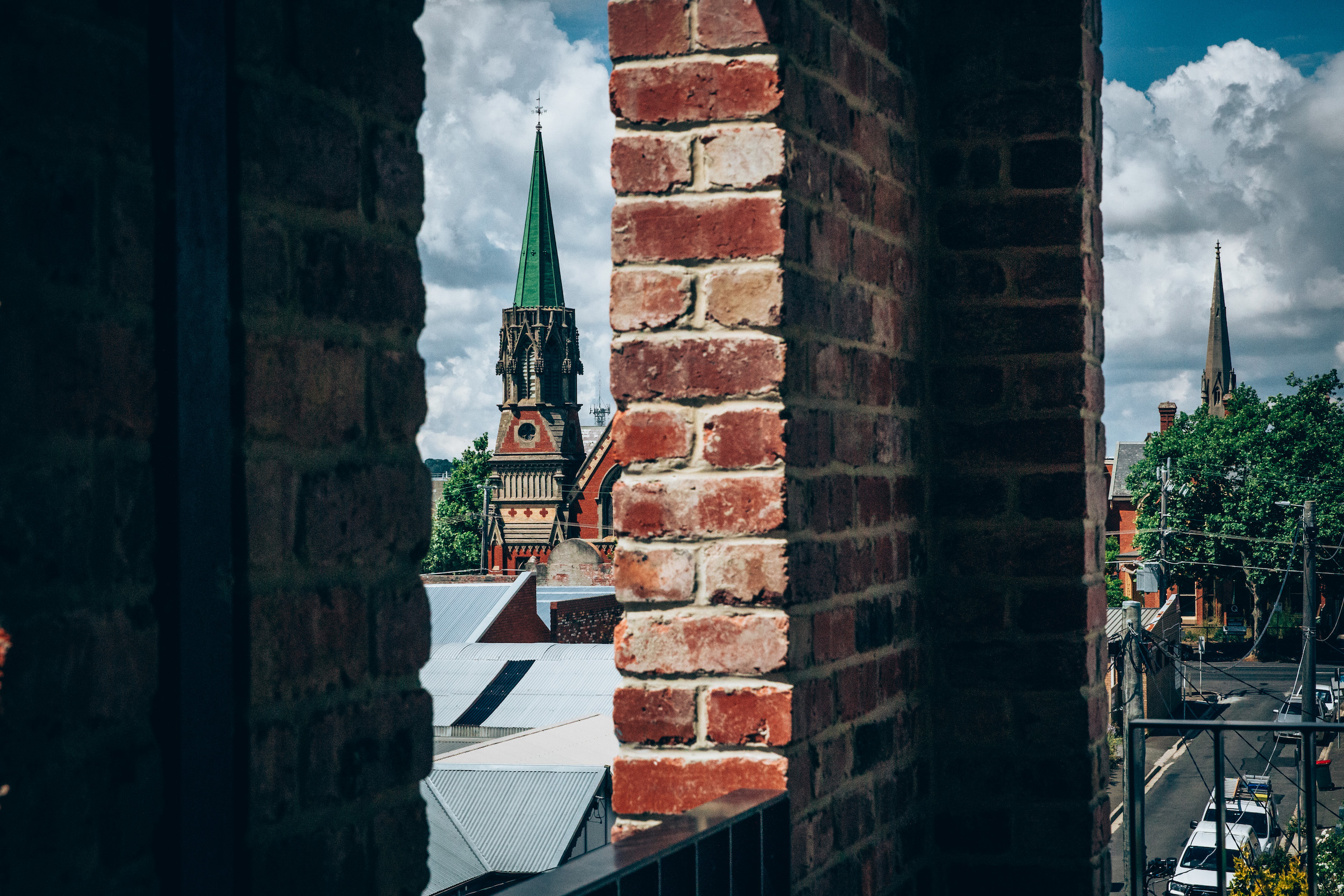
Located in the city centre, the Nightingale site is close to key amenities including the civic centre, hospital, library and train station. The site used to be a lawn mower factory and the immediate surrounds include low-rise industrial buildings with some residential neighbours to the west. The building responds to its context through generous and thoughtful setbacks. On the east, the frontage matches the height and materiality of a neighbouring heritage brick warehouse. Supersized brick archways punch into the facade providing a rhythmic second skin to the street and activation to the commercial tenancies on the ground floor.
Offering a total of 33 dwellings, the make-up of apartments is predominately two-bedroom. All apartments are organised around a large central void and courtyard, which is surrounded by a ring of open-air walkways. These internal streets not only provide fresh air and cross ventilation to each of the apartments but also act as a place for children to play and residents to encounter one another. Residents share a communal laundry and have access to a communal dining space and veggie garden. In all Nightingale developments, a portion of the apartments is allocated to a community housing provider. Here, five homes were pre-allocated to Housing Choices Australia and were designed with specialist accessibility features.
This building continues Breathes approach in the reduction of materials. Superfluous finishes are done away with, including the removal of all unnecessary plasterboard and other linings, concrete ceilings and floors are exposed, as are fire and hydraulic services. Materials were sourced locally where possible; the bricks came from a recently demolished nearby warehouse and the timber floorboards were also recycled and sourced locally. Local craftsmen were enlisted to make the windows, pre-cast metalwork and joinery.
The building has an impressive list of sustainable features. As with all Nightingale projects the building is carbon neutral in operation and has an 8+ NatHERS rating. All materials have a low embodied energy and toxic glues or adhesives were avoided. The building is 100% electric with the roof hosting a 27.65KW photovoltaic array, it has embedded Green Power and is completely gas free. A CO2 heat pump provides hydronic heating to apartments.
Consultation with the community happened throughout the process to ensure that the design response met the specific needs of a regional context. Apartments are generally larger than the city developments with the addition of separate study spaces. There are no studios, and more 3-bedroom types are offered than what would be in an inner-city context. Whilst most of the inner-city Nightingale developments cut out car parking altogether, in this context that would be a hard sell, so 14 car spaces were built and could be purchased separately to dwellings.
The previous inner-city Nightingales have been most popular with first home buyers looking for a home that is competitively priced to other apartments but offering principles of sustainability as well as a strong community. Interestingly and to the surprise of the project team, the demographic of those purchasing into Ballarat were predominately older couples who were downsizing and didn’t want the responsibility of upkeeping a block of land, as well as older single women who wanted to be part of a community.
This project acts as an exemplar model for medium-density housing in a regional context. It provides a refreshing alternative that champions environmentally sustainable living and the potential to build strong communities through responsible development. As suburban sprawl seems to continue unabated, it is examples such as this that will change attitudes in this type of context and accelerate the production of and access to more quality housing.
* This article was first published in our journal, Equity. Copies of Equity can be purchased at The
Fulcrum Press
, with all proceeds going to projects within First Nations communities.
The Fulcrum Agency is delighted to announce that our Co-Founder, Emma Williamson, has been awarded the
2023 Paula Whitman Leadership in Gender Equity Prize
by the Australian Institute of Architects. This prize acknowledges Emma’s outstanding leadership and contribution to the advancement of gender equity in architectural practice, education, and governance.
As she reflects in the film above, Emma’s career has been a study in two parts: contribution to practice through the founding of CODA Studio and then The Fulcrum Agency, two respected, ethical, and award-winning practices; and through her efforts as inaugural Chair of the AIA National Committee for Gender Equity and her advocacy on issues related to balancing
motherhood and work
, and
progressive business practices
.
At The Fulcrum Agency, we are thrilled for Emma and know her to be a compassionate and encouraging practice leader. She is ambitious and expects us to be the same. Most of us have worked with her for a very long time, which we see as a reflection of the warm, challenging, dynamic culture that she has created. Work/life with Emma is always exciting!
Equity says, ‘I need to treat people differently because of who they are and their history of prejudice and disadvantage’.
Franca Sala Tenna describes herself as a ‘non-lawyer’s lawyer’. She is a director at Equal Opportunity Specialists and perfectly placed to offer this passage on Equity:
‘Equity is different from equality. Equality’s challenge is to treat all people equally – this is already hard to achieve, as the biases of my upbringing prevent me from see everyone the same, and therefore sometimes, treat people less favourably than others.
The work I do in training for workplace behaviours, like discrimination, fits here. But equity goes a lot further than equality. Equity says, ‘I need to treat people differently because of who they are and their history of prejudice and disadvantage’. I’ve realised over the years there are different ways of living out equity. For some people, it is becoming one of ‘them’ – living with them and walking in their struggles. For others, it is advocating for the rights of minority groups – being a voice where they have none.
But for me it is giving money. I’ve realised that my gift in the space of equity is that I am good at making money and unattached to it staying with me. I am passionate about making a difference in the lives of women and children, in the space of health, education and personal safety and so this second half of life, for me, is to give away as much money as possible to these areas. Equity is a verb; to rebalance.’
Copies of Equity can be purchased at
TheFulcrum.Press
, with all revenue going towards project in First Nations communities.