We made a commitment when we sold our first journal in 2018 to distribute all revenue to First Nations community projects. Since then, sales have been ticking over and we’ve been steadily stashing away the funds.
We are chuffed to announce that we’ve been able to make a $1000 donation to the language preservation program at
Kanyirninpa Jukurrpa
(KJ), an organisation based in Newman and servicing Martu communities in the Western Desert.
Thank you to everyone who has bought one of our journals – Pivot, Agency, Leverage, Commune, Equity – and made this donation possible. Thank you also to Pauline at the
Fremantle Foundation
for your work in facilitating the grant. Happy days!
As an architect obsessed with entrepreneurs, marketing and ethical business, the politics of space and the machinations of power behind architecture, I see, advocacy and agency rolled in together
Political and social capital are key drivers in understanding one’s own sense of agency. To achieve an outcome, I first decide whether to leverage either my personal brand, as an emerging female architect, or WOWOWA’s might as a medium size practice capable of producing sexy colourful architecture. They are one in the same but are deployed with a degree of nuance
With over 1000 delegates, the Australian Institute of Architects National Conference called ‘Collective Agency’, that I co-curated with Stephen Choi, was an incredible platform for change. Contending aesthetics WITH ethics, we said beautiful work is the price of entry to broader discussions. For too long good architecture has been silently complicit in upholding the status quo – time for broader diversity, generosity, new kinds of leaders and louder voices.
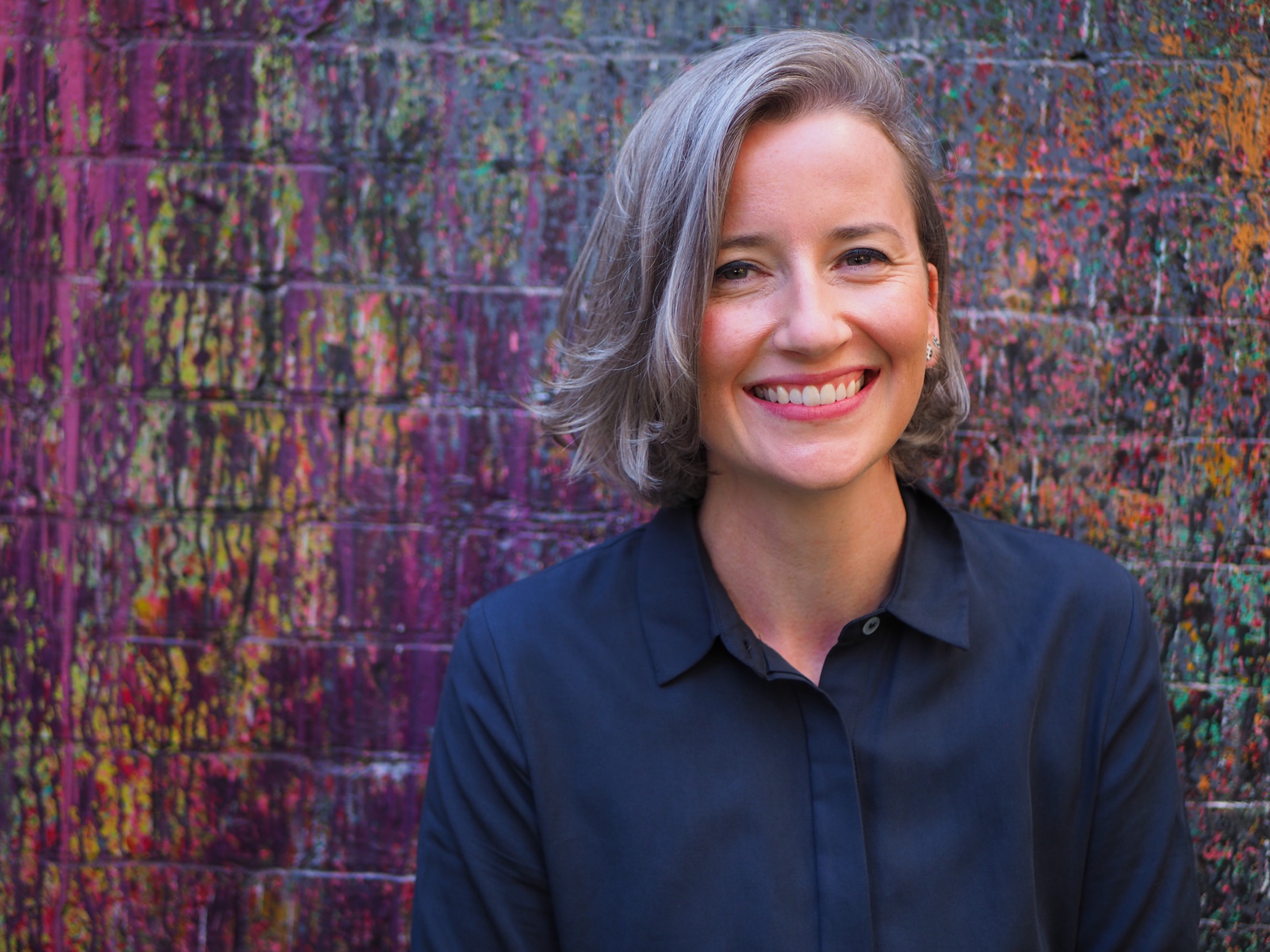
Monique Woodward is a Director at
WOWOWA
, and a good friend to us. She was named the 2019 AIA National Emerging Architect. This was her contribution to our second journal.
About eighteen months ago, I had started to talk to my friend and colleague, Sarah Watanabe about the impacts of fashion on the environment. Through these conversations, I began to feel increasingly uncomfortable with the culture of excess and consumption generated by the fashion industry. As well as working in an architecture practice, Sarah has her own fashion label, Monster Alphabets. Together, we lamented everything from inefficient production processes through to the increasing dominance of cheap, high street clothing stores.
Determined to take a personal stand, I set myself a challenge to see how long I could go without purchasing anything new. I managed to make it to ten months and in the process, totally transformed my relationship to fashion and consumption.
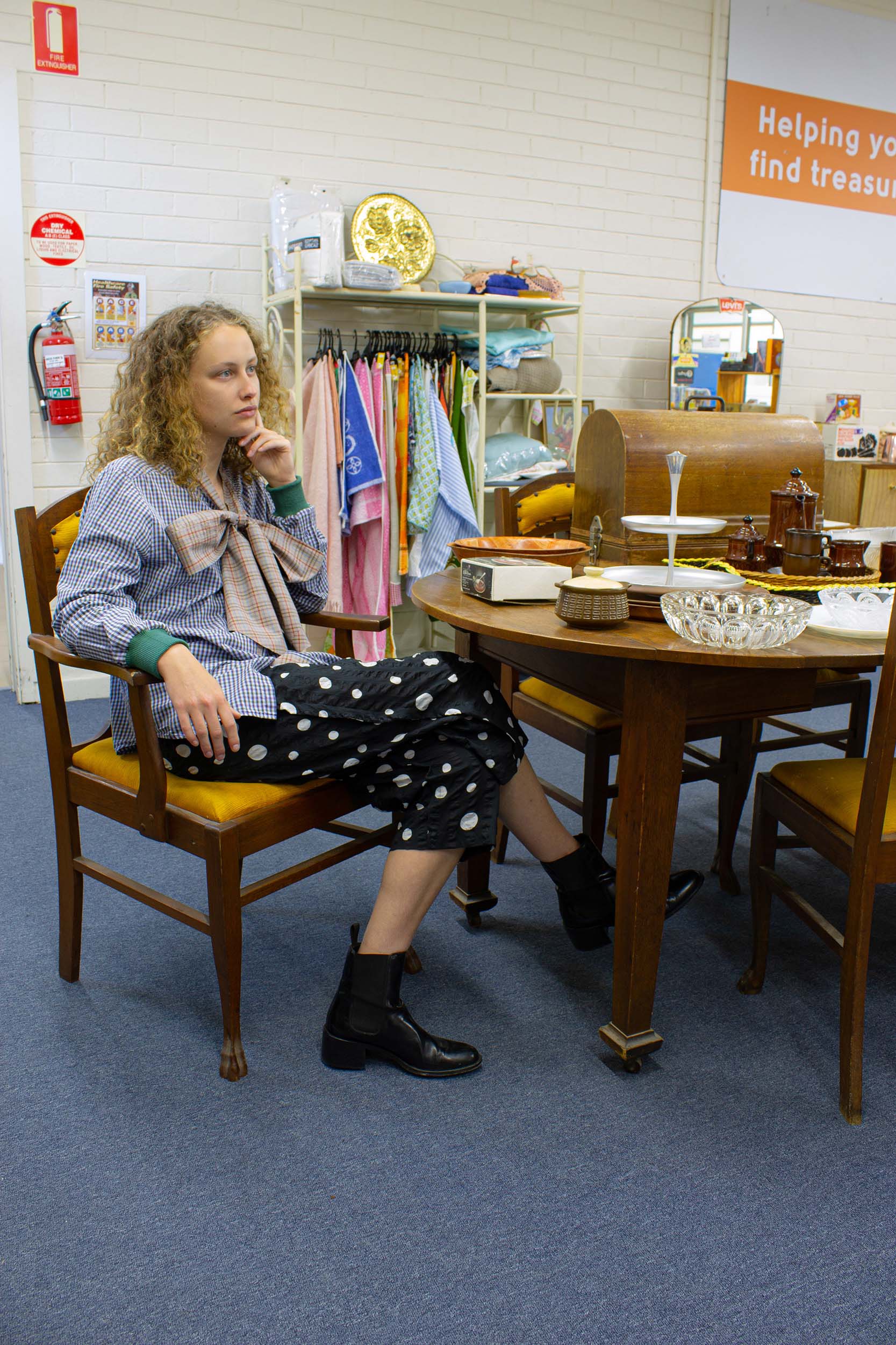
This challenge has made me much more mindful of my actions, has seen me spend a lot more time in op-shops and unexpectedly, ended up with Sarah and I collaborating on a sustainable fashion project, which we’ve named
@monster_alphabet_dilemma
.
Model Lili McAuliffe
The fashion industry creates so much waste – from the process of producing fabric, through cutting and offcuts, items made and not sold, items bought and not worn.
A recent article in Vogue by fashion journalist and sutainability advocate, Clare Press, summarised a lot of what I had read. Press describes how many labels destroy unsold goods, and that at home in Australia we dispose of 6,000 kilos of fashion and textile waste every 10 minutes. The bulk becomes landfill, and the rest heads to op-shops – but event then there are unitended consequences.
According to Press, Oxfam estimates that 70% of donations to op-shops end up in Africa, where ‘mountains of cheap old clothes are killing local textile industries.’
[1]
Mark Liu’s article, ‘Time to make fashion a problem for its makers, not charities’ suggests that, if we carry on the way we are, by 2030 the fashion industry will consume two Earth’s worth of resources per year.
[2]
So many of the clothes that we are purchase are made by people – mostly women – working in poor and often dangerous conditions and for extremely low wages. This is despite the global attention given to disasters such as the collapse of the Rana Plaza building in Bangladesh in which 1134 garment workers died.
[3]
Clothes continue to get cheaper and we continue our disconnection from the efforts made to produce these garments. Our expectations for increasing levels of finish and finesse at a low price fail to acknowledge the effort of low paid workers.
To address this is tricky. Production by major chains is often outsourced and as a consumer it is difficult to know exactly what the production chain looks like. It’s fair to say that a t-shirt that costs $5 was probably produced by someone who was not paid much. Unfortunately, we still have these issues on clothing sold for a lot more.
There is also the lingering question around the impact of fast fashion and the suffication of individual expression. Fashion houses that once delivered two collections per year are now expected to produce four, six or even monthly capsule collections in order to maintain a position in the market. The cycle of consumption is like a treadmill moving faster and faster and insatiable for the fashion follower.
Oddly, through all this output there is a growing homogeneity on the street as clothes barely worn are disguarded in order to keep up with the latest look. When we combine this trend with cheap fabrics, we are faced with pieces destined for landfill and fabrics that do not break down over time
The combination of these three concerns saw me spending more and more time in the op-shop where I made my final and most joyous discovery – that all the good fabrics are found in the men’s business shirt section! I was drawn to the largely monochromatic colour palettes, patterning, finishing details and fabric quality – things glaringly absent from the rows and rows of clothing on offer for women.
Sarah and I started to experiment transforming men’s cotton business shirts into something we could wear. By creating a set of repeated moves, we have reworked the humble business shirt into an entirely unique item of clothing for women. Despite the standardized construction method, each shirt feels bespoke, celebrating clashing patterns, pleating or frayed ends.
The garment cost reflects a reasonable labour rate for the time spent making them. We have created a type of tailoring that opportunistically preserves many of the time-consuming finishing details on the existing shirts , altering the final shirt through addition and subtraction. Importantly, the making of these shirts has almost zero impact, has minimal waste and we’ve saved a garment from landfill.
In summary, there are ways that we can reduce the impact of fashion on the world and its people, and they are simple. We need to consume less, keep things for longer and make sure that what we buy has been made ethically.
Western Australian artist Trevor Richards reflects on a career spent balancing creative ambition and financial imperative, private practice and a desire to share his passion for the artistic process. It’s been an exciting ride from canvas to streetscape.
Finishing touches on The Rocks Warehouse
When reflecting on my career progression the temptation is to summarise it as a series of conscious choices, logical steps and self-motivated moves. However, it’s not like that at all – more like stumbling into situations you hadn’t anticipated, being offered opportunities you’re not sure you’re ready for, and wondering if there’s anything around the next corner. What makes this journey interesting however is knowing that you’re involved in doing something you love.
My mother has always been a keen and talented artist who sparked my interest in art. Also, the way time seemed to magically disappear when I was drawing, or painting made me want to keep doing it. Mum’s encouragement made it easy for me to see a path towards tertiary study and subsequent early steps as an artist. I later realised that while making art was totally absorbing, fun and exciting, it wasn’t possible to generate a steady income on which to survive, so I returned to university to get a teaching qualification.
An Index of Possibilities (detail)
Apart from paying the bills, I learnt on the job about a wide range of different art media and techniques. I also developed strategies of keeping large groups of restless adolescent boys and girls interested in projects, whilst sharing my passion for the mysterious process of turning ideas into artworks. Since retiring from teaching fifteen years ago I still bump into former students and proudly follow the progress of those who have ventured into the art world with success, and who have also become close friends.
Throughout my teaching career I managed to find time to develop my own art practice and exhibit in group and solo shows. Moving into a part time teaching role was an important step, as well as adopting a more organised approach. I needed to be more disciplined, to know what I was doing before I arrived in the studio, rather than sitting around waiting for inspiration to strike. My observations of how our built environment is constructed of surfaces, patterns, colour and geometry drew me towards a more minimal, concrete attitude towards making artworks. My art practice shifted from a representational basis in early years to one where the artwork had its own presence and autonomy. These ideas have characterised my work over the past thirty years.
Richards’ interest in architectural interiors, colour relationships, pattern and perception are constants in his 30 year practice although the outcomes of his investigations range playfully in form – Louise Morrison on Trevor Richards, Artlink 2012
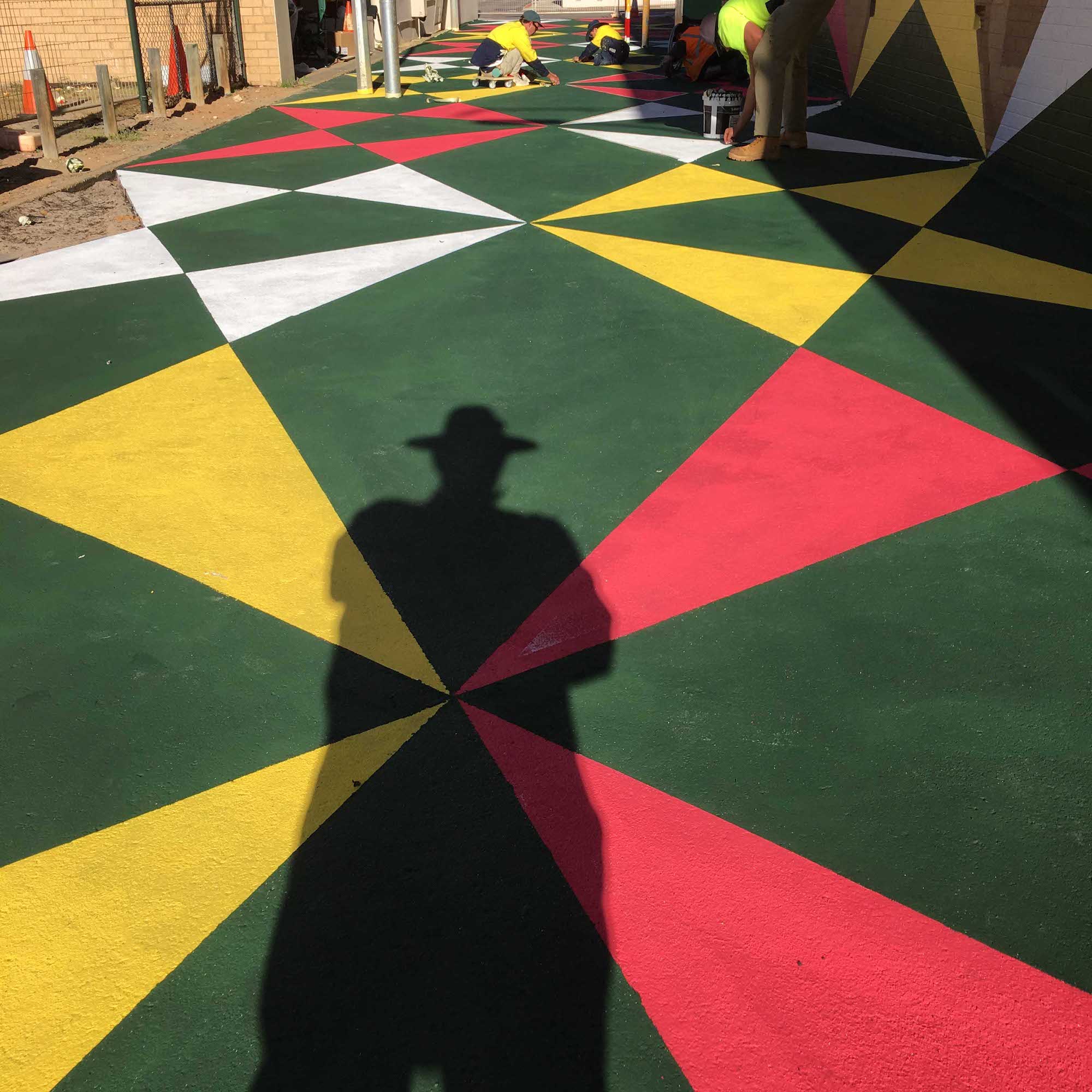
Tesselation Street Project
When I stopped teaching, I was able to devote more time to my studio practice. There have also been some exciting opportunities to collaborate in public commissions, to enjoy the thrill of seeing an idea become reality in a public arena. Being involved in public art demands many new skills unfamiliar to the studio-based artist. Insurance, construction white card, interpreting building plans, PPE, EWP, health and safety, keeping to budgets and working to deadlines are some of the unavoidable demands of making art in public spaces. Being responsible to and reliant on your trusty team as well as other trades and professions, forces you to work with individuals, companies and organisations to successfully complete the project. I feel the need to try harder, be more professional, to counteract the false impression held by many in the public art sphere that artists are lazy, naive and unreliable.
The recent Wildflower Project for the City of Greater Geraldton was a huge challenge, painting a massive meta graphic pattern through the centre of the city. 1800 square metres of hand painted road, laneway and walls, 600 litres of paint and 12 kilometres of masking tape gives an indication of the scale.
Despite these challenges public art has it’s financial rewards and allows me the opportunity to contribute to the aesthetics of shared spaces. I hope that my interventions into public areas are appropriately useful, giving energy and providing a positive experience to those who pass through them.
NB: The Wildflower Project was completed in collaboration with UDLA @udlastudio, the City of Greater Geraldton @cityofgreatergeraldton and TRCB Architects @trcb_architects.
When we act, we modify the shape of the world. Jean-Paul Sartre
When thinking of the term agency, I remembered a quote by
Jean-Paul Sartre. Sartre wrote that when we act, we
modify the shape of the world
. To an extent we already know this ̶ when we protest and lobby governments, these actions help shape the societies we live in. But I believe when we are authentic, when we speak our truth, learn how to love, these acts also mold how our world becomes.
I felt like I had agency when I won the Premier’s Literary Award. When I returned to Perth from Christmas Island, the Border Force Act came into place, so I risked a two year jail term if I spoke about Australia’s detention system. At the award ceremony, in front of several hundred people including government ministers, I told the story of Ali Reza who had his childhood stolen by mandatory detention. It was one of the most important moments in my life.
Reneé Pettitt-Schipp is an award winning writer and educator who
lived in the Indian Ocean Territories from 2011 until 2014. Renee’s work with asylum seekers in detention on Christmas Island and the Cocos (Keeling) islands inspired her first collection of poetry, ‘The Sky Runs Right Through Us’. This manuscript was shortlisted for the inaugural Dorothy Hewett manuscript prize and released by UWA Publishing in February 2018. Reneé’s work has been recognised through many literary awards, including the ACU literature prize, the Ros Spencer Poetry Prize, the Grief Poetry Prize and the Trudy Graham Biennial Literary Award.
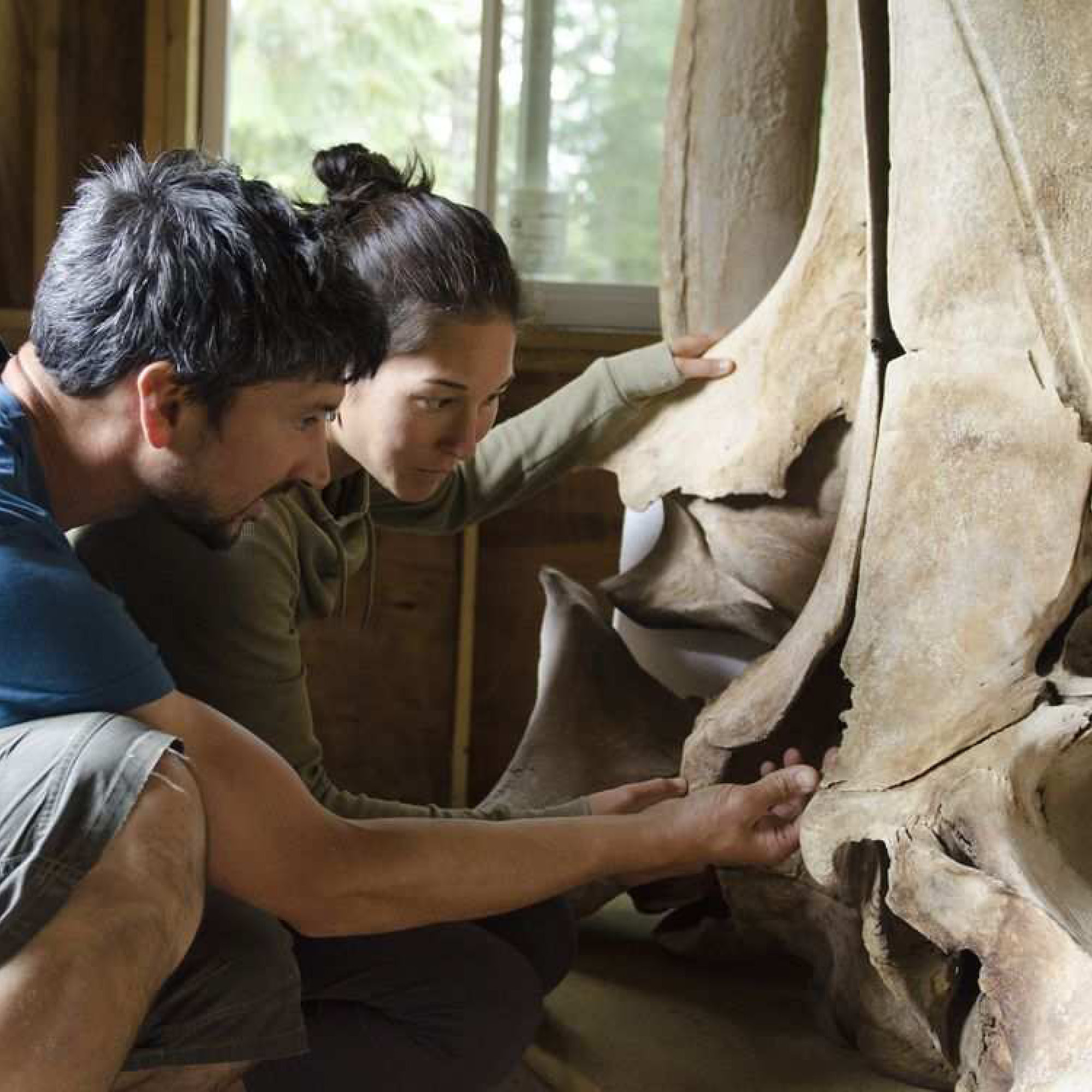
Collectively, Michi Main and Michael de Roos are the company
Cetacea
. The Canadians are experts in the field of skeleton assembly and are in town to re-hang Perth’s iconic
blue whale
for the new Western Australia Museum. They caught up for a chat with TF.A’s Emma Brain, and this is what they had to say.
I’ve heard you described as skeleton articulators. Can you describe that that means?
Mike
Yeah, that’s an interesting term. I guess articulating a skeleton means to put it together. So, you’re joining the bones to create a fully assembled skeleton.
Michi
So, we’re basically really, really excited about biology and puzzles. We’re puzzle makers!
Mike
We’re both trained biologists. I have a Bachelor’s in biology and I specialized in marine biology and the biology of marine mammals: whales, and seals, and sea lions. And Michi has her Masters in…
Michi
I actually specialized in Marine ecology and conservation, but then Mike sort of directed me into this world and it was so captivating that I kind of just dove in and never looked back.
Mike
We met in University, in Canada.
Michi
Yeah, in biology class, actually. Oddly enough!
Mike
I guess to get back to your question, what is a skeleton articulator? Our jobs, or what we do, has developed into this thing where go to a dead whale that’s washed up on a beach. We take it apart and clean all the bones, which is a whole big process.
I have quite a background in animal behaviour and I do quite a bit of marine mammal fieldwork out on boats, watching whales swim around and do what they do. And so, we integrate the latest scientific research on whale behaviour and movements, we use drone footage and underwater photography of whales swimming around. And we take all of that knowledge and come up with a story that we want to tell with the bones.
It’s really unique for every display and it depends on where the skeleton is going, the size and shape of the museum, and the display space, and how people are going to be interacting with it. You bring all of that information together. The first few skeletons I did really looked like dead animals.
Michi
And that’s what conventionally has been done, because people’s experience with these animals is when they’re dead on the beach. And other than that, they’re really elusive. Our view of them is this dorsal fin sticking out of the water or occasionally breached. We haven’t really had a real window into what they’re actually doing in their life.
And so, we have this opportunity with our work to share with people what their life actually looks like based on the research that’s being done. A lot of the animals are tagged now. For this blue whale project that we’re working on, there’s amazing research available. They have tagged blue whales and modelled their underwater movements; it turns out that they’re acrobats.
These animals are very large, and their bodies are designed to be in the water floating. And so usually when they come on shore, there’s some amounts of trauma to the skeleton just by the sheer bulk of it being moved around and experiencing gravity.
As well as evidence of how it died?
Michi
Sometimes that too. That’s an interesting one because often we want to share with people what destroyed the animal’s life. And so, part of that is that any trauma that happened to their skeleton, including their death, and so often we won’t fully repair that kind of damage.
We feel such connection with animals, particularly big ones, there must be a deeply emotional aspect to you work as well as it being a privilege?
Michi
It’s such a privilege to work with the animal and then to get to the point where you can share that with a greater audience is joyous. I mean, the story, and like I say, we try to keep the animal’s death part of the entire story because there is a lot that’s really sad. A lot of the deaths are toxin overloading or related to ship strikes and other human influences. And so that part of it is really, really sad. And yet it feels really good to be able to share that with people too so that we know.
And there’s many times we’re we are like, what are we doing? It’s just like, get normal jobs. But that time when you have installed a skeleton and you see the people coming in and you start to see this gut reaction that people have. And even sometimes you see people moved to tears or the kids come in and be like, what is this thing, I’m just so curious, I need to know everything I can about killer whales or whatever. And that is the part of it that really, really feels amazing.
It keeps us wanting to do this weird job.
We spend hours, like hundreds and hundreds of hours with this individual animal. We kind of get to know it. It’s really a connective personal experience. That’s one thing I really love about it – Mike
Mike de Roos and Michi Main
Kieran mentioned a project that you did with the Shíshálh Nation near where you live in Canada. Can you tell me about that?
Mike
We live on a small island and then we had to go to the big island and drive and then take another ferry and another ferry over to Shíshálh, which is part of the mainland, but kind of on this big remote section. I was on my way over to help an old school friend inspect a house he was thinking of buying…
Michi
This was like a day before Christmas and so Mike went on his own and I stayed at home with the kids. And then he’s going across on the ferry and he’s like, “There’s whales.” And there were whales bow riding on the ferry. Killer whales.”
Mike
Yeah, I called my biologist friends at the biological station. I said, “You should come to check out these whales,” because they keep tabs on which whales are around and stuff. I couldn’t get a hold of anyone, but…
Michi
To make the story short…
Mike
The next day, I just finished crawling through the crawl space in an attic and I said, “Don’t buy this place.” It’s full of work. And we get a text saying there’s a dead killer whale on the beach. Like, 15 minutes from where we were.
Michi
Mike calls me and he’s like, “So there’s a dead whale, should I go check it out?” And I was like, it’s Christmas, please don’t go, but yes, I guess, go.
Mike
So, I drove down to the beach and the fisheries guy was there and the veterinary pathologist had just shown up to do the necropsy, which is basically an autopsy on the animal. And he looks over at me, “Mike, what are you doing here? This is great. We have a team.” We only have a couple of hours to get all this work done. And then he said, “This is Sid from the Shíshálh Nation and they’re really interested in this animal and maybe you can help them preserve the skull.”
Do they have a particular spiritual connection to the killer whale?
Michi
Very much so. The killer whale is their family totem.
Mike
So this is like a deceased family member that’s come back to the family.
Michi
And there were all these crazy coincidences with elders who had passed within this period and ideas that maybe the spirit of the whales have come in because of a connection to that.
Mike
So I threw on a spare pair of boots and rain gear and Sid said, “Yeah, can you help us keep not just a skull but the whole skeleton? We have a museum here that would be perfect for…”
How big is this thing? How big is a killer whale?
Mike
A truck. 25 feet.
A lot of flesh and big heavy pieces. Sid called his road maintenance crew down with the backhoe. Thank goodness. That was the only way… it ended up being two of us finishing at like 11:00 at night. The fire department brought lights down for us.
Messy
Mike
Very messy.
It’s a bit of a learned skill, how to take one of these animals apart to pieces that you can move and get the bones out. So yeah, we did that. And then the very next day, the First Nations mentioned that one of their members had started this composting facility where they do all sorts of composting, including municipal marine waste and dead fish from fish farms. It’s like the size of a football field. A football field in a tent. It was a perfect facility to put the fleshy whale bones into and have all the meat removed…
How long does that process take?
Mike
It depends
Michi
Normally we leave skeletons in for about six months. And we monitor them. It depends on the composition of the compost because as you probably know, composts get really hot. It’s a bit of a balance between cleaning off the flesh and cooking the skeleton, which isn’t optimal. Far from optimal actually.
We explained to them how to monitor it and so they did that composting piece of the puzzle. And then they collaborated on design and were heavily involved in the installation part of it.
And where was it installed?
Mike
They have a museum, a First Nations museum in Shíshálh.
Michi
And it was an amazing project just because…. this one was just held by the community in different ways. It just feels like that skeleton is where it was meant to be.
Mike
There’s a lot of heart to it. They had this big, huge, sort of grand opening ceremony and served 200 people this amazing feast of salmon and elk meat.
Michi
We have also run community-based projects where we organize everything and set things up. And that means you put the tools into the hands of interns or community members, who have maybe never even held a drill before. And that’s also another really meaningful thing. Because there’s so much to learn in a project like this.
Mike
A project like that brings tons of people out of the woodwork. Retired machinists and high school students…
Michi
Totally misfit high school student who like just struggled her way through school and nobody could connect with her. But she just blossomed in our workshop and was amazingly artistic. There’s this level of connecting with the skeleton, as we talked about before, but also in these projects, a chance and opportunity to connect with people in a really unique way.
That’s Brilliant. Thank you.
Mike
Did we answer all of your questions?
Yeah. You did, and more.
Mike
I feel like we just talked.
That’s what I wanted. I’m really happy with that. Thank you, that was very good.
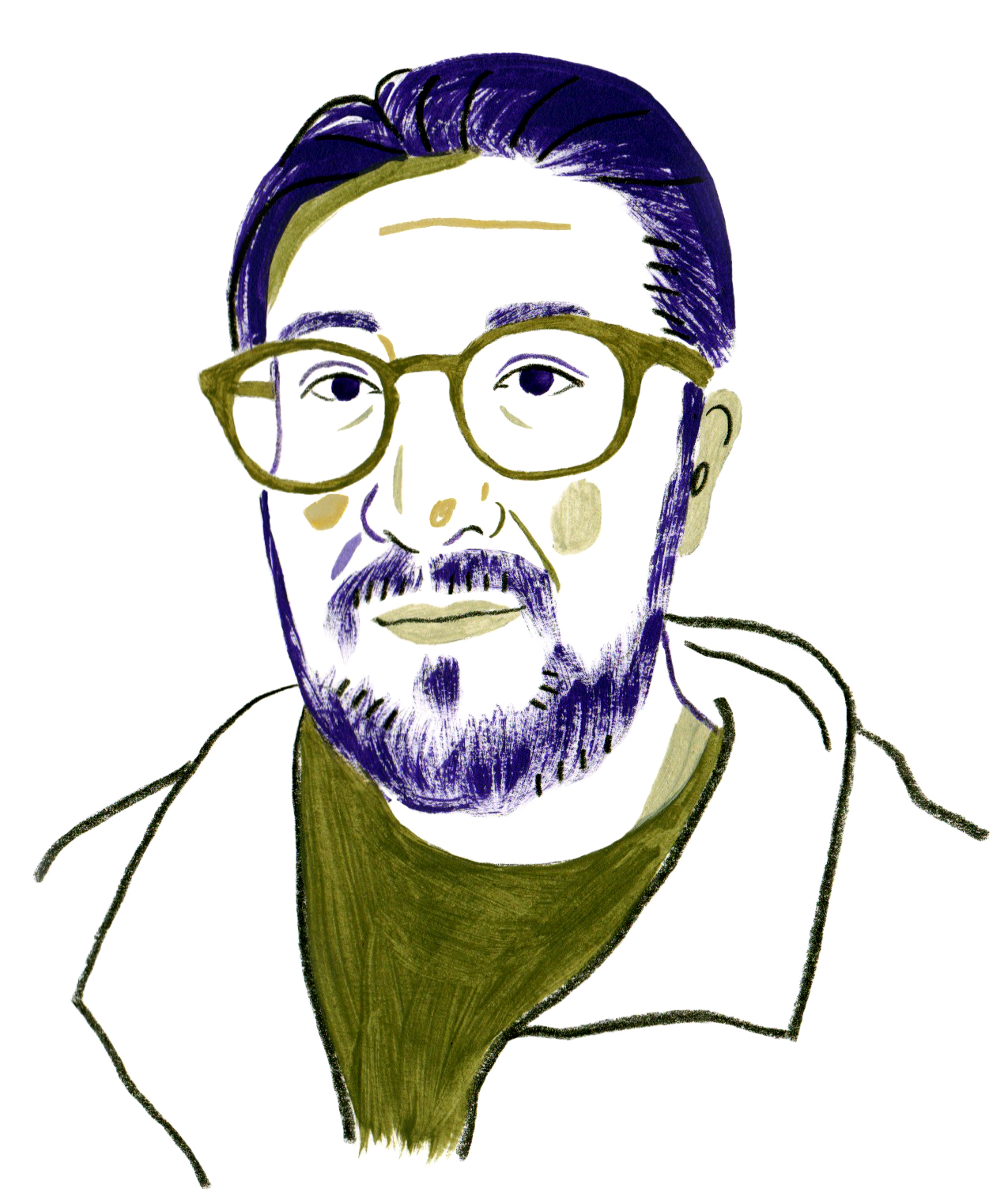
In 2005, Danielle Caruana and her husband, John Butler, established The Seed Fund – a philanthropic organisation born from countless conversations on the road in the early days of touring. Meri Fatin spoke to Danielle about childhood experience, the impetus behind the fund and the joy that comes from celebrating tiny wins.
Illustration by Adrian du Buisson
Meri Fatin [00:01:41]
The first time I spoke with Danielle Caruana was around 2005 when The Seed Fund was first begaun and I was struck immediately by her presence. When she launched her first album Beat and Holler in 2010, she and her brother Michael came toI chatted to her with me at the RTRFM studios and played live. I’ve thought about that conversation a lot and I’ve listened and sung along to the anthemic “You Tore My Heart Out” a stupid amount of times. In 2014 Danielle ran a session at the School of Life called How To Be Confident. I heard she demurred at the initial invitation to present that course. I was bemused by thatthat, but I shouldn’t have been.
Danielle has made no secret of her vulnerabilities and it’s interesting to see how much more powerful she seems with every admission she makes about her limitations. When the Seed Fund was set up by Danielle and her husband John Butler it was a wild Medusa of a thing; the initial scope sent sprawling by the beautiful grandeur of their wish to make good of all the injustices that they saw. Now, The Seed Fund is a refined concept designed to make good by creating strong community in the music industry. Danielle’s sense of direct responsibility to make a difference however still pervades every aspect of her life. (to DC) I heard you laughing!
Danielle Caruana [00:02:56]
No, no it’s good (laughs)
Meri Fatin
[00:02:58]
So, let me ask you about a recent Instagram post you wrote celebrating your dad and his generosity with strangers because I have wondered about where your awareness of social justice and of “other people” germinated.
Danielle Caruana
[00:03:14]
To be really honest, it’s less about an awareness of social justice and more around the idea that as a community, we are completely accountable to each other and responsible for each other. I think that experience came early on in life as my family learned to survive as immigrants and the way they banded together with the community of Maltese immigrants. My parents came over with four kids and then had my sister and I in Australia. My mum ran a daycare at home. My dad did several jobs, was a door to door salesman, worked in concrete and then eventually built up his own business. They started from scratch and were amidst a community of people who were also doing it really hard, raising kids, learning a new language, trying to assimilate and dealing with constant racism. They took great relief in coming together at least once a week, and our family, the Caruanas, were responsible in those gatherings for bringing the joy. We brought the music. We were the music at every christening, wedding, dinner dance, baptism, Holy Communion, confirmation and everyone came to everything. It wasn’t like, “so and so’s second cousin is having a confirmation, surely I don’t have to go?” No. You went to everything that was happening and it was all like a life raft.
Image: @mamakinpics
Meri Fatin
[00:07:22]
So where did the strangers come from? Because it’s one thing to be kind and inclusive in a community, but what you are saying is that there were other people?
Danielle Caruana
[00:07:30]
There were always other people in our house. We always had someone who was in the middle of a divorce living there or my brothers’ friends who couldn’t live with their folks, or so-and-so who’d lost their job. I loved that about our home. It was open. And then the stranger’s thing. I don’t know where that came from, other than I think my dad felt that if he took care of people then maybe he and his family would be taken care of when in need. He actually takes great pride in being charitable. I think he looks for opportunities to be kind and helpful
Meri Fatin
[00:08:47]
And yet that’s exactly what you came up with as the original idea for The Seed Fund.
Danielle Caruana
[00:08:53]
I know! (laughs). Yes totally. I see that now!
And you know, I’ve never connected the idea of my dad’s generosity to what we created at The Seed but that is a beautiful link and I’m really grateful that you’ve put that there because I do have that real deep sense of — what are we doing for each other? How can we make it better for everybody? I often feel overwhelmed by ‘the fight’ ‘the struggle’. I am so terrible at conflict and so terrible at fighting back, but I’m good at making good.
Meri Fatin
[00:10:46]
As you started to see injustices out in the world, was the teenage or early 20s version of you a protester? Were you angry? What were you like?
Danielle Caruana
[00:11:03]
I’m not a very good protester. I’m not someone who is very good at fighting bad. I am someone who is overwhelmed and bewildered by acts of meanness or malice. I’m always looking for how I can be kind and how to make good. Sometimes I wish I was a better fighter!
Meri Fatin
[00:11:44]
Well, you come at it from a different angle.
I come at it from a different angle. Even if I only can make tiny, tiny good. Like last night I got my teacup to float in the bath, and considering how I’ve been feeling lately, that little moment of beauty spoke volumes to me.
Danielle Caruana
[00:12:10]
I wish I was better at fight for social justice. That’s why John (Butler, Danielle’s husband) is a great match for me because he’s absolutely a justice-minded person and I’m a kindness-minded person and that’s why I think The Seed idea came to fruition, because he was wanting to make it right and I was wanting to make it good.
Meri Fatin
[00:12:39]
Tell me about how you came up with the original idea of The Seed Fund because it’s a cool story.
Danielle Caruana
[00:12:56]
The first ramblings came on tour. We were in the van doing long drives and we were like “hey, there’s so many great Australian bands out there, how can they not be getting played on radio… if we ever get money we should set up a fund. Like as if we’re ever gonna get out of this van, playing, driving from festival to festival. And then Sunrise Over Sea happened (John Butler Trio’s third studio album debuted at No 1 in March 2004 and went gold in its first week of release) just after the birth of our first child, and because we had released it independently in Australia, we did have money.
So, we were in this dingy hotel room somewhere in middle America trying to make a career in that massive market, and we thought maybe we should do that thing we had spoken about many moons ago on those long drives. And literally as our daughter Banjo crawled around on the disgusting sticky motel room floor, the idea flowered… we would create a fund for artists by artists. Who knows better what an artist needs than artists?
I made two phone calls. One to a woman named Jacqui Geia, she was the only person I knew in the arts community who was a grant writer – a connector and a total maverick thinker. And the other call to Carlo Santone from Blue King Brown, who was someone we had been friends with for years and would constantly call and brainstorm ideas with. It was a two-minute conversation – “hey we’ve got this idea and you’re the first person we would want to do it with” and they were both like yeah yeah yeah yeah. We got back to Australia, sat in Jacqui’s backyard and in that one meeting came up with the categories that we were going to have the first year: Professional Development, Social Activism through the Arts, Music Marketing,Music Workshops, Art by Refugees – which was only open to artists awaiting their asylum application. It was ridiculous how broad the categories were in hindsight. Our naivety was really something to behold
Meri Fatin
[00:16:14]
But was the impetus for each of them the fact that you’d actually seen that need in the community in your own personal experience?
Danielle Caruana
[00:16:22]
We’d seen and experienced the need in the very recent establishment phase of our own careers. That was our strength I think – we were only one step beyond being emerging and having that perspective of what it really is like in the trenches. John had received a couple of pivotal grants from thegovernment and they had helped to get him into the right place at the right time. But there’s just not enough of those. Our naivety was that money was the best thing we could offer. It was only after the first year of giving away money to stop gap people’s shortfall in projects, that we got to thinking about what was needed outside of funding. We thought back to how often people would ask us about our management set up, or team set up, or advice on publicity, and we realised that what we were all missing was an opportunity to brainstorm with each other. So, the management workshop was born out of “let’s think of something that we can do that is more about learning and connecting than giving money.
Meri Fatin
[00:17:37]
And what did you realize your strong suit was?
Danielle Caruana
[00:17:39]
Our strong suit was we could pull all of the people who we already worked with into a workshop space for three days. It’s a crazy idea. Pulling thirty emerging managers and self-managed artists and workshopping ‘what is it to be self-managed? what is it to manage? what are the skillsets required? what are we responsible for and how can we support each other? what are some examples of pathways which are a little more off the beaten track?
We’re now about to deliver the twelfth one – three hundred emerging managers later. And what happens in that space every year has been an ever-evolving thing. We want to be speaking with people and empowering people who are right on the edge of the industry, who are creating the industry right now. We want to connect maverick thinkers to become each other’s support network. We’ve renamed the workshop ‘The Future Makers’ because we want to do everything we can to empower them to create the industry that we all want to see.
Meri Fatin
[00:18:48]
I was really interested that one of the previous participants talked about the extreme sense of relief from being able to have those conversations. I’d love to a bit more about what happens here
Danielle Caruana
[00:19:13]
They’re conversations around the idea that there is not only one way to do this. Management is a creative endeavour and art is a creative endeavour. The mixture of the two should be a mixture of identifying a vision and then creating a great roadmap to get there that is absolutely of your making.
We also try and do as much uncoupling between the artist and the manager as far as understanding that people often get into management as “I just love this music SO MUCH,I have to work with you,” passion play. Eventually, you have to recognise that you are running a management business. We lose so many great management operators from sheer burn out – financially and energetically.
We also try and place the artist in the center of the industry. What is the industry if the primary producer of the art and their manager, get paid the least up until the point where it becomes unviable? So, how do we position the artist to be at the center of their own industry and value them a bit better?
You know the workshop is a little bit academic and a little bit philosophical. The amazing thing is that thirty participants walk away each year with a network of peers from all around Australia. I think they come in thinking that the biggest deal they’re going to get is hearing from industry professionals and they leave realising that they have a community.
@theseedfundau
Meri Fatin
[00:24:08]
And do you challenge the participants to really reflect on their sense of who they are and what they represent and how they want to be in the world?
Danielle Caruana
[00:24:18]
And why. Do you know why you’re doing this because that’s what you’re going to have to return to every time you hit a roadblock. And that’s what’s going to help you inform what your next step is. A small step towards your actual ‘why’ rather than what you think the industry’s imposed ‘why’ is. Because what is the industry if it is not us? We are the industry. We’re making it on the daily. So, what are we making? What standards do we assume are being placed upon us, that we are complaining about, yet perpetuating by our daily practices? So we’re sort of taking the lid off the idea that the industry happens to us and we need to reshape ourselves to fit it, rather than we are IT.
Meri Fatin
[00:25:32]
I wonder how having these conversations year on year and building a community of which you are like the centrifuge fuels your recognition every year of why you’re doing this. Why do you do The Seed Fund now in 2019?
Danielle Caruana
[00:25:59]
Because it just keeps showing me the power of connection and how important it is to break the myth of isolation and I need that as much as every participant needs that. I do it as much for myself and for my own remembrance that I am part of the community. I get a double kick back when people are like yes,we’re in this together! I feel just as vulnerable. I subscribe to just as many of the myths of isolation as every other manager and self-managed artist and emerging manager does in that room. And I think that’s why I can keep the conversation at its edge because I’m at the edge myself
Meri Fatin
[00:27:04]
But it is the strangeness of being a creative person as well isn’t it? A lot of what you develop is done in isolation but then you deliver it, it is such an extraordinarily different space from whence it came.
Danielle Caruana
[00:27:21]
It is so tricky; moving between those two spaces with fluidity takes a lot of organization and requires a lot of structure and a maverick mindset. And that’s why I think every person in that room is a hero. The thing is how not to let it slip because whatever that spark was that got you from your bedroom to your first gig or from being able to write your first press release or to book your mates’ band because you really believed in them or whatever that thing was still lives inside you. So, let’s actually go back and remember what that thing was. The real reward comes from actually carving a path of your own making. That’s where the real reward is.
Meri Fatin
[00:29:15]
And also knowing that as an artist you can be in an industry and be truly excellent in your product and be critically acclaimed, be decades into what you’re doing and still be living hand to mouth
Danielle Caruana
[00:29:31]
This is why I’m constantly saying ARTISTS you are the CEO. You have to make sure you are the CEO of your business. When you get a manager, you don’t resign from the CEO position. Yet so many in the music industry do this. And then we blame the manager. No no no – don’t blame the managers. You checked out. The manager is a navigator. You’re the driver.
Meri Fatin
[00:31:07]
You must get a lot of feedback from the people who’ve had the privilege of coming to a Seed Fund workshop. Is there something that someone said to you that’s stuck in your mind, something that spoke to you deep down?
Danielle Caruana
[00:31:39]
You know what, it’s actually the unspoken. It’s the hugs on the way out. That last day when everyone’s leaving and they’re mostly speechless and there’s tears and there’s this feeling of connection and relief and “oh my God maybe I can but holy fuck I’m so overwhelmed. But oh my God, maybe there is a way.” That is huge for me. And then the other thing is seeing them out in the world. Bumping into them at conferences, at festivals. To be like “Hey! Hi! I was at the workshop!” “Oh my God, what year?” That is the best for me, actually watching them out in the world doing it. You know what OR choosing not to do it; going “yeah, I just realized that I wasn’t really much of a manager”. Like, thank God you realized and didn’t waste the next four years of that artist’s career
Meri Fatin
[00:33:13]
I want to ask you a little bit about your own music because you are still very much a happening thing with Mama Kin Spender. I read that you were filled with doubt about your own musical ability because of how many gifted musicians there were in your family. It amazed me because I mean, you know that I’m a huge fan of yours. So, I want to ask you about the sense of being good enough, as a musician, because I remember being deeply moved the first time someone looked me in the eye and said, ‘you are enough exactly as you are’. And I wondered how that statement makes you feel?
Danielle Caruana
[00:35:35]
It feels like a statement I would like to believe, and I believe it when I’m in the space that things are going the way that I think they should. However, I probably can’t hear it when I’m struggling or frustrated with how things are or rather aren’t progressing. At those times I try to remember to believe my own advice, which is that a block is an opportunity to create a career that’s of my own making. But that’s hard.
And so, one of the biggest things to me is how important it is to build a network of peers and associates. Vested interest partners – and also non-vested interest people – who you can call on, unpack things with. Because that support network – meticulously created and taken care of – it’s just vital.
So, I feel just as vulnerable now as I did when I released Beat and Holler. I feel just as vulnerable as I did the first time I hopped on stage and did our first gig. We opened for John. Just my brother and me. And even that, the fact we were opening for John, made me feel like a complete fraud. There’s times when I feel just as vulnerable and there are times when I feel totally on top of it. So, do I feel like I am “exactly enough”? I suppose that depends on which lens I am wearing and how hard I am being on myself, and how realistic and flexible my expectations are. I keep trying to remind myself to live with an attitude of high optimism and low expectation! That helps.
@mamakinpics
Meri Fatin
[00:38:06]
I hear you. I just want to ask you one last thing. To me it seems thatone of the great things that you have done up until this point is your work with The Seed Fund. Creating this strong community for musicians and I wonder at this point how you reflect on that as an achievement, as a legacy.
Danielle Caruana
[00:38:50]
I’m so proud of the work we’ve done. It is still John and I, and Carlo is still involved and Stacia, who came on in the first year of the fund. Jacqui passed away shortly after realising the first Management workshop, but her legacy is still alive. I couldn’t do it without them. So, I feel proud of us, of who we are as people, as friends, as colleagues. I am proud of who we are in our community, and the way we keep pushing the envelope. And, what I’m most proud of is the fact that we’re still willing for it to change year after year and to not become comfortable – because the thing we delivered in the first year would actually be still fun to deliver now. But it wouldn’t put us at the edge of the industry and the edge of what we want to create in the industry. I’m most proud of the fact that we’ve been so brave.
Meri Fatin
[00:39:59]
I don’t know if you remember that after our preliminary chat prior to this conversation I emailed you to say that I’m always amazed at how I go away from our conversations feeling like you throw me a ball of wisdom that I’m only just strong enough to catch. I go away grappling with our conversations and I always feel like it’s been a privilege to have some of your time. Thank you so much for today.
Danielle Caruana
[00:40:30]
That’s very, very generous. And thank you for that beautiful intro you wrote. I was laughing. I was like oh my god someone actually sees me like this! I don’t see myself like that today Meri so thanks for holding up a mirror.
How many of us are seeking our purpose, and moreover, trying to muster up the motivation (or perhaps, courage) to pursue that purpose? It’s strange that from a young age, we’re taught to conform with social norms that follow a prescriptive path (school> uni> career> house> marriage> kids> retire) BUT ALSO, we’re told to follow our hearts and dreams.
That ambition, that self-awarded freedom to pursue dreams, that execution of freewill – that’s what I think of as
agency
.
My life has been an enmeshment of the very traditional and the completely unbelievable. I guess it’s a mix of personality-plus-circumstance that has forced my living with
agency
. Becasue of my ‘fuck it’ attitude, that acceptance of the inevitability of failures (and associated shame), and the search for fulfilment (don’t get me started about
that
trap) I try a lot of things.
OR, is it that I’ve rebranded ‘commitment issues’ as ‘
agency
’; “
I live independently with free choice
”?
Kate is someone we’ve admired for a very long time.
Most often ‘agency’ is spoken of as something that resides in an individual, but if putting together the second issue of TF.A Journal has taught us anything, it is that many hands make Agency happen.
From skeleton articulators to fashion designers, it wouldn’t have been possible without this diverse crew of contributors.
To me, it’s one of those words that gets appended to things; collective, personal, federal, media, creative, and in being so prevalent has had its meaning diluted. However, as a stand-alone, it’s a wonderful word; one of my favourites. It’s the realisation that you are in control and you can decide the direction and shape of your circumstance.
It’s the secret to a meaningful life. It’s personal power.
Personally, as a white Anglo male, agency is all around me. I have always had access to support and the levers of personal progression, but not always the realisation that they were there. That came with self-reflection and maturity. My story of personal realisation was probably on the commencement of this phase of my life in Perth. Understanding that I had to be an active part of the betterment of the city I live in.
Nic Brunsdon is Director at Design WA, an initiative of the State Government to ensure that design is at the centre of all design.