• Who Needs A Drink?

    Who Needs A Drink?
    “They take wealth from our country, leaving behind a huge open cut pit and toxic waste rock pile for us to clean up.”   “They take wealth from our country, leaving behind a huge open cut pit and toxic waste rock pile for us to clean up.”
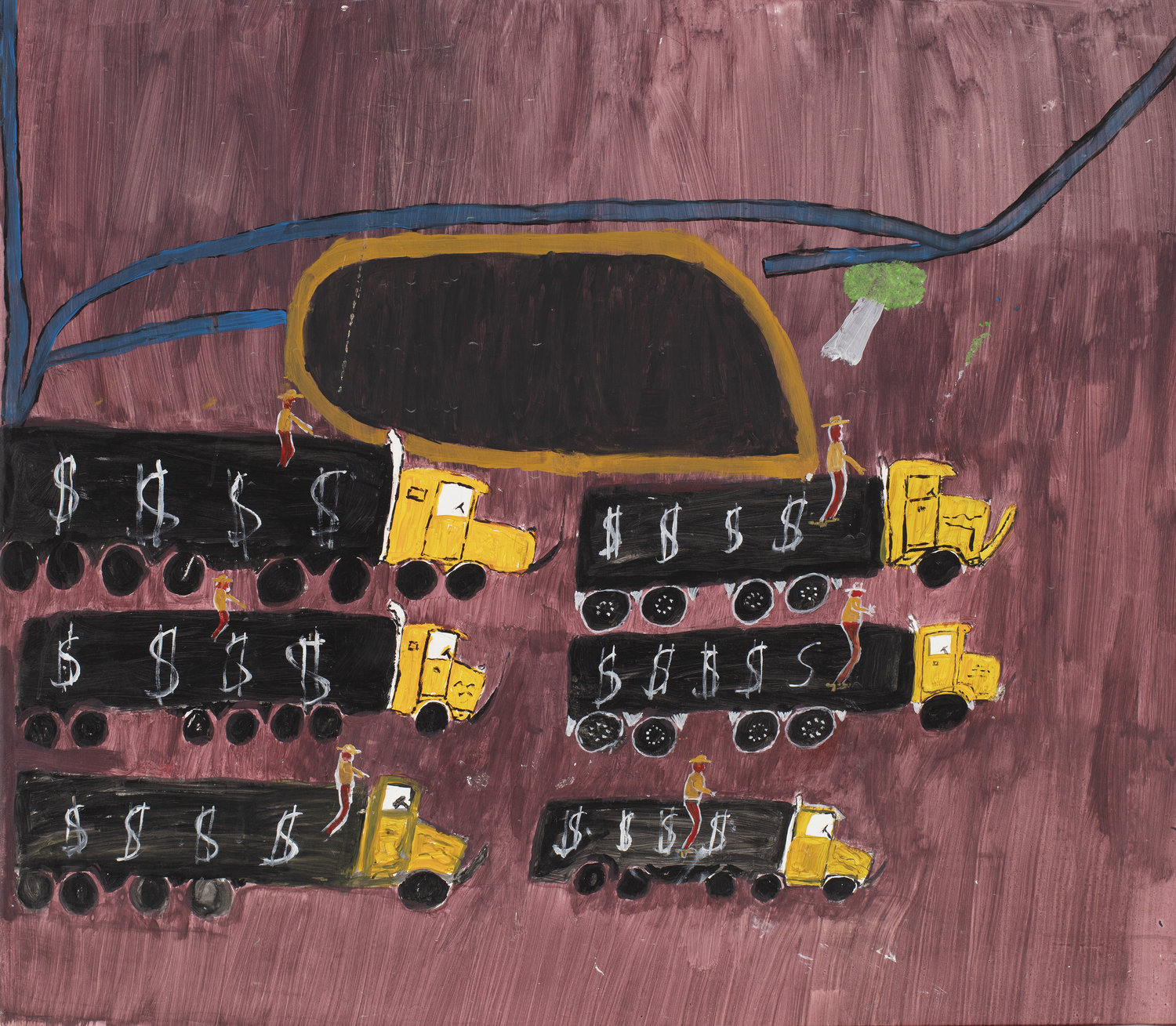
    Yee Haw, Money Trucks by Jacky Green

    The roads, pipes and wires that make up the infrastructure of our towns and cities aren’t often considered to have moral dimension. But, as Dr Liam Grealy investigates, we are, quite literally, building inequality into our urban fabric.

    In August 2017, ten inches of rain over four hours led to days of flooding in central New Orleans – from the Seventh Ward to Treméto Mid-City to Lakeview. City officials claimed the pump system was working but that rain outstripped capacity. But subsequent revelations of a power-station control-panel fir e offered a partial explanation for the drainage failure. Three of the five turbine generators that power New Orleans’ 120 pumps were already down for maintenance and with one on fire, just one was left to manage the downpour. Sixteen of the pumps were also down, despite contrary initial reports, for which senior Sewerage and Water Board and Public Works Department staff were quickly asked to resign. A ritual sacking provided a swift and visible response to the more complex infrastructural challenges of managing subterranean “vibrant matter”[1].

    Image: Liam Grealy
    Pump Station 2

    Situated on drained former swampland, below (a rising) sea level, sinking, and adjacent to the disappearing protective wetlands of the Louisiana Gulf Coast, living with water is the perennial challenge of the crescent city. Every storm season, flooding elicits memories of the devastation wreaked by Hurricane Katrina in 2005, when the repeatedly-predicted failure of the US Army Corps of Engineers’ “city of walls” [2] – that is, levees, embankments, floodwalls, and other rigid barriers – came to fruition. Technocratic explanations for the levee failure, offered in a progressivist vein to promote further construction, elide the complexly entangled negligence of regulatory, maintenance, planning, and disaster recovery regimes. They also discount historical explanations for the former and ongoing racialization of infrastructural risks, such as access to high ground, the geography of redlining, federal compensation programs, and insurance determinations bearing on who was able to return post-disaster.

    When the 2017 floods arrived, the demography of some of America’s oldest black neighbourhoods had already shifted: social infrastructures had been razed and replaced by foreclosure, eviction, gentrification, and short-term rentals for the tourist economy.

    Image: Liam Grealy
    Eviction in the Seventh Ward, New Orleans

    Eight months later, in Australia’s top end, the remote community of Borroloola faced its own man-made hydrological catastrophe. Indigenous residents called on the Northern Territory Department of Health in April 2018 to blood-test community members following water samples revealing elevated levels of lead and manganese in the drinking water supplies of town camps. Glencore’s nearby McArthur River Mine had previously confessed to poisoning cattle and fish via zinc and lead leached from its dumpsite, generating suspicion over its ongoing role in contaminating local water systems. As Jacky Green narrates in Yee-haw, Money Trucks (2017)[3], “They take wealth from our country, leaving behind a huge open cut pit and toxic waste rock pile for us to clean up.”

    In this recent instance, the Department of Health and the government-owned Power and Water Corporation suggested the contamination occurred between the bore and the tap, with corroded brass fittings in the camps’ internal reticulation systems a likely cause. The extensively detailed Town Camps Review (2017) had already recommended urgent upgrades to the camps’ water infrastructure. Yet with assessments made without subterranean investigation, and with incomplete historical records, just what’s down there, when it was installed, and who’s responsible for it, remains opaque. It was almost two months before residents in Garawa 1 camp were advised the water was again safe to drink, with the Department of Health noting that “the problem . . . was more complicated than originally thought.” Community members know all too well that having such issues investigated is hard fought, requiring sustained protest and advocacy in the face of multiple pressing issues that demand their attention. In October 2018 a new water treatment plant was opened in Borroloola, however further extensions are required to service housing on the east of the McArthur River, including at Garawa 1 and Garawa 2 camps.

    Image: Liam Grealy
    A new water treatment plant, Borroola

    “It’s exhausting to create an event out of nothing”, says one of anthropologist Chloe Ahmann’s[4] (2018) Baltimore informants about the difficulty of representing the cumulative effects of infrastructural slow violence. The distribution of both displacement for infrastructural development – think highway and “urban renewal” projects – and risk of harm – think waste dumps, chemical factories, and mine sites – are never demographically equal, but are instead central to the ongoing reenactments of settler-colonialism’s voracious appropriation of territory and capitalism’s serial frontiers of extraction and abandonment. Such geographies of governance are variously conceptualised by Evelyn Araluen as “cartographies of colonisation” (2018; also see 2019[5]), by Stephen Lerner[6] (2010) as “sacrifice zones”, and by Elizabeth Povinelli[7] (2011) as “economies of abandonment”. They are constituted, in part, by the extension (or not) of infrastructures, as “material forms that allow for the possibility of exchange over space” (Larkin 2013)[8]. Of course, the construction, use, and maintenance of infrastructures can also dispossess, degrade, and disconnect. Most of the time, residents at the metaphorical and literal coalface of environmental and financial hazards lack a Hurricane Katrina, or a Northern Territory Intervention, to spectacularly expose the slow-to-accrue cumulative toxicities of infrastructural failure. Even when industrial disasters are major events, such as Union Carbide’s Bhopal disaster in 1984, their effects long outlast the cameras, the aid money, academic interest, and even the attention of community organisers overwhelmed by the demands of acute crises and new looming threats. The ongoing groundwater contamination at Bhopal signals what Nikhil Anand[9] (2015) describes as “the work of ignorance in maintaining state institutions”: proof of harm, the designation of culpability, and eventually redress, first require investigation.

    Image: Liam Grealy
    This is where the sidewalk ends, Lower Ninth Ward, New Orleans

    Bringing the harms of infrastructural violence to light is always tough political work, and efforts to do so are confronted by reductionist interpretive habits, or cultural clichés. Poor health is explained by dietary and lifestyle choices, or the dilapidated remote community house signifies tenant damage rather than, as the not-for-profit organisation Healthabitat has shown, a lack of routine maintenance and poor initial construction. We need to acknowledge that infrastructure is always in motion, ageing, and trending toward entropy. It is rarely “completed”, instability is its norm, and functionality requires constant attention: tinkering, fix-work, maintenance, replacement, patches, upgrades, and renovation. Such labour requires government resources, and monitoring and accountability systems that recognise the natural decline of infrastructures, rather than simply attributing breakdowns to users. The recent victory for public housing tenants in the Central Australian community of Santa Teresa – awarded compensation for the government’s failure to ensure their homes were maintained to a habitable standard – shows the potential for redress via public litigation, but also the risks associated with asserting basic legal rights (including countersuits, administrative labour, insecure tenancy, and so on).

    Most readers of this essay can probably still take potable and plentiful tap water largely for granted. As many writers have conceived of infrastructure in general – that it becomes visible when it breaks down – so too are our expectations made apparent through disruption: an occasional boil water alert, for example. With a scarce commodity literally on tap, we can forget the already quotidian everyday realities of many global cities – Cape Town, Mumbai, and São Paulo among them – variously characterised by water’s undersupply, privatisation, and rationing. This while future-focused fantasies of being overwhelmed by water and of water’s disappearance have become increasingly central to speculative dystopias in popular culture: of flooded worlds, desert wastelands, and “water knives”[10]. We should also direct our imaginations to how the right to water might be guaranteed under conditions of increasing scarcity. What political work is required to ensure the redistribution of this natural wealth from wasteful industries that benefit a small minority to serve the basic needs of everyone? Such imaginative work must contend with fantasies of water’s infinity facilitated through techno-fixes, such as proliferating desalination plants, and the tendencies of such “solutions” to mortgage the future on behalf of contemporary lifestyles.

    Image: Liam Grealy
    Sinkage on O’Keefe Street, New Orleans

    All strategies for sustainable futures struggle with the sinking mess of the present. As at Borroloola, the reticulated infrastructure delivering drinking water to New Orleans’ residents has also exhibited levels of lead beyond safe drinking standards. 65-80 per cent of city pipes are almost two centuries old. Shortly before the 2017 floods, the New Orleans  Office of the Inspector General found that residents could be exposed to lead by construction projects shaking the metal loose from old pipes. This construction includes a 135mile Federal Emergency Management Agency funded water-line replacement project, which promised to remove the problem it is shaking loose; this in a context where the city admits it doesn’t know the locations of all the existing lead service lines. Given this material was once the industry standard, such ignorance isn’t surprising, but nonetheless requires further government intervention. Thus the legacy of yesterday’s infrastructural promise is today’s public health hazard. Importantly, and despite the identified dangers of the pipes to residents’ drinking water, the Sewerage and Water Board of New Orleans is only replacing waterlines on public property.

    If lead is leaching from and flowing through the pipes, how might we respond to the fact that the state doesn’t know what’s down below or determines that its responsibility extends only to the edges of public land? How might water bind us in ways that thinking about broken infrastructure in our own backyards and elsewhere does not? Writing about Flint, Michigan, anthropologist Catherine Fennell (2016) [11] notes the discursive similarities between the claims “We are all Flint” and “All lives matter”. In practice, such statements convey “the kind of risks that a far-flung group of citizens can recognize as shared, and thus worthy of collective concern and action, and those that will, despite their ubiquity, seem isolated events that will never break the surface of widespread attention.” Where the contamination of municipal pipes is liable to produce “hydraulic publics” (Anand 2017) [12] through citizen science initiatives demanding government responses, in contrast, the failure of housing to also support healthy living practices has been more difficult to articulate and engender such collective demands and actions around. Compared with pipes that leach lead, the inability to access housing, (let alone secure tenancy in affordable housing that supports tenants’ positive health outcomes) is more likely to be explained by individual shortcoming.

    In the United States especially, the shift from public housing to the curtailed state provision of vouchers for housing in the private market has also effected a privatisation of responsibility for infrastructural failure. This is evident in the logic of pipe replacements in New Orleans: householders, or in what is now a city of majority renters, landlords, are responsible for replacing pipes from the curb to the kitchen. The privatisation of infrastructural provision and failure, or in Ara Wilson’s (2016)[13]phrase, the “unbundling” of public infrastructure under neoliberalism, exacerbates the contemporary “concrete divide”[14] between the infrastructural haves and have-nots. Often presuming models of home-owner tenants, building science recommendations for healthy homes are typically quiet on the means renters might use to improve their water or their indoor air quality without risking eviction by punitive landlords. Put differently, while affordable housing advocacy might prioritise the issue of domestic infrastructure’s effects on tenants’ health, on behalf of establishing minimum healthy housing standards, building scientists and hygienists must also become advocates of tenants’ rights.

    As Fennell writes, “while ‘we’ might all be at risk of ingesting toxins, some of us can spit back the lead soup that leaches from ‘our’ pipes, even as others must swallow the lead dust that flakes off ‘our’ walls.” This is the challenge of infrastructural inequalities: who can spit back what? How can we conceive and respond to problems that are shared, but never evenly? And how do infrastructures themselves give rise to particular kinds of publics and specific potentials for collective action?

    Image: Liam Grealy
    Open Your Eyes at the F. Edward Hebert Defence Complex, New Orleans

    A version of this essay was originally presented to open the Infrastructural Inequalities public program at Artspace in October 2018 – a collaboration which is ongoing between the Housing for Health Incubator and Snack Syndicate. That event pulled together artists, activists, academics, and other professionals, because facing the challenges of infrastructural inequalities requires responses that are equally creative, collective, critical, and technical. As Sara Ahmed[15] writes, “It takes conscious willed and willful effort not to reproduce an inheritance”, and any work against social reproduction requires a broad coalition, locally organised and institutionally disparate, flexible to internal difference and critique, and open to ongoing reorientation. In the contexts described above, community-led planning and local organising around water monitoring and against further extraction is working towards ensuring the ongoing security of communities in the face of flooding and contamination. As citizens and as allies, we might reflect on how we can contribute to an “infrastructure of dissent”[16], which is a social, intimate infrastructure, and which like concrete can also be “built, material, and lasting”[17].

    [1]Bennett, Jane. 2009. Vibrant matter: A political ecology of things. Durham & London: Duke University Press.

    [2]Caldeira, Teresa P. R. 2000. City of walls: Crime, segregation, and citizenship in São Paulo. Berkeley: University of California Press.

    [3]Green, Jacky. 2017. Yee-haw, money trucks. Artwork.

    [4]Ahmann, Chloe. 2018. “It’s exhausting to create an event out of nothing”: Slow violence and the manipulation of time. Cultural Anthropology. 33(1): 142-171.

    [5]Quoted in Spring, Joel and Munro, Lorna. 2018. Survival Guide. Radio Skid Row. Accessed: https://soundcloud.com/radio-skid-row/sets/survival-guide; Araluen, Evelyn. 2019. To outlive a home: Poetics of a crumbling domestic. Cordite Poetry Review. 1 February.

    [6]Lerner, Stephen. 2010. Sacrifice zones: The front lines of toxic chemical exposure. Cambridge, MA: The MIT Press.

    [7]Povinelli, Elizabeth. 2011. Economies of abandonment: Social belonging and endurance in late liberalism. Durham and London: Duke University Press.

    [8]Larkin, Brian. 2013. The politics and poetics of infrastructure. Annual Review of Anthropology. 42: 327-343.

    [9]Anand, Nikhil. 2015. Leaky states: Water audits, ignorance, and the politics of infrastructure. Public Culture. 27(2): 305-330.

    [10]Bacigalupi, Paolo. 2015. The Water Knife. Vintage Books: New York.

    [11]Fennell, Catherine. 2016. Are we all Flint? Limn. (7): https://limn.it/articles/are-we-all-flint/

    [12]Anand, Nikhil. 2017. Hydraulic city. Durham and London: Duke University Press.

    [13]Wilson, Ara. 2016. The infrastructure of intimacy. Signs: Journal of women in culture and society. 41(2): 247-280.

    [14]Gandy, Matthew. 2004. Rethinking urban metabolism: Water, space and the modern city. City. 8(3): 363-379.

    [15]Ahmed, Sara. 2014. White men. feministkilljoys. 4 November.

    [16]Alan Sears quoted in Brett, Matthew. 2015. Building an infrastructure of dissent. New Socialist. 17 February.

    [17]Cowen, Deborah. 2017. Infrastructures of empire and resistance. https://www.versobooks.com/blogs/3067-infrastructures-of-empire-and-resistance
  • Block Brands TheFulcrum.Agency

    Block Brands TheFulcrum.Agency
    TFA_Logo_Wordmark_ORANGE_RGB

    We were delighted to work with our friends and creative partners, Block Branding , on the recasting of our new practice. Block is responsible for our branding but also, more critically, helping us to filter through our sometimes tangential threads around what it means to be an architect.

    Arriving at our new identity and journal has been a fantastic, truly collaborative journey. Here’s an excerpt from a press release that Block distributed last week celebrating the work that they did for us…

    “It wasn’t a simple brief,” says Tanya Sim, Co-Founder and Director at Block. “Emma and Kieran wanted to build a new model for an architecture practice, but didn’t know what shape it might take. They are defined by an evidence-based approach to architecture so we thought: ‘Why not bring this transparency to the branding?’ Most brands come into existence from nowhere – this seemed like the perfect opportunity to shed light on the thinking that goes into launching a new brand or business. “

    Visually, TheFulcrum.Agency’s identity is based on a fulcrum and a beam, which together create a lever: the simplest of machines capable of lifting large loads with minimal effort. The symbolism is direct, illustrating TheFulcrum.Agency’s ability to leverage enormous change by utilizing the right architectural levers. The dot in TheFulcrum.Agency’s name becomes the pivot point, or fulcrum.

    Mark Braddock, Creative Director at Block, says: “TheFulcrum.Agency is a business built on content and substance so we wondered if it was possible to create a brand that rejects the usual emphasis on style and fashion. Yet by self-consciously avoiding style, we risked creating yet another minimal identity in the style du joir for architectural businesses wishing to present an intellectual, theoretical face to the world.”

    “Instead, we took inspiration from classic editorial design, a practice that has evolved over a millennium to convey content with a sense of authority. At its core, TheFulcrum.Agency is about leverage, so the new identity creates a natural point around which to explore this idea.”

    Every branding decision, every wrong turn or deadend, are carefully documented on TheFulcrum.Agency’s website to show how Williamson and Wong’s conversations around architecture have guided the branding. Typography is inspired by classic editorial design, while the colour palette began with a dusty burnt orange, from which a palette of complementary, earthy hues emerged that is distinctly Australian.

    More than an architecture practice, TheFulcrum.Agency aspires to be a platform for conversation. Block hatched the idea of TheFulcrum.Agency as content creator and curator, creating ‘The Journal of TheFulcrum.Agency’ to give context to everything the agency stands for. The first issue, ‘Pivot’, celebrates agility and resilience, echoing Williamson and Wong’s own pivot in launching a new practice together.

  • Our Reconciliation Action Plan is Endorsed!

    Our Reconciliation Action Plan is Endorsed!

    We are delighted that our Reflect Reconciliation Action Plan has been endorsed by Reconciliation Australia .

    The Fulcrum Agency acknowledges that Aboriginal peoples are the Traditional Custodians of the lands on which we live and work, and that the many nations that occupied the Australian continent have never ceded sovereignty of their country. For us reconciliation is nuanced, contingent and a central driver in all that we do.

    We will share our Reflect journey with you as it unfolds over the coming twelve months.

  • Prof. Diego Ramirez-Lovering on PIVOT

    Prof. Diego Ramirez-Lovering on PIVOT
    Diego Ramirez-Lovering
    Selfie

    In 2006 I led a four-month study of Guadalajara, Mexico… my hometown. It began as an exploration of vernacular and utilitarian forms of architecture and their connection to social patterns. As the investigation deepened, there was an evolution in thinking from:

    what architecture is (as an object or series of objects)…

    to what it does (as a contributor to urban processes)…

    to urban processes as constituent parts of larger city systems…

    to the operation of city systems as complex combinations of the planned and the unplanned.

    This was a real pivot point – the beginning of a transition away from a practice focusing on objects toward a focus on systems and the messy realities of cities as complex assemblages of physical, social and economic structures.

    It was the start of a new direction – effecting processes of transformation for the informal cities of the Global South.

  • An Australian first: Traditional Owners direct Indigenous housing projects

    An Australian first: Traditional Owners direct Indigenous housing projects

    We were chuffed to see this review in Domain of a presentation that we gave at the Housing Futures conference in Melbourne last week. Thanks to journalist Jenny Brown for picking up on this important story.

    “The slowest of the art forms, and one that generally starts with considering local context, community connections and subtle elements like site lines, is spun into a whole new dimension when architecture needs to consider the world’s oldest living culture, clan, inter-family and moiety relationships, and the ancient insider knowledge of songlines.

    In the Groote Eylandt part of East Arnhem Land, and in an Australian-first project where traditional owners rather than a government agency have directly employed an architecture firm to deliver “culturally empowered housing”, Perth practice TheFulcrum Agency has been learning a great deal about “the ability to work slowly”.

    To a wide-ranging architectural forum Housing Futures, convened in Melbourne last Friday by Architecture Media, Fulcrum Agency principal Kieran Wong explained that with all the cultural constraints of the project commissioned by the Anindilyakwa Housing Aboriginal Land Council (AHAC), he saw “working slowly as the great opportunity of the project”.

    Engaging in years of meetings in which members of 14 local clan groups had explained why the prescribed housing solutions of the past had failed, and all the changes and adaptations that would actually maintain wellbeing and necessary traditions, Wong said what was being asked for  was “very different to any masterplan the [NT] government had on file”.

    “We don’t need to invent anything. What we need to do is what works; to do it properly and not to rush it,” Wong said.”

    It may look conventional but it contains a whole range of climate and cultural considerations.Image: Bo Wong

    Indigenous housing projects, he said, had the tendency “of burning architects out in repeating cycles of failure”.

    Instead of doing more of the same, the Groote Eylandt projects are modelling what happens when the directions come straight from traditional owners and the ultimate occupants like Gregson Lalara, founding chair of the Anindilyakwa Housing Co-operative and, therefore, Wong’s boss.

    To the audience of mainly capital city architects, Lalara outlined cultural behaviours that were not only different to those of settler Australia, “but different to other Indigenous cultures in Australia”.

    He said the new generation housing needed to be properly mindful “of different privacy structures” that could govern inter-action between neighbours and even members of the same family who occupied a single house.

    At times and for reasons of correct (social or ritual) moiety relationships, various members cannot share what would be normally be common spaces such as bathrooms.

    Meetings with traditional land owners have been ongoing since 2015.Image: Bo Wong

    On the old standard-issue housing model, this has led to hot-climate houses being shrouded in shade cloth or tarpaulin screening – both within a single structure and to ensure that outward viewpoints towards neighboring houses were not inappropriate.

    Even where there is a sea view, or an excellent potential for cross-breeze ventilation, conventional design can very clumsily contravene tradition. “Houses can also be facing the wrong way, or towards the wrong part of the country,” Wong said. “And this has led to all sorts of strange enclosures happening.”

    With the current housing projects still under construction, and with a five to 10-year delivery schedule, the emphasis has been on “making the houses incredibly elastic because of the way occupancy patterns can change over time”.

    “In the life of a house, events – say through marriage – can change family groupings quite dramatically.

    “These are not Western nuclear families and the houses need to have multiple entry and exit points so ‘poisonous cousins’ and in-laws don’t encounter each other.”

    The housing project work crew is as local as possible.Image: Bo Wong

    The screening devices that will continue to be a big part of making a house flexible must therefore have adaptable fixing points that don’t, at the same time, impede healthy ventilation. For this, gable roof-lines are proving useful. “We need simple formats that can be flipped,” Wong said.

    Because of the belief in nocturnal sorcery, Lalara explained the need for certain outdoor areas to be floodlit.

    The myriad subtle differences necessary in the designing and delivering of housing that will be successful for the resident communities has, says Wong, “been an amazingly engaging project in which we’ve sat down and talked properly”.

    Taking the directions from the local communities has been “a milestone”, he says. “To hand back decision-making to the people of Groote has been a process of listening and trying to understand.”

    https://www.domain.com.au/news/indigenous-housing-what-happens-when-the-directions-come-straight-from-traditional-owners-863624/

  • Architects Declare

    Architects Declare

    The Fulcrum.Agency is proud to be a founding signatory on a declaration acknowledging the twin crisis of climate breakdown and biodiversity loss as the most serious issue of our time.

    Architects Declare was launched in the UK in May 2019 and has quickly gathered momentum on a global scale. As signatories, The Fulcrum.Agency commits to the following eleven actions:

    1. Raise awareness of the climate and biodiversity emergencies and the urgent need for action amongst our clients and supply change.
    2. Advocate for faster change in our industry towards regenerative design practices and a higher Governmental funding priority to support this.
    3. Establish climate and biodiversity mitigation principles as the key measure of our industry’s success: demonstration through awards, prizes and listings.
    4. Share knowledge and research to that end on an open source basis.
    5. Evaluate all new projects against the aspiration to contribute positively to mitigating climate breakdown, and encourage our clients to adopt this approach.
    6. Upgrade existing buildings for extended use as a more carbon efficient alternative to demolition and new build whenever there is a viable choice.
    7. Include life cycle costing, whole life carbon modelling and post occupancy evaluation as part of our basic scope of work, to reduce both embodied and operational resource use.
    8. Adopt more regenerative design principles in our studios, with the aim of designing architecture and urbanism that goes beyond the standard of net zero carbon in use.
    9. Collaborate with engineers, contractors and clients to further reduce construction waste.
    10. Accelerate the shift to low embodied carbon materials in all our work.
    11. Minimise wasteful use of resources in architecture and urban planning, both in quantum and in detail.

    Importantly for us as a practice, the Australian declaration aims to achieve these actions by meaningfully addressing the interdependent and reciprocal relationship between our land and its Indigenous people.

    We congratulate each founding signatory for taking this bold step – ARM, Alec Tzannes, Bates Smart, Breathe Architecture, Brit Anderson, BVN, Circa Morris Nunn, Clare Design, Design 5, DWP, FJMT, The Fulcrum.Agency, Glenn Murcott, Greenaway Architects, Gregory Burgess Architects, Hassell, Iredale Pedersen Hook, JCB, John Wardle Architects, Ken Maher, Kerstin Thompson Architects, Koning Eizenberg, Liminal, Partners Hill, Peter Elliot Architecture, Peter Stutchbury, Rick Leplastrier, Six Degrees, Taylor and Hinds, TKDA, Troppo and Woods Bagot.

    If you’re an architect, we encourage you to make your own declaration here: ARCHITECTS DECLARE.

  • Becoming Bruno

    Becoming Bruno

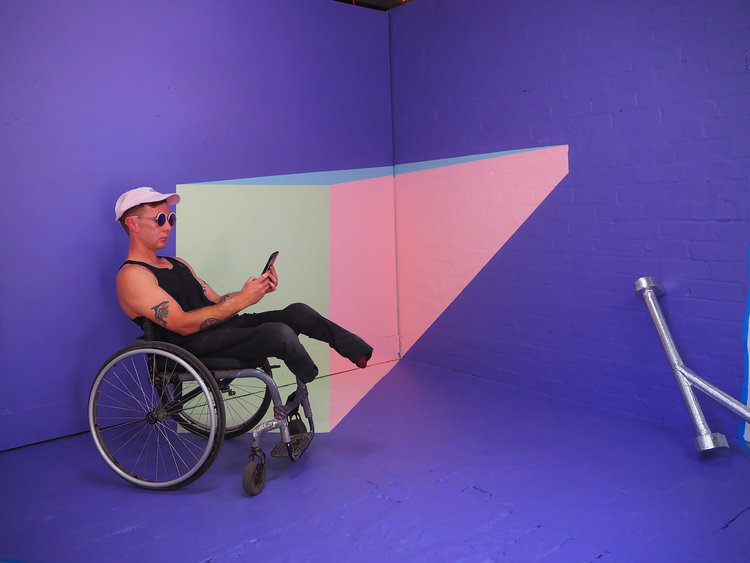
    Bruno Booth studied science, and then he studied design, and then he became a street artist, and then his art started to find a home within the walls of galleries. At each stage of his artistic evolution, his work has become more personal, more deeply rooted in his experience of the world from the perspective of someone in a wheelchair. With his breakout installation Hostile Infrastructure at Melbourne’s Testing Grounds, Bruno now asks that you, too, suffer (a little at least) for his art.

    “When Emma asked me to write an article for The Fulcrum Agencies new journal, we talked about how my practice has pivoted from illustrative graphics to participatory installations. In particular she was interested in how I’ve managed to translate my skills as a painter into producing my current work. Although it looks like I’ve made a radical shift, to me it feels like an extension of what I’ve been doing my whole life. I’ve tried many different things and have had three seemingly distinct careers, but really, they’re all related.

    The more I make work about (my disability), the more I’m asked about it. It’s nice. I like talking about it.— Bruno Booth quoted on Broadsheet.com.au

    I grew up in a small village in Lancashire. There wasn’t much to do there apart from get into trouble, ride motorbikes (an enjoyable way to get into trouble), go camping if the weather permitted or hang out at friends’ houses getting high and listening to music. It was here that I decided I was going to become a famous musician. I was going to learn to play guitar/learn to rap, form a band with my mates, play our first gig and then decide to sign a record deal with EMI or DefJam. Things didn’t go exactly to plan. I never managed to get that major label deal, but music taught me to be creative, appreciate patterns and gave me a wealth of life experience. What it didn’t give me was a way to support myself, so in my early-20s I made a conscious decision and changed direction.

    My second love was Evolution. Learning about Darwinism and natural selection at university was a trip. The idea that every living thing – including the chickens in my garden, the trees out my window and the dinosaurs in Jurassic Park – are the product of an impossible number of tiny, accidental changes over millennia had me hooked. I did two degrees in the Sciences and ended up working as a Hydro-geologist, a pivot that I had not intended and work that I didn’t really enjoy. So, I decided, once again, to make a change.

    I started my career in the arts soon after turning 30. I studied Graphic Design at TAFE with the idea that I would work in the industry after I graduated. Again, the best laid plans have a habit of being derailed by life. Studying design introduced me to the world of contemporary art; grand ideas, personal narratives and a desire to communicate experiences. I went to exhibitions, attended artist talks and before I knew what was going on, I had changed direction again.

    It’s true that the work I’m making now is a departure from what I was making a few years ago but to me it feels like an organic change. My work now is all about disability, the way people perceive it and the experiences that are awarded to me as a result of seeing the world a bit differently. All the jobs that I’ve done, people I’ve met and sub-cultures that I’ve been a part of feed into my practice. Yes, my work has pivoted, but I don’t see what I’m doing now as an end point at all. I fully expect to pivot again, the one thing I don’t know is when this will happen or what I’ll be doing next. I’ve always liked food so maybe I’ll start my own quince paste empire, who knows.”

    I go places, I judge the space, and I think, “This’ll be fine, there’s a step there, but this looks surmountable,” but then I get there, and suddenly it isn’t.— Bruno Booth quoted on Broadsheet.com.au

    Words: Bruno Booth

    Images: Keelan O’Hehir

  • Prof. Sarah McGann on PIVOT

    Prof. Sarah McGann on PIVOT
    Sarah McGann
    Selfie

    An architect, a lawyer and an accountant walk into a bar. The bartender looks at the three women and says, so, who’s in charge here?

    Reflecting on my pivoting career—as architect/educator/researcher/leader—I return to the opening lines of my recent book chapter in Visual Spatial Enquiry, (Creagh and McGann 2019). An important pivot-point for me has been to question who is ‘in charge’ of our built environment and where the role of responsible stewardship and strategic decision-making sits. I am convinced that building design, good and bad, has a causal effect on the social patterns of the people that live, work and occupy, or are excluded from, our built environments. Looking back, and projecting forward, the pivot upon which I rest and turn is the strategic agility and critical thinking first fostered in my architectural education and now employed in research and leadership.

    *Prof. Sarah McGann is Dean, School of Arts & Sciences at Notre Dame University, Fremantle. Her musings on the word Pivot appeared in issue 00 of The Fulcrum Agency’s journal.

  • The Fatin Tapes: Scott Free

    The Fatin Tapes: Scott Free

    In July 2017, Scott Ludlam resigned from the Australian Senate after he was made aware that he held joint Australian and New Zealand citizenship, rendering him ineligible to hold elected Federal office. In this article first published in our journal, PIVOT, Meri Fatin spoke to Scott about life since his very public career change and the potentials of contemporary activism.

    Meri Fatin [00:00:00]

    Scott, you’ve been away from Perth for well over a year. Where the bloody hell are you and what are you doing?

    Scott Ludlam [00:00:10]

    (laughs) At the moment I’m camped up in southern New South Wales in a really beautiful part of the world, working on a book. I left Perth in January 2018 so it has been a little while.

    @scottludlam
    first light

    Meri Fatin [00:00:23]

    And tell me about the book.

    Scott Ludlam [00:00:27]

    Well it’s the first time I’ve ever tried to write anything longform and I spent nearly all of last year travelling around the world talking to social justice organisers, peace activists, architects, journalists, Greens MPs and candidates from global Greens parties and I’m trying to synthesize that together into something that hopefully will be useful… even if it’s just useful for me.

    Meri Fatin [00:00:55]

    So how did the book come about?

    Scott Ludlam [00:01:04]

    I was approached to write something and then I made a suggestion that it be something along these lines and they were like okay, sounds crazy, go do it.

    Meri Fatin [00:01:12]

    So how would you best summarize it then?

    Scott Ludlam [00:01:25]

    I guess what I’m most interested in is how social movements and political processes deliver change – or don’t. You know, we’re at a really important moment in history where, unless we’re able to unlock political power, the 21st century is going to be a very dark place. Unless we’re able to mobilise on a scale that we simply haven’t seen for a while then we’re going to cop the full force of climate change and all of the political and economic consequences of that. So, what I’m interested in, I suppose, are the kind of historical andcontemporary ways in which social movements and political machineries either deliver change or are used to prevent it.

    Meri Fatin [00:02:18]

    When you talk about mobilizing, what would you regard as sufficient mobilizing to actually generate some change now?

    Scott Ludlam [00:02:28]

    So, a mobilization that wasn’t successful was the campaign undertaken by millions of people in 2002 and 2003 to prevent the invasion of Iraq. That’s an example of a mobilization that was enormous, it gathered pace very fast. History has proven that we were absolutely right to do that and that we didn’t institutionalize any kind of outcome. The invasion still went ahead. It was clearly unlawful under international law and it cost hundreds of thousands of people their lives. And so, I’m interested in mobilizations that hit critical mass and are able to push over an outcome, whether it be the Arab Spring uprising in Tunisia where a dictator was toppled and now a democracy exists or, you know, the interesting kind of processes and success of the Occupy movement from 2011.

    What can we learn from movements around the world? Oneinteresting expression at the moment are the children striking against climate change. They’ve read the paralysis and they’ve taken action without asking for permission and it’s a really, really interesting development.

    Meri Fatin [00:03:41]

    You’ve talked about how that kind of activism with kids involved is a new challenge for the establishment.

    Scott Ludlam [00:03:50]

    Well it clearly is. It’s caught the establishment completely wrong-footed and I mean in this countrythe establishment isn’t simply preventing climate action, it seems tobe trying to accelerate it (climate change). It’s trying to accelerate the worst kind of climate consequences imaginable in hanging onto coal, in accelerating onshore and offshore gas extraction. You know, mainstream politics has completely failed to deliver an outcome and so hundreds of thousands of kids from primary school, high school and uni students have just taken it upon themselves. I don’t think the establishment has any idea what to make of it.

    @scottludlam
    this place is turning me into a morning person

    Meri Fatin [00:04:40]

    And also, the establishment is still, to some degree, trying to ask the general population to turn a blind eye to what these catastrophic consequences might be. Would you describe what you see transpiring that is so alarming? What you believe is an actual reality, say over the next 20 to 50 years?

    Scott Ludlam [00:05:08]

    I think unless we’re able to change course dramatically what we’re going to see over the next couple of decades is the age of climate disasters, super storms, droughts, fires, heatwaves and so on that we’re already seeing with less than one degree of average warming. And what that does, is it pushes people across borders. It accelerates the breakup of fragile states and ultimately it starts to inundate coastal sediments and destroy agricultural regions. There’s no real precedent for that on a global scale. We have no idea what that drives us into. Apart from that it’s unlikely to be very good.

    Meri Fatin [00:06:11]

    In these conversations that you spent last year recording, was there any solace where you felt there was some genuine progress being made? Some sort of genuine movement being created that might actually offer some hope?

    Scott Ludlam [00:06:27]

    Absolutely. Even in places where they’re really up against it, there’s hope. Not false or blind hope but hope with action and hope with a plan, all over the world. I was able to drop in on a conference of Young Greens from right across Europe, where these young people have grown up with climate change as a part of their lives, and the failure of political processes is also part of their lives.  What they’re turning the green movement to in Europe is something incredibly exciting and very practical. Something that we can learn from. But then I’ve also spent some time in Jharkhand in the eastern part of India where campaigners are trying to prevent an expansion of uranium mining and the imposition of a huge steel smelter on their land and their stories of struggle were just as inspiring, you know, opposite sides of the world working very different ends of the problem but incredible resourcefulness, courage… and some success.

    Meri Fatin [00:07:49]

    Coming from the idea of mobilisation and asking you now with your activist hat on, what do you miss about being a parliamentarian?

    Scott Ludlam [00:08:07]

    I think what I miss the most is having access to the kind of machinery (of parliament) and particularly the team. It’s an incredibly talented and very motivated group of people that I’ve been privileged to work with. You have one foot inside the parliament building and then one foot in all the other campaigns and community groups and other kinds of things that you want to support or be able to provide some backup to.  Being able to do that with a measure of resourcing and the levers and the machineries of Parliament is something that you can’t really place in other walks of life.

    Meri Fatin [00:08:46]

    Do you feel that you can still make a difference from the outside though? It’s known that changes, big changes don’t happen from inside government. They happen from agitation from the outside.

    Scott Ludlam [00:09:01]

    Yeah absolutely. And so that’s it. If I thought that the only way to make a difference in the world was in Parliament, we would be a very bad place indeed.  There’s only 76 senators and 150 members of the House of Representatives.  We know what happens if we leave it up to that building is that we end up in the kind of trouble that we’re in.

    I think one really interesting recent example is the campaign for marriage equality where you saw very clearly the parliament being the last place in the country to “get it”. All of the hard work got done by campaigners working as part of broader social movements and the government was the absolute last ones to get the memo. And that campaign was bruising and much harder than it needed to be because of the tactics that Malcolm Turnbull chose. But to my mind, it’s a really interesting recent example of how change comes from outside the building and then you get your allies in there to actually knock it through.

    Meri Fatin [00:10:01]

    I want to go back again to these conversations that you’ve been having (for your book) because you mentioned that you’ve been talking to architects among the people that you’ve spoken to. What kinds of conversations were you having with architects?

    Scott Ludlam [00:10:15]

    I suppose in a way the work that we started in Western Australia with the WA 2.0 Project and with the Transforming Perth work that we were doing just before I finished up, I wanted to work out how to continue that conversation and how that’s being read elsewhere in the world. Whether there’s more that we could do in that area. It was one of the most rewarding times and some of the most rewarding projects that I did while I was in office. So (the interviews were about) being able to see how these kinds of conversations are being had in other parts of the world.

    Meri Fatin [00:11:03]

    And is there some agreement about the frustrations that architects and designers have in being able to be involved in these projects from the earliest possible stage?

    Scott Ludlam [00:11:13]

    I guess it’s really difficult to generalise as most of my experience and learning in that area has come from the work that we were doing in Western Australia. In other parts of the world, the pattern is similar in the sense that architects, or designers more broadly are often forced to compromise (based) on issues of cost and on issues of economics.  What we were trying to do in W.A. was to really turn that on its head, turn that around. Not that we were ignoring the financial consequences of what was possible but that we were putting people and the planet at the centre of what we were talking about.

    @scottludlam
    this coast

    Meri Fatin [00:12:06]

    That whole experience of creating the Transforming Perth report was really rewarding, as you say in the sense that you presented, based on stark choices, quite an ambitious vision and then asked for help in finding solutions. What are your recollections of that collaborative effort?

    Scott Ludlam [00:12:28]

    Really that everybody bought something very interesting and valuable to the conversation. So we (The Greens) were bringing a policy perspective but also advocacy perspectives to the conversation. But I’m not an architect. I don’t have a background in that kind of design work. I don’t know the financial background. I suppose what we wanted to do was throw our hats over the wall and say what we are called upon to do at the moment is dramatically change the energy basis of industrial societies but also change how we get around, building materials that we use, spatial layout of cities,… it’s an enormously ambitious agenda and we’re being asked to do it very rapidly.

    Practically, how does that get done? You can’t just put a leaflet out and hope for the best and so that was why we found it really valuable to talk to people who do that kind of thing for a living and ask the question about what would happen if you got what you wanted? What would happen if we won? Not just the developers but the architects, the designers, the planners, homeless people, cycling advocates… people who actually have to live in these communities. What would it look like if we got it right? And the answers that we got back were really inspiring.

    Meri Fatin [00:13:48]

    And clearly everyone was energised in that conversation too.

    Scott Ludlam [00:13:53]

    Well I hope so. I mean WE certainly were. We got great response from it, not just in the media sense but also in a policy sense. The documents that we did, Design Perth (and Transforming Perth before it) we certainly used to inform our work, but I think, we found some of those reports ended up travelling quite widely.

    Meri Fatin [00:14:13]

    I was having a look at responses that had been received to Transforming Perth via social media and was really shocked at the amount of very nasty pushback on the Greens generally. I guess people use whatever forum they have to do that. Even now that the climate agenda is a mainstream understanding, the Greens seem to still have an image problem with what they’re bringing to the table. Is that how you see it?

    Scott Ludlam [00:14:51]

    I think when you take on really entrenched economic interests it’s going to make you unpopular. As we’re seeing over the last couple of weeks in the wake of the atrocities in Christchurch, that Government and some really extreme elements in the commercial press are trying to kind of weirdly point the finger back at the Greens and say that we are the real extremists here, which is incomprehensible until you realize why they’re doing it. If you’re a threat to the status quo, if you want to shake things up and if you’re directly challenging the industries that are driving us into this climate nightmare, then there’ll be pushback. I don’t know what you’ve seen on social media but it’s not surprising, in fact I think it’s part of the process.

    Meri Fatin [00:15:40]

    I want to ask you about cultural issues in governments that make them avoid including designers from the early stages in projects. I understand that in some parts of Australia, designers are considered one of the risk factors in being able to deliver a project within budget and on time. How do we turn that around? How do we change these attitudes?

    Scott Ludlam [00:16:04]

    Well I think we have processes of design backwards in that a particular project will be decided on and then it’s a case of kind of ramming it through. Whether it be planning permissions or your other certifications or whatever it may be. And that obviously runs the risk of stoking an oppositional response either from people living over the back fence or from neighbourhoods more broadly. And I suppose what we were doing (with Design Perth and Transforming Perth) was paying a bit of attention to processes of deliberative democracy and we worked with Janette Hartz-Karp a little bit on this as well, who ran the Dialogue with the City process for Minister Alannah MacTiernan going back quite a few years.

    Meri Fatin [00:17:06]

    Yeah early 2000s.

    Scott Ludlam [00:17:08]

    Yeah, which is to use the theory, I suppose, of the citizens jury. Use what’s good about the way that the criminal justice system uses the jury system, widen its scope to take on really difficult questions around planning because these laws are difficult. There are always going to be trade-offs and if you involve a really diverse cross-section of the community early, and if you provide them with whatever information they seek, make available architects, engineers, planners, technical people whatever it is that they are seeking, the design process that unfolds and the results that come out are the opposite of simply trying to drive headlong into a foregone conclusion.You get really nuanced, balanced, and to my eye, very compassionate design solutions come forth.

    Meri Fatin [00:18:04]

    Was there something that came directly out of Dialogue with the City that’s an example of that, that sticks in your mind?

    Scott Ludlam [00:18:11]

    Yeah there was… and this is something that happened quite a while back, I think around 2004. What came out of it was a planning concept for greater metropolitan Perth that was profoundly green. Small g, not party-affiliated but very people-centred. It proposed a dramatic increase in public transport, creating village-scale urban and suburban centres that would be linked together with public transport, a dramatic increase in green space. It wasn’t a Green initiative – it was a Labor initiative – but I think it’s one of the best examples of (what happens) when you turn your planning processes over to a broad cross-section of people.  The documents and the planning proposals you get back are better than anything put together by a narrow cohort of experts or people with financial interests.

    Meri Fatin [00:19:12]

    And it is a difficult thing isn’t it, where people who are working in the design, architecture field are very much wanting to deliver high quality work and to put their name against something that they genuinely, passionately felt was the best that they could deliver, but are being hampered in the current process. Having been inside government how do you think that approach needs to change so that they’re in amongst it from the very beginning?

    Scott Ludlam [00:19:51]

    Well, I guess some of that you can do around election time and a lot of it (you) can’t. Some of it is simply about making sure that commercial interests don’t have a chokehold on the policy making process. One of the nice things about the work that we were doing for both those projects was that developers and finance people were at the table. We weren’t trying to invert gravity or force people to build stuff that they weren’t going to be able to finance, but they didn’t have a chokehold on the process.

    I think one of the things that’s gone badly wrong with Australian democracy, not just in land planning and real estate but much more broadly, is that commercial interests have basically sabotaged democratic process and now have an outsized impact on policy making. What that looks like, is just an urban carpet of very low density suburbs with very poor amenity, rolling out across the horizon without public transport, without schools, without hospitals.We’re creating places that not only will be very difficult to live in, in an age of climate change, but are also going to be quite difficult to retrofit. So at a practical level a lot of the designs that people came up with in the Design Perth process couldn’t be done without networked rapid transit in the city of Perth, which successive governments have failed to deliver. And that’s a political question. It’s not that the technology isn’t there, it’s that budget decisions have gone into making tunnels and freeways and those are decisions that can change democratically.

    Meri Fatin [00:21:43]

    And it is interesting also that when you find yourself at the table with the people whose interests are around commercial and financial outcomes, that they’re still on Team Human.

    Scott Ludlam [00:21:56]

    Yeah. They’re not bad people. That was a pleasant surprise for us and hopefully for those folks too. When you sit around the table, they realised that we weren’t placard wielding lunatics and we realised that they weren’t voracious capitalists with no care for the world they were leaving their kids. Everybody ended up on Team Human and the designs that came forward were designed to be very human scale but, you know, it’s clear that something has gone deeply wrong not just in this country but around the world where we’re seeing these aggregations of very, very perverse outcomes leading to some pretty scary forecasts, if we don’t change direction quite soon.

    Meri Fatin [00:22:46]

    Is part of that direction change understanding that perhaps we might have to give up the idea of living in enormous houses and having a lot of space around us? That we need but go into high density living and actually accept THAT as being aspirational rather than the big show of wealth?

    Scott Ludlam [00:23:09]

    I think even that is probably more complicated than it looks and some of that is mythology spread by the real estate industry to make it look as though it wasn’t their idea all along. The Australian real estate market is structured around investors much more than it is structured around people on low incomes or people who might be renting for their entire lives or empty nesters who might want to move out of the suburbs and closer to amenity. I think it’s AHURI (Australian Housing and Urban Research Institute) who do a report every couple of years called “The Housing We Choose” that shows the dramatic mismatch between what the market is providing for investors and what regular people actually want to be able to live in. So, I don’t think it’s so much about giving up this Australian dream of a giant house fifty kilometres over the horizon with a lawn. I think what we’re going to have to give up is the idea that housing is simply another form of asset to be traded by people with nine other properties. It’s actually a human right and city building is a lot more complicated than just catering for land packaged up as an investment vehicle.

    Meri Fatin [00:24:29]

    What about regional and remote areas?  What have you been involved in where you’ve seen some good planning outcomes for country dwellers?

    Scott Ludlam [00:24:54]

    Much less to be honest. The work that I was doing before was expressly for cities. My thoughts on the regional areas somewhat are that it can be actually easier to experiment. I’m living about six hours down the coast from Sydney at the moment. I’m not living in a big city for the first time in my life and the kind of stuff that people are doing out here is crazy great. There’s more space. There’s more opportunity to experiment. What always occurred to me was we can’t all live in an eco-village in a regional area. We need to somehow bring this technology back into the city. So, what I see happening, at least in this part of the world, is people with tremendous ideas that need to wash back into the city because cities are wonderful in their own way. And you know in regional areas it’s not simply the case of walking down to the end of the street catching a bus or putting a light rail line in. Their spatial problems are very different to what you come across in the city.

    Meri Fatin [00:26:07]

    So, what’s an idea that you think would be worth washing back into a city context?

    Scott Ludlam [00:26:13]

    I think we need to invite the natural world back into cities. Where I’m living at the moment is a really interesting example of that. Your body clock works differently. I think your sensorium is completely different, the soundscape is completely different, you know, clocks move at a different speed. Purely for the practical benefit of shading streets and dropping temperatures, one of the things that we had in the Design Perth and the WA 2.0 work that we were doing was re-weaving the urban forests and re-growing the urban forest canopy. So, some of it is really kind of basic, it’s not rocket science. It’s planting more trees as though our lives depend upon it.

    Meri Fatin [00:26:56]

    I want to go back to asking you about the “report” work that you’ve been involved in, the collaborations that you’ve been involved in, the civic engagement …and then how those reports then get treated.  How the recommendations are then either ignored or delivered, because it seems to me that there must be a certain level of repetition in what those recommendations are. And yet we’re still making reports and we’re still making those same recommendations.

    Scott Ludlam [00:27:24]

    Yeah that’s true but progress is slow – it’s much too slow – but it’s also worth pausing to acknowledge progress where it does happen. Right at the beginning of 2017 there was a change of state government in Western Australia. Instead of building an incredibly costly and destructive urban freeway, the incoming state government ploughed some of that money (after they cancelled the Roe Highway extension) into new railway lines, to new rail corridors. And so slowly we do have some successes and the element of repetition, I guess, is just that stuff takes time. Not all these campaigns are spectacular. Some of them are pretty low key. The most important thing I guess is just to keep the pressure up because for some of those sustainability issues we’re running out of time.

    Meri Fatin [00:28:28]

    I was reading that you said that your political theory when you first joined the Senate was that “we should all just be nicer to each other” and that it was “dashed” before you even started in the Senate. But because I know that you’re a strong believer in the power of civic engagement, I’m curious to know what you believe the role of a cultural understanding and empathy is in getting design right for communities?

    Scott Ludlam [00:29:27]

    I guess I was being a bit tongue in cheek with that initial comment about “wouldn’t it be easier for us just to be nice to each other” but I believe that’s true. It was a recognition that power doesn’t concede anything without a fight. Concentrations of power here in this time or historically anywhere never concede anything without concerted effort. And so that almost builds confrontation rather than collaboration into your political makeup right from the beginning. Look at the way that refugee policy is unfolding, for example – a lack of empathy has been weaponized against an extremely helpless independent cohort of people who have managed to survive under these gruesome conditions for years and years. But empathy just keeps coming back to the fore. It keeps coming back into it. Human beings are empathetic creatures and I think you can only hold it off for so long. And part of our work politically has to be to mobilize that and to help people shape that into something that is politically effective so that change can happen.

    Meri Fatin [00:31:41]

    Do you see opportunities for people who are working in this urban planning space to make change? And what are the priorities?

    Scott Ludlam [00:31:54]

    I think to be honest the priorities need to focus around very short-term political change to at least make it politically impossible for climate change deniers to occupy any political office in this country. I think that’s a very urgent task because then that can unlocksome of policy machineries to be supportive of our work rather than in opposition to it. And then I think it’s a case of planting trees as though our lives depend upon it and getting new technologies into the ground where they exist, designing them where they don’t, and building cities that are climate ready.

    Some of it is going to be about retrofitting and shock-proofing infrastructure that already exists. Some of it is going to be about making sure that new build is being designed for the climate it’s going exist in. The last piece of that puzzle – to pick up on where we started with empathy – is that if we’re not willing to take people on, you know from, further afield then it’s not worth building. We’re all going to be in this together. I imagined in one sense building a lifeboat and then being able to welcome people to it because there’s other parts of the world are going to be hit probably harder than here.

    Meri Fatin [00:33:15]

    You’ve alluded a couple of times in this conversation to our looming opportunity to make change in government as voters. I’m interested in the result that you’d like to see. I guess not so much on the macro level, although that’s interesting, but more on the finer makeup of parliament and what we can achieve as voters with some thoughtful pencil markings.

    Scott Ludlam [00:33:38]

    Well I think we’re fortunate that we’ve got an electoral system which is more responsive to the popular will than most people realize. Certainly, more responsive than what they suffer in the U.K. or the United States or some of the world’s older democracies. In the sense that with preferential voting you don’t have to be satisfied with voting for the lesser evil, because I think that the those days are done. So, you can vote for progressive minor parties, you can vote for progressive independents with your number one and then if that person doesn’t get elected, your number two vote, which might be for the lesser evil (let’s just put it politely). Not only does that build numbers in the Parliament but it also builds that impression that collectively we’re quite a powerful political movement.

    I think there’s a mood for a change of government in Australia which should never be taken for granted but there’s also a mood for breaking up the monopoly of the two parties and we’re seeing that not just in Labor-held seats falling to the Greens but Liberal-held seats in the inner cities. I think what happened in Wentworth is quite an instructive example that maybe the days of the really brutal hard-line hard-right white male conservative just driving us down the drain are coming to an end.

    @scottludlam
    Scott, Scoot and Rose

    Meri Fatin [00:35:20]

    Scott Ludlam It’s been a pleasure. Thank you so much for spending time with me today.

    Scott Ludlam [00:35:24]

    Oh you’re very welcome. I really enjoyed that.

    Words by Meri Fatin

    Illustration by Sofia Varano

  • ArchAU on the 2020 National Architecture Conference

    ArchAU on the 2020 National Architecture Conference

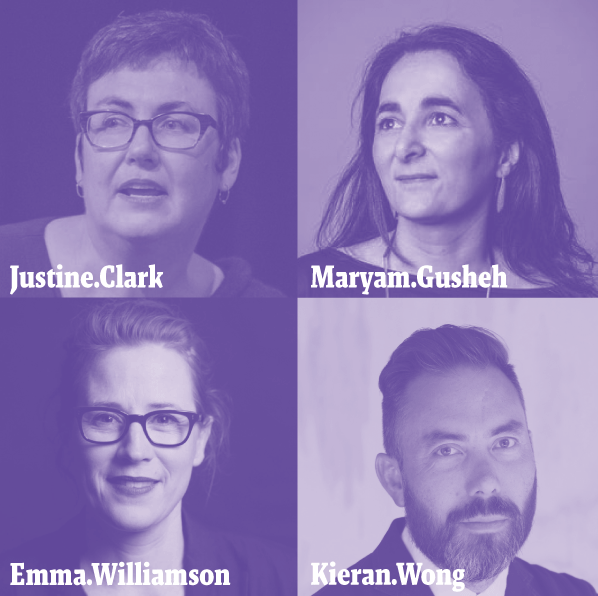
    Justine Clark, Maryam Gusheh, Emma Williamson and Kieran Wong will be creative directors of the 2020 National Architecture Conference that will take “Leverage” as its theme.

    “The role of the architect and architectural knowledge in contemporary society is shifting from a service provider to new roles that have the potential for transformative influence,” said creative directors Justine Clark, Maryam Gusheh, Emma Williamson and Kieran Wong. “This fluidity is hallmark of contemporary culture as rigid boundaries are increasingly blurred and challenged. Architecture appears uniquely positioned to extend its reach and amplify its impact. This is the ripple effect, the ability for architectural thinking to leverage positive change.

    Where do we find our leverage, as individuals, as practices or organisations, as a profession? How can we exploit our contemporary professional circumstance, training and knowledge to instigate positive change well beyond our disciplinary remit? How can architectural wit and intelligence, agility and diligence, cheekiness and humour, restraint and flamboyance, ethics and goodwill maximise (social, environmental, economic) impact and advantage? How can we play with and agitate the rules to sustain our culture while we embrace new associations? What are the levers, large and small, at our disposal? How do we find them and how far do they need to be moved to make a difference?”

    The conference will be organized around four streams: Policy and Politics (leverage through advice, strategy and negotiation), People and Partnerships (leverage through discourse, argument and education), Practice and Projects (leverage trough speculation, process and production), Publishing and Polemics (leverage through discourse, argument and education).

    The creative team represents “intersecting fields of research, advocacy, agency, practice, production and teaching.”

    Justine Clark is former editor of Architecture Australia and co-founder and director of Parlour: Women, Equity, Architecture. Maryam Gusheh is associate professor and deputy director of architecture at Monash University. Emma Williamson and Kieran Wong cofounded The Fulcrum Agency in 2018. The pair were previously directors of Cox Architecture and CODA Studio. Williamson is currently chair of the Design Advisory Committee for the City of Canning in Perth. Wong is also immediate past national president of the Association of Consulting Architects.

    The 2020 National Architecture Conference will take place in Perth from 7 to 9 May 2020.

    * This article was first published in ArchitectureAU on 2 July 2019.