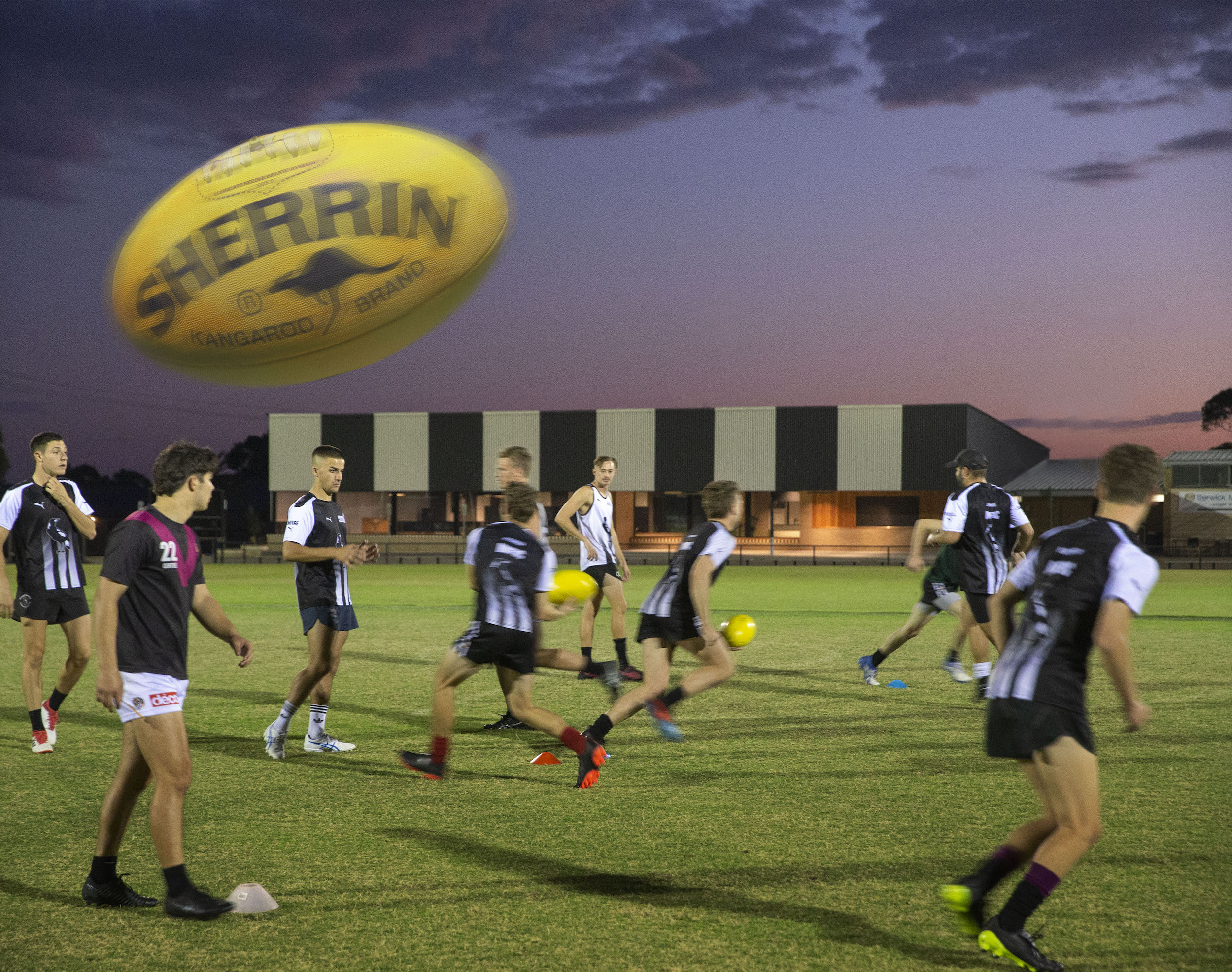
The refurbishment and extension to Kalora Park Sports Pavilion in the perri-urban Melbourne suburb or Narre Warren is a joyful celebration of active participation and the important role that sport’s clubs play in our community. It is the work of one of our favourite Australian studios, WOWOWA Architecture & Interiors. In a review commissioned for Commune*, Amelia Borg shows us that modest suburban architecture need not be beige and uninspiring.
Small community buildings are notoriously hard to build, many complicated and opposing forces need to align perfectly and all at the right time. To get anywhere near breaking ground these projects require budgets to be allocated, strong political will, overcoming countless regulatory requirements and unwavering community support. If there was ever a project to demonstrate how determined local spirit and unstoppable architects came together against these odds to deliver a new sporting and event hub for a community– it is the Kolora Park Sports Pavilion by
WOWOWA Architects.
Located in Narre Warren, an outer suburb of Melbourne 38km southeast of the central business district, this growth corridor stretches out and borders the Dandenong Ranges National Park. Over the last twenty years this area has remarkably transformed from a semi-rural residential town to a suburb laden with row upon row of almost identical houses on winding suburban streets. Through all this change, one place for the community stood still, the home of both the Narre Warren Football and Netball clubs. This project delivers a large new club and event space through an extensive addition to the existing facilities.
The project came about through WOWOWA director Monique Woodward’s father, who had been member at the club for years and played for the club as a teenager. There was no budget to begin with, but after convincing the club to abandon the original plans they had drawn up by a draughtsperson, the architects got to work and hatched a plan to get the project moving.
The clients originally wanted to demolish the entire building and start from scratch, but WOWOWA cleverly decided that re-using elements of the existing slab and infrastructure could be a way get more value out of the limited funds. The 770m2 addition provides a new flexible club and event room, anchored by a new bar and amenities which wrap around the existing facilities-in what Monique describes as a “big warm hug”.
Central to the design is a roof plane which appears to sharply fold into the facade, creating a generous under croft which allows for spectators to gather and cheer as they onlook onto the oval. This element, which appears as a heavy hovering mass, works hard to provide adequate shading to windows as well as cover over entries and a place to gather around the kiosk. Humble and pragmatic in its material palette, a masonry and timber base give the building a warm and durable grounding. Translucent polycarbonate ends give off a warm glow at night, and the building acts as a beacon in the suburban context.
Drawing from the teams’ magpie mascot colours, and as a nod to the streamers which adorned the original clubrooms, a strong black and white graphic wraps up the façade of the building and continues within the wavy cranked internal ceiling. The bathrooms are a colourful and exuberant surprise against the monochromatic pallet of the clubroom. Explosive tones of reds, pinks and blues charge across the ceiling- colours which were chosen in consultation with the netball team.
Beyond just updating tired facilities, this modest project has an important ambition in making a new and inclusive community space. The historical 60-year-old clubroom held within its walls the culture that existed at sports clubs at the time, a private and secluded space for men to gather, clash and drink. The original dusty clubrooms excluded families, children and importantly the netballers who also shared the facilities. In line with many projects of this nature occurring across the country, a key objective of the project was to update this historical legacy and reimagine the facility as a community hub that is accessible and welcoming to everyone.
In addition to creating a place for the sports teams to feel at home, the architects also thought about how the facility could give back to the club and help raise funds to contribute to the cost of build. Central to the proposition was the inclusion of a large event space which could be rented to the public and additionally help generate funds for the club.
Monique explains that all design decisions had to pass through the metric of being “cheap, fun and classy”; ‘cheap’ to meet the budget constraints, ‘fun’ to appeal to a wide-ranging demographic of community and ‘classy’ to be attractive for events and venue hire.
The dedication and perseverance of the architects is remarkable –their initial scheme was done with no fees to get the community on-side and excited. They spent some long nights and weekends painting the columns and bathrooms themselves to ensure all aspects of the design got across the line. The architects lobbied government and were able to secure bipartisan support for the project, who contributed more than half of the total funds towards the build. The local Casey Council contributed additional funding, and the remainder was made up with hours of community pro-bono support.
The help of many associated with the club was enlisted and material donations came from a wide range of sources, including fridges for the bar and granite for the bar top. Players, many of whom are tradesmen and specialists contributed to the project and Monique says the thoughtful details and references to the club’s history and culture helped in creating an emotional investment for them in the project. The expertise of Monique’s father who is a truss manufacturer was also brought in- a simple and cost-effective truss roof system was employed to ensure that the large event space could be column free internally.
Whilst Covid has been a slight deterrent in bringing people together, after the completion of the new facilities the club has seen a big increase in patronage. Modest in budget, this project is big in heart and ambition. Small moments of detail and delight tell a story about the community and enshrine the shared memories that extend beyond the football pitch. The project celebrates the history of the club, whilst creating a shared space for the future of a community that includes all.
* Copies of Commune can be purchased through
TheFulcrum.Press
and all proceeds are directed to
The Fulcrum Fund
, a charitable fund that we established to support projects in First Nations communities.
Ian Michael is an emerging director, actor and current 2022 Richard Wherrett Fellow at Sydney Theatre Company. We first connected with Ian through our support of a play he was directing at the Blue Room Theatre in Perth, and he was one of the first people who came to mind when we were thinking about contributors for our next journal. This is Ian Michael on Commune*:
I think of theatre. The gathering of people from places all over, people who press pause on their differences and sit in the dark and share that collective breath, their hearts beating in synchronisation, the moment of stillness before the applause erupts and the responsibility of artists who hold an audience and reflect the world, our histories and stories back to us.
Selfie
As a Noongar man, I think deeply on the accountability to Elders, Community and family. From them I’ve learned and continue to learn about the values I carry with me, the role I play in the present and future and what it means to be a storyteller.
Lee Stickells is a lecturer in architecture and urban design at the University of Sydney. In an article for Commune*, he applies his enquiring lens to Belvidere, an experiment in communal living that grew from the bush south of Perth in the seventies.
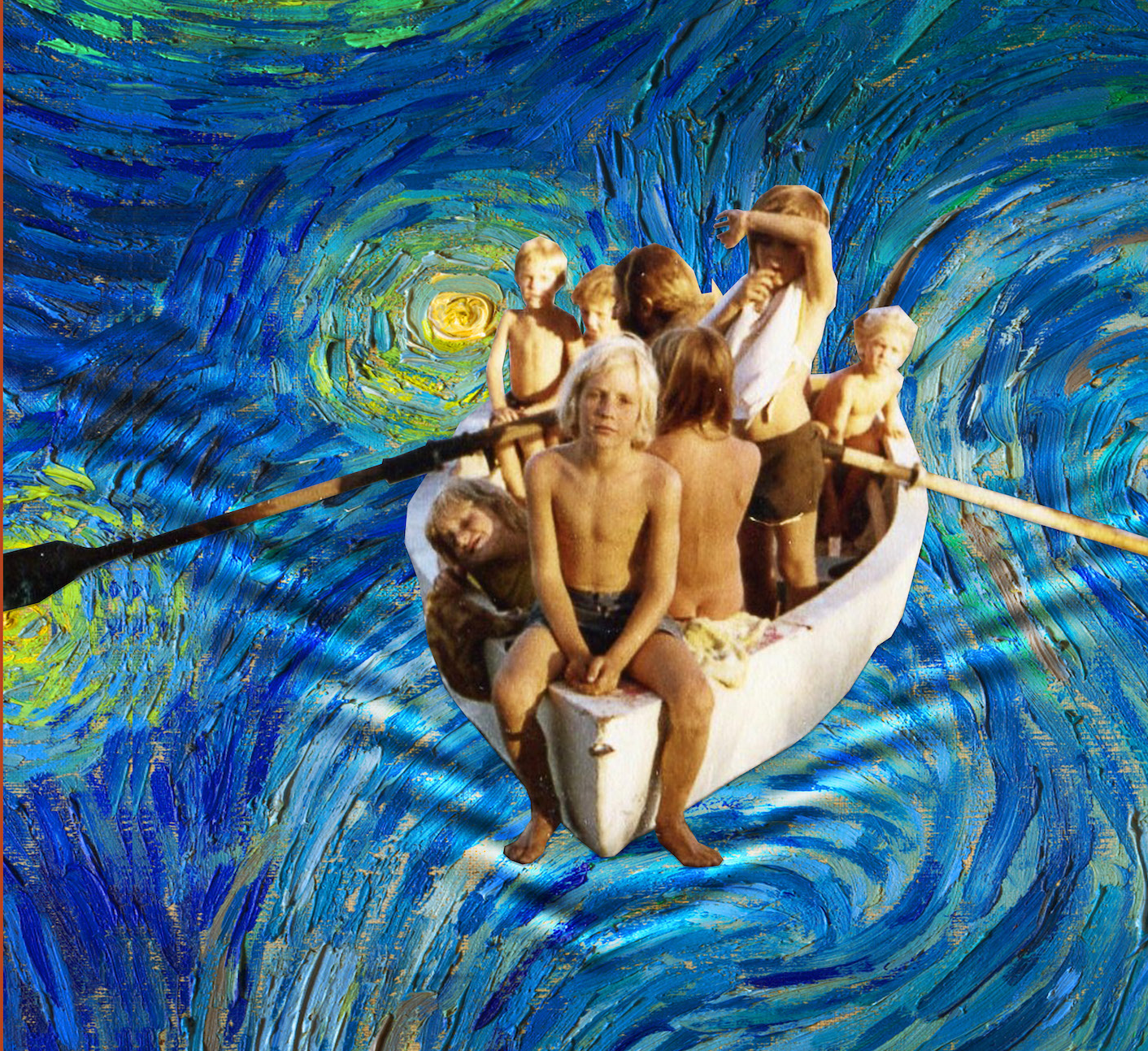
In the early 1970s, perhaps 1972 he tells me, Devissaro (then David Mott) rode his childhood horse 150 kilometres south from Perth to Leschenault. There, he struck out onto the thin peninsula, bounded on one side by the Indian Ocean and by the Leschenault Estuary on the other. He found peppermint and tuart woodland behind the foreshore dunes, and within this Brushtail possums, kangaroos, and two fibreglass radar domes.
He also found a new home and a form of escape. Dev’s arrival signalled the beginning of a shared living experiment that lasted over a decade. It emerged on the former site of a short-lived colonial estate—Belvidere—established to raise horses for the British Army in India. The 1970s Belvidere commune was home only to one horse. But it did involve many dozens of people during its lifespan: some for weeks, some for years, all searching for an exit from mainstream Australia. That search perhaps has consequence when considered alongside the intense unsettlement of our present moment. Sea, tree and lifestyle changes are prominent in questioning of the way we currently live together. Does Belvidere have lessons for us?
Belvidere operated through a period in which the personal became political. Historian Michelle Arrow has described how 1970s Australia saw a new politics of personal intimacy, where public claims to rights and protections were made in the language of personal experience. In various social movements—feminist, gay, environmental and others—personal transformation and change was connected to new modes of solidarity and larger political ambitions. Belvidere’s communards hardly saw themselves as remaking Australian society so overtly. Still, it’s possible to understand their placemaking venture as more than just a dropout hippie commune. Living off-grid and trying to be self-sufficient, the Belvidere experiment produced intimate counter-forms to the dominant patterns and accepted wisdoms of Australian life. Hand-built homes, collective organic gardens, kilns, and other structures became tools for creating a space within which to work, teach, share, and play in a way that was not commodified, based on private property, or hierarchically organised. Along the way, participants’ ideas of domesticity, ownership, productivity, and spirituality were transformed.
Devissaro made the move to Belvidere with a small group of friends who’d shared a communal house on the outskirts of Perth. University dropouts, Vietnam draft-evaders, devout readers of the counterculture bible the
Whole Earth Catalog
; they were escaping expectations and figured themselves as part of a global back-to-the-land movement. Dev remembers the optimism:
So there’s a romance about creating something, building our own places, creating a new community. And I guess we really had the feeling that we could create an alternative lifestyle. And I think the fact that we as a movement, the anti-war movement, had actually managed to change a government and get Australians out of the war, we felt empowered. We felt that, you know, this was our time, and that we were going to make a difference.
There was nothing that could be described as a plan amongst the group. There was, though, “a sense of oneness” and 500 acres of land they had been given. The Belvidere property at Leschenault was owned by the architect Wallace “Wally” Greenham (who they had encountered at a “hippie” gathering in the Darling Scarp, east of Perth). Greenham was busy conducting his own unconventional life, which included forays into communal living and the development of a “nuts and berries” architectural modernism ahead of the Sydney School. He offered the land to the young people at no charge, provided there was “no dope, no dole, and no dogs.”
The group settled into life on the property, along with an American couple discovered living in the modified radar domes. The newcomers initially camped together in an open-ended Nissen hut, another of Wally’s gifts. After the chilly 1972 winter, though, there was a strong desire to spread out and build individual shelters. The results ranged from a simple tent to more elaborate hand-built homes, even a treehouse. There was no collective planning, just an intuitive siting of dwellings—not too close to each other, but not too far; private but connected. Any collectivism was more organic than structured—former residents remember regular evening gatherings hosted by Franco, Carol and their young daughter Gita. Homemade wine would be shared by the open fire of the couple’s A-frame house (one of the few Belvidere dwellings that may have passed a building inspection). Discussion might turn to chores needed to maintain the collective gardens or a shared shopping list for the next trip to town. Devissaro remembers no individual money in the earliest days— “one person would pay and the other would pocket the change.” A shared bathing facility was eventually constructed in a clearing by the water’s edge and a wooden shed became a food cooperative. However, Belvidere never really became a commune, in the typical sense of a group sharing living spaces, income and tightly held values. It’s perhaps better to view Belvidere as a venture in commoning: the piecing together of collective forms of creativity and exchange to meet concrete needs and build lives outside the enclosure of the city.
The community expanded and transformed in waves. New members would arrive and might reside for a week or for years. Homes were shared, extended, or passed on to others.
They continued to be unauthorised, off-grid, hand-built affairs, using salvaged and recycled materials, even flotsam, driftwood and zinc alloy printing plates, along with shared and bartered labour. An environmental care ethic precluded felling trees for building stock. There is almost no evidence on-site now, but memories of the buildings are strong amongst former residents. Sue’s tiny cottage (also known as “little house on the prairie”) was built just south of the shared windmill. The nearby “Glass House” was so named because it’s estuary-facing façade was built entirely from salvaged timber windows. Steve, a potter, built his own kiln. Morris, described as “mad about music”, installed a solar photovoltaic panel in a tree to power his cassette deck. An Iranian refugee carefully constructed his octagonal shelter under a tree Belvidere folk called “the Matriarch.”
Devissaro’s own building activities emphasise how critical material practices were to shaping Belvidere. In 1973 he sheltered himself in a rudimentary wooden hut built in a Peppermint tree grove. By the time he left Belvidere in 1977 (bound for a Buddhist monastery in Thailand) he was running an Ashram that included a sunken hexagon-shaped retreat, sauna and three cabins (“kutirs”). It was far from planned. As he sees it, he responded to the opportunities presented by material conditions: “you just see what’s available … and then the creative exercise is simply how best to use that … in a way, it’s an extension of play.” The only material he paid for was nails and he sometimes gathered items for years before finding a use for them. One element he remains most proud of is a set of windows, built from panes of glass taken from car doors found at the Bunbury tip
Oh, the windows, I love my windows … it turns out it [the car glass] fits perfectly into the groove in tongue-and-groove flooring. So, you simply put one at the bottom and you have another one with a groove at the top and you can slide [the glass]. If you put them side by side, you can have sliding windows … It was lovely.
While Devissaro was hosting Buddhist monks, Belvidere grew to selling fruit, vegetables and sandwiches at a shop in nearby Bunbury, producing pottery and staging a music festival. A school was built for resident children, who had great freedom—building cubby houses, go-karts, roaming the inlet and crabbing. Together, the community collectively found ways to open up space in order to do what it wanted. Building provided a vital sense of ownership and agency, whether it was as simple as making somewhere to sleep, work, to produce food or art.
However, the surrounding community’s tacit acceptance of Belvidere waned. By the late-1970s, Wally Greenham’s “no dope, no dole, no dogs” rules were being circumvented. Meanwhile, the local government found it could no longer ignore the settlement in the face of a public health complaint. All the buildings were bulldozed in 1985. Greenham reluctantly undertook the demolition himself and sold the land to the state government, to be incorporated into an industrial effluent disposal system.
What to make of the Belvidere experiment? An obscure, colourful historical episode, it offers easy romantic images of countercultural free spirits exploring the estuary waters. These images also have a darker resonance, though, recalling the 19th century colonisers who pushed the
Elaap
—a Wardandi Noongar people—from the country that nourished and sustained them, or uncomfortably mirroring the Indian “coolies” who had to row supplies from Bunbury to the first Belvidere farm. The communards gave little thought to this history. Devissaro concedes: “one of the things we did not really consider was that this land, we actually had no right on, no one had any right on it.”
Refracted in this way, the Belvidere commune connects waves of settler colonial dispossession and transformation of the land. These waves stretch back to 1836, when the keen eye of Lieutenant Henry William Bunbury was attuned to the extractive possibilities of the metallic sands he saw along nearby beaches. They flow through the initial 1838 Belvidere estate and its failed ventures in raising horse and water-buffalo, as well as its subsequent use by nearby farmers for grazing stock. They keep flowing through the 1960s into the 1990s as the peninsula was used as a disposal site for acid affluent—a result of the mineral sands that caught Bunbury’s attention coming to underpin Western Australia’s role as a key global supplier of titanium minerals for paints and colouring agents. And in the 2000s, even as the state sought to rehabilitate the peninsula environment, its reconfiguration as a recreational site for camping and boating keyed it into post-industrial tourism and experience economies.
In terms of a useable history, then, we might feel we’re faced with a meagre harvest. However, the value of revisiting the Belvidere commune in our present moment is the window it opens onto a different way of imagining everyday life. As one resident put it: “It wasn’t all rosy but it broadened my awareness of what is possible.” To be interested in the 1970s, to be interested in experiments such as Belvidere, is to be interested in alternatives to our neoliberal, consumerist present. Belvidere’s short history points to the way social relations of trust, care and mutuality can emerge when people collectively build forms of life outside commercial prerogatives, domestic norms, and conventional institutions. The potential of this commoning arises not as a form of protest but as a way of materializing an alternative—producing an actually existing crack in reality.
Acknowledgements
Research for this essay drew on various published histories of the site and surrounding region as well as social media material, interviews, and personal archives. I’d like to particularly thank contributors to the Lost Belvidere Facebook Group for all the posted memories, Wally Greenham’s family for access to his papers (and their own stories), the Harvey Historical Society, and those former Belvidere residents who answered my questions and supplied images, especially Devissaro, Alison Batten and Valli Waugh.
* Copies of Commune can be purchased through
TheFulcrum.Press
and all proceeds are directed to
The Fulcrum Fund
, a charitable fund that we established to support projects in First Nations communities.
In each edition of our journal*, we ask a handful of people to reflect on our chosen theme. This is Tanya Sim on commune:
One of the blessings of ageing, and with it, life experience, is that I have a much more intentional, sometimes belligerent approach to what I do with my time and who I choose to share it with. With this intentionality, I feel deeply caring and often fiercely protective of the community of people around me. I love this. Those that I ‘commune with’ aren’t centred in a physical space – certainly not a church, but we each choose to show up and share. It may be an exchange of thoughts or feelings but equally it may be a business transaction or an idea for a project. Many friends are also, or have been, colleagues, clients, suppliers, employees, family or part of a brains trust.
Selfie, Tanya Sim
I love bringing together people who may not know each other yet, or who I know would work really well together. And this communal pot of sharing is beneficial in so many scenarios – growing a business, raising children, emotional support, finding great information.
In my business, some of our best work has been because of the people we’ve collaborated with – in fact collaboration is fundamental to any success we’ve had.
Fundamentally, my close posse/s have shared values and will speak up with their opinions, thoughts and ideas. For me though, perhaps a difference between those that I commune with and ‘anyone’ – is my ability to be completely authentic, vulnerable and honest.
* Tanya is a Co-Founder and Director at Block Branding, Board Member at the Perth Theatre Trust, Chair of Highgate Primary School Board and Committee Member at the Borderless Friendship Foundation WA. Copies of Commune can be purchased at
The Fulcrum Press
, with all proceeds going towards projects within First Nations communities.
In each edition of our journal*, we ask a handful of people to reflect on our chosen theme. This is Will Ek-Uvelius on commune:
Selfie
I think of it as being close to the idea of ‘chosen family’, a concept that challenges stereotypes driven by hegemonic notions of ‘nuclear family’. It accepts new constellations of family and what it means, something more inclusive and open to others.
Constellations that I imagine correspond to that of a commune, where
to share
is the key word. Commune could be even more about the people I choose to see as my own and
share
my life with on a non-material level, rather than that of materialistic possessions and resources.
* Will is a Creative Digital Engagement Specialist with a rich academic background, having studied non-violent leadership, documentary filmmaking and intersectionality and gender studies. Copies of Commune can be purchased at
The Fulcrum Press
, with all proceeds going towards projects within First Nations communities.
In each edition of our journal*, we ask a handful of people to reflect on our chosen theme. This is Michelle Blakeley on commune:
Commune. I immediately think of groups of people creating communities in Nimbin, Margaret River and other idylls. A sharing of beliefs, values and desires underpinning a physical sharing of property, childcare, cooking, planting vegetables and whatever else is required for the commune to function. Rarely have they been sustainable which I’ve always found to be an insightful example of the human condition.
Fundamental to commune is sharing freely without competitiveness, ego, judgement, greed, selfishness or possessiveness (I could go on).
How do we embrace our positive offerings and eliminate the negatives, leaving them at the door with all the other uncomfortable baggage we want to discard? I want to believe in a commune of sharing between kindred spirits who collaborate openly and with trust. But commune is fragile and so easily destroyed by those in commune.
* Michelle is an Architect and the Chair of
MyHome
, an innovative response to providing housing for the homeless. Copies of Commune can be purchased at
The Fulcrum Press
, with all proceeds going towards projects within First Nations communities.
As a gay Aboriginal-Italian kid growing up in a small Western Australian Wheatbelt town, it’s not easy to find your community. As part of
Commune, issue 04 of our journal
, entrepreneur Gerard Matera chats to Meri Fatin* about how self-acceptance was the spark he needed to create businesses with social good at their heart.
Meri Fatin [00:00:27]
How do you introduce yourself when you when you meet someone for the first time?
Gerard Matera [00:00:48]
I tell them that I’m very proud to be Noongar and then I tell them a little bit about my journey. More recently, I let them know that I’m part of the LGBTQI community too.
Meri Fatin [00:01:28]
Why does it matter for you that they know?
Gerard Matera [00:01:33]
I think it has to do with my age to be honest. What I’ve found is the more open and transparent I am with myself – for many, many years, I didn’t know who I was – the more success I have, the deeper friendships I get, and the more my business succeeds.
Meri Fatin [00:02:10]
You’re the youngest of eight children. How has being in that position in the family impacted you?
Gerard Matera [00:02:30]
I’m one of seven boys and one sister. As the youngest, I became very close to my mum because my dad had to work seven days a week, in two jobs, to put food on the table. I was in the kitchen a lot. I had this passion to be a chef from a very young age. I always enjoyed bringing people together with a full table.
I grew up in a really small country town called Wagin, about three hours southeast of Perth, with an Italian father and an Aboriginal mother. As I was growing up, I didn’t really understand why these two people came together, particularly with what was playing out. Wagin was built in an era where Aboriginals lived on one side of town and white people lived on the other. Mum and dad didn’t have a lot of money and we were raised in state housing. When you come from a place of not having a lot, then it’s really about the love, the relationships.
I think I was 10 years old when my mum took me to the doctors because I wasn’t playing football or any sports. I had quite a close relationship with the doctor back in Wagin and he said, “just take him and force him to play”. And she did – I started playing basketball and football and I actually enjoyed it. But I didn’t really see myself… being gay and also Aboriginal – it was very difficult for me to see myself anywhere. Yeah. So that’s kind of, you know, the reason why I was quite isolated in the beginning.
Matera family home in Wagin
Meri Fatin [00:06:15]
It’s amazing when you think about how for the Matera family, not wanting to play footy was almost a pathology. What was the broader social picture that you grew up in?
Gerard Matera [00:06:58]
Wagin was a very dysfunctional town. We lived with a reserve at the back of our house and most weekends a lot of Aboriginal families would be fighting, fuelled by alcohol and drugs, and there was lots of unemployment. As I got a little bit older, I definitely saw the divide. I don’t know if someone in the planning department thought, oh, let’s put all the blackies over here and then put all the white fellas over here. Funnily enough, you know, 50-plus years later, Mum and Dad are still in that house.
Meri Fatin [00:08:45]
When we started you said that you introduce yourself as a Noongar man. Where is the bit of you that identifies with your Italian heritage?
Gerard Matera [00:08:58]
Yeah, I think through food. When we were growing up Mum would cook a lot. But Dad would make pizzas and pasta and all that sort of stuff and a lot of bread. And still today, you know, if you’re heading to Wagin on the weekend, he’ll make sure there’s pizza and some bread that he’s made to give you. I think the Italian heritage has always been about the vino, the fruit and veg, living off the garden.
We came from a place of not having a lot of money and so Dad was very vocal about eating from the garden, you know, making sure there’s chooks that gave us eggs. He tried to be quite self-sufficient in that sense. We always had rows and rows and rows of fruit and veggies in the backyard. And Mum would probably get yelled at if she went to the shops and bought apples. When I went to Italy for the very first time in my late 20s, it was very similar. I actually thought that I was going to see a wealthy side of the family. I pictured Italy being this the most amazing country and my family to be living in these estates with vineyards and all that sort of stuff. It just wasn’t the case. My Italian family weren’t wealthy either. So, when I saw the Italian part, I realised that the Aboriginal part is actually very similar when you’re talking about culture, food and bringing people together.
There’s a backstory to this photo. A photographer would travel through country towns each year to take family photos, a bit like the Avon Lady. Mum and Dad said yes to the picture but could not really afford it. Somehow, they made it work and this is the only formal photo that we have of the young years.
Meri Fatin [00:10:28]
Before we move away from your earliest years, I want to ask you, when were you first able to articulate to yourself that you were gay? Tell me a bit about that side of what was going on for you.
Gerard Matera [00:10:45]
Yeah, I think early teens to my early 20s. I definitely knew that I was gay, but obviously with the laws and restrictions and also growing up in a family environment that was very footy-focussed and very masculine, I didn’t ever feel comfortable.
Meri Fatin [00:11:10]
So, what did you know about what it was to be gay, that stopped you from telling anybody at that time? What was your sense?
Gerard Matera [00:11:18]
Yeah, I was seeking love and affection but being in Wagin, I didn’t find that in anyone. I didn’t see the LGBTQI community anywhere in Wagin. That’s why I think it took me a very long time to realise that I was gay, because I didn’t really feel comfortable and didn’t see other people that were similar until I was probably late teens, early 20s.
Meri Fatin [00:11:54]
So, does that mean that you knew that there was something not quite right but you couldn’t tell what it was?
Gerard Matera [00:11:59]
Yeah, most definitely. I knew that there was something going on and I knew quite clearly that I couldn’t talk about it and I had to hide it from everybody.
Meri Fatin [00:12:14]
So, before we leave Wagin, I’m interested in the impact on you of being part of a footy family and the expectation placed on you. The impact that football had on the Matera family.
Gerard Matera [00:12:28]
Yeah. Look, don’t get me wrong, I’m very happy that my brothers found success through football. But for me, what played out was finding myself getting more and more depressed and struggling with anxiety because I just couldn’t be myself. I couldn’t talk about myself. I couldn’t, you know, say to my mum or my family, hey, I’ve fallen in love or this is who I am. It was never that environment. And even going to a football game whilst my brothers were playing AFL, even being invited down to the bar that the players’ families go to after a game; everyone’s got a girlfriend, everyone’s got a partner. I didn’t see an LGBTQI person anywhere.
While my brother was playing, particularly in 1992, the memory is quite prominent because I was in my late teens and I was kind of just realising… I lived a lie for so long, telling my brothers that I had girlfriends, dating girls for years just to fit in and, you know, lying to everybody about that. It did not make me feel very good.
Meri Fatin
[00:14:16]
Was it about protecting the public reputation of the family?
Gerard Matera
[00:14:24]
Yeah, yeah. Most certainly. I think twenty plus years ago when my brothers were playing footy I don’t think they would have been comfortable with me rocking up with a boyfriend to the members bar at the AFL. Certainly not.
Meri Fatin [00:14:58]
It’s important to remember how recently that that was the case.
Gerard Matera [00:15:04]
Yes, but I want to make this point. My mother also was treated in a very similar way. For many, many years, my mum was never properly accepted in Wagin. I feel that no one really embraced her up until my brother won the Norm Smith Medal in 1992, when they changed the street name to Matera Street and they changed the football oval to Matera Oval. They had a banner that stretched across the main street welcoming my brother as the Norm Smith medallist of Wagin and then gave mum and dad the key to the town… so when your successful, football rallies behind people with differences.
I think if you subtracted the whole AFL thing, I don’t think Mum ever would have been celebrated in such a way.
When Peter won that Norm Smith medal in ’92, Channels Seven and Ten rocked up at my mum and dad’s house wanting to interview them, but before that, you know; no way. So, the point I want to make is that it’s hard to see your mother vilified for her race and her not feeling very comfortable with who she is. You know, my mum never went to an AFL game. She went to South Fremantle in the early days when Phil and Pete and Wally were playing because I think a lot of Noongars were hanging out back then and my aunties and extended family were there. But I don’t think Mum was ever really comfortable going to an AFL game.
And so in the early days, I was very reluctant to tell anyone that I was Aboriginal, particularly after moving to Perth and being a young Aboriginal boy looking for employment. I was always involved in conversations that were very, very negative about Aboriginal people. And then when you let them know that you’re Aboriginal, the conversation kind of changes. So, I had two fronts. I was reluctant about telling people that I was Aboriginal but I wasn’t telling people that I was part of the LGBTQI community either.
Meri Fatin [00:18:04]
I want to get onto the racism directly. But first I want to ask you about leaving Wagin. Where did you go and what did you do next?
Gerard Matera [00:18:21]
When I was about 16, I said to my mum that I want to become a chef. I came to Perth hunting for an apprenticeship and I ended up getting one at Radisson Observation City, which was then a five-star hotel. I worked there for all of my apprenticeship and I did some really cool things, like you know, hosted an array of different people, cooked for Elle MacPherson. I still have that passion today, I’m still in the food industry, but not cooking commercially anymore. I worked in hospitality for a very long time and then I moved into the government space and worked for the apprenticeship board for many years, overseeing apprenticeships and the traineeship sector. And again, I didn’t see a lot of Aboriginal people working there and LGBTQI people just didn’t really exist.
Meri Fatin [00:22:35]
So how did you end up having multiple businesses all creating opportunity and overcoming obstacles for Aboriginal people?
Gerard Matera [00:22:46]
It’s funny. Working for government, I realised that the energy level is quite vanilla, and no one is out there campaigning unless you’re a politician. So for most of Government it’s about what you can and can’t do. I was always striving to do something bigger. When you grow up in a family that has nothing except love and food in the backyard, and sometimes going without lunch because there’s no food in the cupboard… I knew that I didn’t want to struggle like that.
I wanted a life that was an abundance of experiences and drive and I wanted to be self-sufficient and I wanted to have enough money to do the things that I want to do. I’m not interested in having billions of dollars just sitting in the bank, I’d rather just have a life full of experiences and things.
I wanted a life that was an abundance of experiences…
So many years ago, pre-2010, I started to strategize. I wanted to start a business that was based around giving back. My first business was a company called EON, which stands for Empowering Our Nation. I designed a business that was really about social change – from the name, the purpose, the vision, the values. It was built around giving back to people that might not see opportunity for themselves. EON was founded to try to lower incarceration rates for people. I was quite big on understanding the landscape in all these different business sectors, particularly for Aboriginal people. Security is an industry where government and the private sector spend billions of dollars per year but when you go to a shopping centre or a bank and there’s a security guard standing at the front, it’s not an Aboriginal person. That needed to change.
So today we’ve got some huge contracts. BP Kwinana, we’re looking at KATAGIRI out in Kalgoorlie. We’ve done some work with Woodside, with Wilson, an array of government contracts and our employment of Aboriginal people in that business is about 40 percent. I’m trying to make it the norm that when there’s a building being secured the person standing at the front is Aboriginal. And it’s not like, “Oh, my God, there’s an Aboriginal security guard!”. It is the same for all the businesses. Now I’ve got a security business, I’ve got a construction business, I have a food business and an energy business. They’re all built around looking at where Aboriginal people aren’t succeeding. So, education, housing, providing energy for themselves out in communities, incarceration rates – all those things.
When I launched Marawar (Building and Civil Services), there were 40,000 apprentices and trainees in the state of WA and less than 100 of them were Aboriginal.
You look at the billions of dollars that is spent by government and also by the private sector and that’s the bang for buck we get? Less than 100 Aboriginal apprentices in the whole state. So I wanted to address this and start a building business that looked at employing Aboriginal people. I want it to be the biggest Aboriginal building company in WA.
Even in the food business you don’t see an Aboriginal person serving you when you’re in a café. There’s not an Aboriginal barista. It’s just not commonplace. As I found out when I was young, you’ve really got to see yourself in normal places, in normal positions. It shouldn’t be “Oh, my God, will I be accepted?” Because that’s the landscape we’re dealing with. So, all the businesses are driven with the same purpose, same values – how do we get more Aboriginal people in these jobs so that it becomes the norm?
Left to right: Wally (holding me), Peter, Gino, Michael and Carmel
Meri Fatin [00:27:38]
That classic saying “You can’t be what you can’t see”. What interests me about you in this enormous landscape that you’re creating is that you’re the interface in a lot of racist conversations, fronting up to blunt prejudice. You’re that person. You are that guy every single time. So how do you brace yourself and deal with that stuff so that you stay safe?
Gerard Matera [00:28:12]
Yeah, If I was to go back 10 years, I don’t think I would have been ready to be the face of a business and be openly out and also be telling people that I’m Aboriginal just because of the backlash. I don’t want to give the illusion that it is easy being an Aboriginal business because it isn’t, and it isn’t easy being part of the LGBTQI community and Aboriginal. I’ve had some shocking conversations with corporates about them wanting to have diversity and inclusion in their business, but they really go about it in a clumsy and inauthentic way.
It just becomes so much easier when you are authentic, and you don’t hide. Hiding yourself from the world is a horrible thing to do. And when I look at my family, my brothers and colleagues, no one’s hiding themselves – no one. They’re able to hold hands in public, get married and do all those things. So I think that I’ve got this resilience now but it’s taken time. I don’t think 15 years ago I could have stood up and said who I am. But now I realize that corporates and government need to do better in a sense that if you want to have an honest conversation about diversity and inclusion, we need to have a different dialog. Because rainbow ticks and black cladding and all those things where Aboriginal people and LGBTQI people are being used to paint a certain facade, that definitely needs change.
Meri Fatin [00:30:35]
Yeah, it sounds when you talk about it now, like you are squarely standing on two feet full-frontally facing this thing and ready to challenge that topic.
Gerard Matera [00:30:49]
I think when you become successful in business, people do want to have a different conversation with you. But when you’re an employee or someone at a different level, no one wants to sit down and find out who you are and how you are doing what you’re doing. And many, many people now say to me, how the hell do you do all the stuff that you do? Sit on all these boards and run all these businesses. It hasn’t been easy. I’m out in public doing all the things that I’m quite passionate about, so that people understand what we’re doing so I can potentially get more opportunities to employ more people. That’s the ultimate game.
Meri Fatin [00:32:23]
Yes. So, you’re establishing yourself on behalf of all the people that you’re creating opportunity for and overcoming obstacles for…
Gerard Matera [00:32:30]
Yeah. I mean, I’ve got a trans woman at the moment working for me as a painter. And, you know, I’ve had conversations with her about being so happy and excited and thankful that she’s in an organisation that embraces her for who she is. And we’re here for her journey. When that kind of stuff plays out and we become an organisation where people are seeking me out for employment because they can see what we’re doing, that makes you feel good, that really cements that we are doing the right thing. The businesses are doing what they’re supposed to be doing. When I set the businesses up and I had that whole thing about empowering our nation, you know, it wasn’t just a silly dream. It really has come to fruition. And, unless you’ve got a business, no one will really understand what it takes. The hours and the commitment and the sleepless nights and the stress and all those things. But it does get easier. It’s all about critical mass. As the businesses grow, it does get a little bit easier.
Matera kids in Wagin
Gerard Matera [00:40:09]
One of the things that I came into Pride WA saying was that we need to make organisations more accountable for using Pride in a way that ticks a box or makes them look good. An example is a corporate would get in contact with Pride to say, “hey, can we be a part of your parade?” And, you know, they donate some money and they run their staff through the parade. And then after the parade is finished, we get crickets. We don’t hear from them again until next year when they might want to participate, or we don’t see them again at all. We couldn’t run the parade in 2020, so we used that time to work out how we could pivot Pride WA to be the organisation it should be. Moving forward, we are going to be having a conversation with corporates and government about how they can participate and partner with Pride more meaningfully, more inclusively, all year round, and not just for one day of the calendar year.
Meri Fatin [00:44:27]
Yeah, yeah. It’s obvious you’ve got a really strong hypocrisy-radar, right back from your parents being given the keys to Wagin in the footy years.
Gerard Matera [00:44:38]
Yeah. This story was the nail in the coffin. I went to speak to someone at a national organisation many years ago about a catering opportunity for my business. And the organisation said to me “no, no, we can’t be using an Aboriginal business because we have in the past and it didn’t work.” Apparently, they were holding an executive lunch and the Aboriginal business rocked up and provided sausage rolls and Twisties. All of a sudden, I’m sitting there and I’m like, oh, my God, here’s a guy who thinks that all Aboriginal people are the same, that we’re all useless, and now we’re not going to be given the opportunity. I basically begged him, I talked about my cheffing background, having a food business and our clients. We got the opportunity and this organisation now uses us for all their events year round. I think that’s what it’s about – having uncomfortable conversations with people about making a bit of a change and being authentic, you know.
Meri Fatin [00:46:29]
Over the last year or two especially, you’re in a space with PrideWA where your sexuality is completely the norm, and broadly in your work, your Aboriginality is fundamental to the success of your work. A lot more comfortable to be what you are, and who you are. How has that impacted your health?
Gerard Matera [00:47:18]
Look, I think being the first Aboriginal person to be elected to Pride WA says a lot about that organisation and about being accepted. But I have to say, I was in a really dark place for a very long time – probably a decade. I was depressed, I had anxiety, all those things set in.
It’s hard to explain when people really don’t understand what it feels like not to see yourself anywhere.
My immediate family haven’t always embraced it without difficult conversations. I got out of that dark place through a conversation with my brother about, you know, no one’s coming to save me (you said no one is going to save you or he said no one is going to save you?). No one’s coming to help you. You need to get off your ass and do it yourself. The Aboriginal landscape and the LGBTQI landscape are very, very similar. The biggest eye-opener for me joining Pride is nothing has really changed. Yes sure, we’ve got an organisation. Yes, we’ve got a Pride flag and we’ve got a group that campaigns. But when you really go out into the community, it’s still dysfunctional, it’s still segregated. There are still young kids that need help, that need workplaces and government to make sure that they’re safe.
Meri Fatin [00:51:20]
Have you thought about what would satisfy you in terms of what you achieve through your work?
Gerard Matera [00:51:37]
If we’re talking about the LGBTQI-rights space, what I would love to do is leave a legacy of a hub in Perth that doesn’t exist right now. A place where kids could feel safe and where young LGBTQI entrepreneurs could come and get business coaching and just really get that sector flourishing and get more corporates involved and not the rainbow ticking that’s going on.
In the last couple of years, I’ve been approached by corporates that are seeing some of the cool stuff we’re doing and reaching out about their diversity and inclusion strategy. That says to me that I’m on the right path.
Meri Fatin [00:52:20]
It’s going to be very interesting to see how Perth is increasingly impacted by your leadership and your steadying hand around this. Thank you so much for talking with me.
Gerard Matera [00:53:43]
OK, thank you so much.
*Journalist Meri Fatin conducts the main interview in each edition of our journal, and always astounds us with her thoughtful, intelligent and kind approach to these conversations. Copies of Commune can be purchased at The
Fulcrum Press
, with all proceeds going to projects within First Nations communities.
In each edition of our journal*, we ask a handful of people to reflect on our chosen theme. This is Matt Stack on commune:
As a Gen-X son of Boomers I have met actual hippies. My uncle and aunt lived in remote locations with alternative lifestyles, and sent postcards when their boat got stuck in Samoa. As a Bunbury teenager I explored the abandoned hippie commune of Belvidere on the Leschenault Peninsula.
Shelter
, Lloyd Kahn’s illustrated guide to alt-traditional building, was my gateway to architecture. For me,
Commune
resonates with cutting-off from the mainstream to pursue other ideals, and I’m a bit susceptible to that.
Selfie
My closest-to commune encounter was in a collective of fine art and architecture students who formed the Jacksue Gallery in Murray Street from 1995-1998.
We would have scorned the term Commune, but nonetheless we formed our own alternative world behind an opaque shopfront
I now work in the relentlessly mainstream world of state government planning, but there remains a commune-dweller part of me who can never fully believe that the way things are, is the way things have to be.
* Matt is an architect and urban designer working on the Metronet project at the Department of Planning, Lands and Heritage. Copies of Commune can be purchased at
The Fulcrum Press
, with all proceeds going towards projects within First Nations communities.
Fremantle, like port cities the world over, has always been a cultural melting pot. Terrazzo, which arrived in port with the wave of Italian immigrants, is the perfect metaphor for this rich communal mix. Focussing a contemporary eye on Freo and terrazzo, Gabrielle Howlett, Margaret Dillon and Jesse Lee created a series of functional objects for the home that were exhibited as part of the launch of Commune.
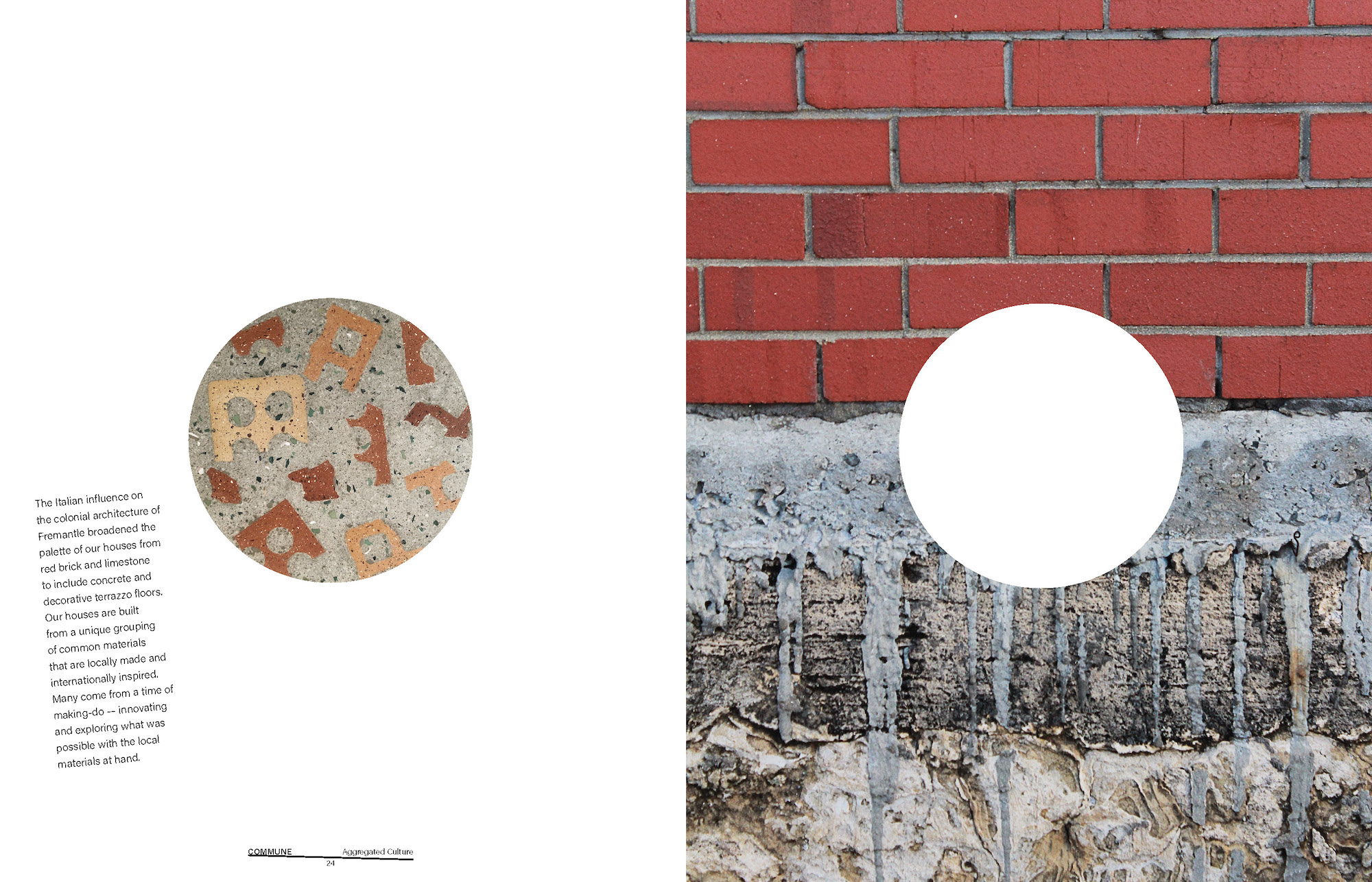
The Italian influence on the colonial architecture of Fremantle broadened the material palette of our houses from red brick and limestone to include arches, concrete and decorative terrazzo floors. Our houses are built from a unique grouping of common materials that are locally made and internationally inspired. Many come from a time of making do – innovating and exploring what was possible with the local materials at hand.
Graphic Design
The three of us have been particularly curious about terrazzo and its capacity to move between the decorative and functional, the local and international. Gabrielle Howlett from How Productive has long been fascinated by the story of the Scolaro terrazzo tiles made in Fremantle through the 50s and 60s at the Universal Tile Factory. Gabby approached Fremantle-based contemporary terrazzo makers Margaret Dillon from Concreto and Jesse Lee from The Terrazzo Tailor to create a functional product using their skills.
Together we have designed a limited series of terrazzo tableware revisiting the building palette of Fremantle and creating new connections to place and community. Bricks were salvaged from tips and verges, limestone and shells collected on walks around South Beach. Following tip offs from friends, there has even been the occasional raid on a loaded skip bin. These found materials are bound together in concrete allowing us to develop a unique terrazzo product that is very local, very Fremantle. Cast products produced in a traditional terrazzo method are polished to highlight the individual beauty of each material and equally expose the importance of unity. The grinding process reveals the delicateness of the most utilitarian materials, like fine sand and stone particles in brick clay.
Where materials such as brick are typically seen en masse as units of building, here we see only small parts, in section and polished. The humble brick moves from utility to beauty.
This project has been a collaboration inspired by the commune of Fremantle. It celebrates the role of the built and natural environments in creating a unique sense of place.
*Aggregated Culture was first published in Commune, issue o3 of our journal. Copies can be purchased through
TheFulcrum.Press
and all proceeds are directed to
The Fulcrum Fund
, a charitable fund that we established to support projects in First Nations communities.
In each edition of our journal*, we ask a handful of people to reflect on our chosen theme. This is Joseph London, the filmmaker behind the extraordinary documentary ‘The Beloved’**, on commune:
Selfie 2021
To me, the commune represents the promise of being relieved of the grinding effort to get big things up on your own, of joining forces and to be ambitious.