In our work and personal lives we are committed to doing what we can to build a reconciled Australia, where Aboriginal and Torres Strait Islander cultures are foundational to our national identity and embraced by our institutions.
This is the sixth year that we have decided to work on the 26th January – a small but genuine reflection of our desire for a more truthful acknowledgement of our nationhood.
As a gay Aboriginal-Italian kid growing up in a small Western Australian Wheatbelt town, it’s not easy to find your community. As part of
Commune, issue 04 of our journal
, entrepreneur Gerard Matera chats to Meri Fatin* about how self-acceptance was the spark he needed to create businesses with social good at their heart.
Meri Fatin [00:00:27]
How do you introduce yourself when you when you meet someone for the first time?
Gerard Matera [00:00:48]
I tell them that I’m very proud to be Noongar and then I tell them a little bit about my journey. More recently, I let them know that I’m part of the LGBTQI community too.
Meri Fatin [00:01:28]
Why does it matter for you that they know?
Gerard Matera [00:01:33]
I think it has to do with my age to be honest. What I’ve found is the more open and transparent I am with myself – for many, many years, I didn’t know who I was – the more success I have, the deeper friendships I get, and the more my business succeeds.
Meri Fatin [00:02:10]
You’re the youngest of eight children. How has being in that position in the family impacted you?
Gerard Matera [00:02:30]
I’m one of seven boys and one sister. As the youngest, I became very close to my mum because my dad had to work seven days a week, in two jobs, to put food on the table. I was in the kitchen a lot. I had this passion to be a chef from a very young age. I always enjoyed bringing people together with a full table.
I grew up in a really small country town called Wagin, about three hours southeast of Perth, with an Italian father and an Aboriginal mother. As I was growing up, I didn’t really understand why these two people came together, particularly with what was playing out. Wagin was built in an era where Aboriginals lived on one side of town and white people lived on the other. Mum and dad didn’t have a lot of money and we were raised in state housing. When you come from a place of not having a lot, then it’s really about the love, the relationships.
I think I was 10 years old when my mum took me to the doctors because I wasn’t playing football or any sports. I had quite a close relationship with the doctor back in Wagin and he said, “just take him and force him to play”. And she did – I started playing basketball and football and I actually enjoyed it. But I didn’t really see myself… being gay and also Aboriginal – it was very difficult for me to see myself anywhere. Yeah. So that’s kind of, you know, the reason why I was quite isolated in the beginning.
Matera family home in Wagin
Meri Fatin [00:06:15]
It’s amazing when you think about how for the Matera family, not wanting to play footy was almost a pathology. What was the broader social picture that you grew up in?
Gerard Matera [00:06:58]
Wagin was a very dysfunctional town. We lived with a reserve at the back of our house and most weekends a lot of Aboriginal families would be fighting, fuelled by alcohol and drugs, and there was lots of unemployment. As I got a little bit older, I definitely saw the divide. I don’t know if someone in the planning department thought, oh, let’s put all the blackies over here and then put all the white fellas over here. Funnily enough, you know, 50-plus years later, Mum and Dad are still in that house.
Meri Fatin [00:08:45]
When we started you said that you introduce yourself as a Noongar man. Where is the bit of you that identifies with your Italian heritage?
Gerard Matera [00:08:58]
Yeah, I think through food. When we were growing up Mum would cook a lot. But Dad would make pizzas and pasta and all that sort of stuff and a lot of bread. And still today, you know, if you’re heading to Wagin on the weekend, he’ll make sure there’s pizza and some bread that he’s made to give you. I think the Italian heritage has always been about the vino, the fruit and veg, living off the garden.
We came from a place of not having a lot of money and so Dad was very vocal about eating from the garden, you know, making sure there’s chooks that gave us eggs. He tried to be quite self-sufficient in that sense. We always had rows and rows and rows of fruit and veggies in the backyard. And Mum would probably get yelled at if she went to the shops and bought apples. When I went to Italy for the very first time in my late 20s, it was very similar. I actually thought that I was going to see a wealthy side of the family. I pictured Italy being this the most amazing country and my family to be living in these estates with vineyards and all that sort of stuff. It just wasn’t the case. My Italian family weren’t wealthy either. So, when I saw the Italian part, I realised that the Aboriginal part is actually very similar when you’re talking about culture, food and bringing people together.
There’s a backstory to this photo. A photographer would travel through country towns each year to take family photos, a bit like the Avon Lady. Mum and Dad said yes to the picture but could not really afford it. Somehow, they made it work and this is the only formal photo that we have of the young years.
Meri Fatin [00:10:28]
Before we move away from your earliest years, I want to ask you, when were you first able to articulate to yourself that you were gay? Tell me a bit about that side of what was going on for you.
Gerard Matera [00:10:45]
Yeah, I think early teens to my early 20s. I definitely knew that I was gay, but obviously with the laws and restrictions and also growing up in a family environment that was very footy-focussed and very masculine, I didn’t ever feel comfortable.
Meri Fatin [00:11:10]
So, what did you know about what it was to be gay, that stopped you from telling anybody at that time? What was your sense?
Gerard Matera [00:11:18]
Yeah, I was seeking love and affection but being in Wagin, I didn’t find that in anyone. I didn’t see the LGBTQI community anywhere in Wagin. That’s why I think it took me a very long time to realise that I was gay, because I didn’t really feel comfortable and didn’t see other people that were similar until I was probably late teens, early 20s.
Meri Fatin [00:11:54]
So, does that mean that you knew that there was something not quite right but you couldn’t tell what it was?
Gerard Matera [00:11:59]
Yeah, most definitely. I knew that there was something going on and I knew quite clearly that I couldn’t talk about it and I had to hide it from everybody.
Meri Fatin [00:12:14]
So, before we leave Wagin, I’m interested in the impact on you of being part of a footy family and the expectation placed on you. The impact that football had on the Matera family.
Gerard Matera [00:12:28]
Yeah. Look, don’t get me wrong, I’m very happy that my brothers found success through football. But for me, what played out was finding myself getting more and more depressed and struggling with anxiety because I just couldn’t be myself. I couldn’t talk about myself. I couldn’t, you know, say to my mum or my family, hey, I’ve fallen in love or this is who I am. It was never that environment. And even going to a football game whilst my brothers were playing AFL, even being invited down to the bar that the players’ families go to after a game; everyone’s got a girlfriend, everyone’s got a partner. I didn’t see an LGBTQI person anywhere.
While my brother was playing, particularly in 1992, the memory is quite prominent because I was in my late teens and I was kind of just realising… I lived a lie for so long, telling my brothers that I had girlfriends, dating girls for years just to fit in and, you know, lying to everybody about that. It did not make me feel very good.
Meri Fatin
[00:14:16]
Was it about protecting the public reputation of the family?
Gerard Matera
[00:14:24]
Yeah, yeah. Most certainly. I think twenty plus years ago when my brothers were playing footy I don’t think they would have been comfortable with me rocking up with a boyfriend to the members bar at the AFL. Certainly not.
Meri Fatin [00:14:58]
It’s important to remember how recently that that was the case.
Gerard Matera [00:15:04]
Yes, but I want to make this point. My mother also was treated in a very similar way. For many, many years, my mum was never properly accepted in Wagin. I feel that no one really embraced her up until my brother won the Norm Smith Medal in 1992, when they changed the street name to Matera Street and they changed the football oval to Matera Oval. They had a banner that stretched across the main street welcoming my brother as the Norm Smith medallist of Wagin and then gave mum and dad the key to the town… so when your successful, football rallies behind people with differences.
I think if you subtracted the whole AFL thing, I don’t think Mum ever would have been celebrated in such a way.
When Peter won that Norm Smith medal in ’92, Channels Seven and Ten rocked up at my mum and dad’s house wanting to interview them, but before that, you know; no way. So, the point I want to make is that it’s hard to see your mother vilified for her race and her not feeling very comfortable with who she is. You know, my mum never went to an AFL game. She went to South Fremantle in the early days when Phil and Pete and Wally were playing because I think a lot of Noongars were hanging out back then and my aunties and extended family were there. But I don’t think Mum was ever really comfortable going to an AFL game.
And so in the early days, I was very reluctant to tell anyone that I was Aboriginal, particularly after moving to Perth and being a young Aboriginal boy looking for employment. I was always involved in conversations that were very, very negative about Aboriginal people. And then when you let them know that you’re Aboriginal, the conversation kind of changes. So, I had two fronts. I was reluctant about telling people that I was Aboriginal but I wasn’t telling people that I was part of the LGBTQI community either.
Meri Fatin [00:18:04]
I want to get onto the racism directly. But first I want to ask you about leaving Wagin. Where did you go and what did you do next?
Gerard Matera [00:18:21]
When I was about 16, I said to my mum that I want to become a chef. I came to Perth hunting for an apprenticeship and I ended up getting one at Radisson Observation City, which was then a five-star hotel. I worked there for all of my apprenticeship and I did some really cool things, like you know, hosted an array of different people, cooked for Elle MacPherson. I still have that passion today, I’m still in the food industry, but not cooking commercially anymore. I worked in hospitality for a very long time and then I moved into the government space and worked for the apprenticeship board for many years, overseeing apprenticeships and the traineeship sector. And again, I didn’t see a lot of Aboriginal people working there and LGBTQI people just didn’t really exist.
Meri Fatin [00:22:35]
So how did you end up having multiple businesses all creating opportunity and overcoming obstacles for Aboriginal people?
Gerard Matera [00:22:46]
It’s funny. Working for government, I realised that the energy level is quite vanilla, and no one is out there campaigning unless you’re a politician. So for most of Government it’s about what you can and can’t do. I was always striving to do something bigger. When you grow up in a family that has nothing except love and food in the backyard, and sometimes going without lunch because there’s no food in the cupboard… I knew that I didn’t want to struggle like that.
I wanted a life that was an abundance of experiences and drive and I wanted to be self-sufficient and I wanted to have enough money to do the things that I want to do. I’m not interested in having billions of dollars just sitting in the bank, I’d rather just have a life full of experiences and things.
I wanted a life that was an abundance of experiences…
So many years ago, pre-2010, I started to strategize. I wanted to start a business that was based around giving back. My first business was a company called EON, which stands for Empowering Our Nation. I designed a business that was really about social change – from the name, the purpose, the vision, the values. It was built around giving back to people that might not see opportunity for themselves. EON was founded to try to lower incarceration rates for people. I was quite big on understanding the landscape in all these different business sectors, particularly for Aboriginal people. Security is an industry where government and the private sector spend billions of dollars per year but when you go to a shopping centre or a bank and there’s a security guard standing at the front, it’s not an Aboriginal person. That needed to change.
So today we’ve got some huge contracts. BP Kwinana, we’re looking at KATAGIRI out in Kalgoorlie. We’ve done some work with Woodside, with Wilson, an array of government contracts and our employment of Aboriginal people in that business is about 40 percent. I’m trying to make it the norm that when there’s a building being secured the person standing at the front is Aboriginal. And it’s not like, “Oh, my God, there’s an Aboriginal security guard!”. It is the same for all the businesses. Now I’ve got a security business, I’ve got a construction business, I have a food business and an energy business. They’re all built around looking at where Aboriginal people aren’t succeeding. So, education, housing, providing energy for themselves out in communities, incarceration rates – all those things.
When I launched Marawar (Building and Civil Services), there were 40,000 apprentices and trainees in the state of WA and less than 100 of them were Aboriginal.
You look at the billions of dollars that is spent by government and also by the private sector and that’s the bang for buck we get? Less than 100 Aboriginal apprentices in the whole state. So I wanted to address this and start a building business that looked at employing Aboriginal people. I want it to be the biggest Aboriginal building company in WA.
Even in the food business you don’t see an Aboriginal person serving you when you’re in a café. There’s not an Aboriginal barista. It’s just not commonplace. As I found out when I was young, you’ve really got to see yourself in normal places, in normal positions. It shouldn’t be “Oh, my God, will I be accepted?” Because that’s the landscape we’re dealing with. So, all the businesses are driven with the same purpose, same values – how do we get more Aboriginal people in these jobs so that it becomes the norm?
Left to right: Wally (holding me), Peter, Gino, Michael and Carmel
Meri Fatin [00:27:38]
That classic saying “You can’t be what you can’t see”. What interests me about you in this enormous landscape that you’re creating is that you’re the interface in a lot of racist conversations, fronting up to blunt prejudice. You’re that person. You are that guy every single time. So how do you brace yourself and deal with that stuff so that you stay safe?
Gerard Matera [00:28:12]
Yeah, If I was to go back 10 years, I don’t think I would have been ready to be the face of a business and be openly out and also be telling people that I’m Aboriginal just because of the backlash. I don’t want to give the illusion that it is easy being an Aboriginal business because it isn’t, and it isn’t easy being part of the LGBTQI community and Aboriginal. I’ve had some shocking conversations with corporates about them wanting to have diversity and inclusion in their business, but they really go about it in a clumsy and inauthentic way.
It just becomes so much easier when you are authentic, and you don’t hide. Hiding yourself from the world is a horrible thing to do. And when I look at my family, my brothers and colleagues, no one’s hiding themselves – no one. They’re able to hold hands in public, get married and do all those things. So I think that I’ve got this resilience now but it’s taken time. I don’t think 15 years ago I could have stood up and said who I am. But now I realize that corporates and government need to do better in a sense that if you want to have an honest conversation about diversity and inclusion, we need to have a different dialog. Because rainbow ticks and black cladding and all those things where Aboriginal people and LGBTQI people are being used to paint a certain facade, that definitely needs change.
Meri Fatin [00:30:35]
Yeah, it sounds when you talk about it now, like you are squarely standing on two feet full-frontally facing this thing and ready to challenge that topic.
Gerard Matera [00:30:49]
I think when you become successful in business, people do want to have a different conversation with you. But when you’re an employee or someone at a different level, no one wants to sit down and find out who you are and how you are doing what you’re doing. And many, many people now say to me, how the hell do you do all the stuff that you do? Sit on all these boards and run all these businesses. It hasn’t been easy. I’m out in public doing all the things that I’m quite passionate about, so that people understand what we’re doing so I can potentially get more opportunities to employ more people. That’s the ultimate game.
Meri Fatin [00:32:23]
Yes. So, you’re establishing yourself on behalf of all the people that you’re creating opportunity for and overcoming obstacles for…
Gerard Matera [00:32:30]
Yeah. I mean, I’ve got a trans woman at the moment working for me as a painter. And, you know, I’ve had conversations with her about being so happy and excited and thankful that she’s in an organisation that embraces her for who she is. And we’re here for her journey. When that kind of stuff plays out and we become an organisation where people are seeking me out for employment because they can see what we’re doing, that makes you feel good, that really cements that we are doing the right thing. The businesses are doing what they’re supposed to be doing. When I set the businesses up and I had that whole thing about empowering our nation, you know, it wasn’t just a silly dream. It really has come to fruition. And, unless you’ve got a business, no one will really understand what it takes. The hours and the commitment and the sleepless nights and the stress and all those things. But it does get easier. It’s all about critical mass. As the businesses grow, it does get a little bit easier.
Matera kids in Wagin
Gerard Matera [00:40:09]
One of the things that I came into Pride WA saying was that we need to make organisations more accountable for using Pride in a way that ticks a box or makes them look good. An example is a corporate would get in contact with Pride to say, “hey, can we be a part of your parade?” And, you know, they donate some money and they run their staff through the parade. And then after the parade is finished, we get crickets. We don’t hear from them again until next year when they might want to participate, or we don’t see them again at all. We couldn’t run the parade in 2020, so we used that time to work out how we could pivot Pride WA to be the organisation it should be. Moving forward, we are going to be having a conversation with corporates and government about how they can participate and partner with Pride more meaningfully, more inclusively, all year round, and not just for one day of the calendar year.
Meri Fatin [00:44:27]
Yeah, yeah. It’s obvious you’ve got a really strong hypocrisy-radar, right back from your parents being given the keys to Wagin in the footy years.
Gerard Matera [00:44:38]
Yeah. This story was the nail in the coffin. I went to speak to someone at a national organisation many years ago about a catering opportunity for my business. And the organisation said to me “no, no, we can’t be using an Aboriginal business because we have in the past and it didn’t work.” Apparently, they were holding an executive lunch and the Aboriginal business rocked up and provided sausage rolls and Twisties. All of a sudden, I’m sitting there and I’m like, oh, my God, here’s a guy who thinks that all Aboriginal people are the same, that we’re all useless, and now we’re not going to be given the opportunity. I basically begged him, I talked about my cheffing background, having a food business and our clients. We got the opportunity and this organisation now uses us for all their events year round. I think that’s what it’s about – having uncomfortable conversations with people about making a bit of a change and being authentic, you know.
Meri Fatin [00:46:29]
Over the last year or two especially, you’re in a space with PrideWA where your sexuality is completely the norm, and broadly in your work, your Aboriginality is fundamental to the success of your work. A lot more comfortable to be what you are, and who you are. How has that impacted your health?
Gerard Matera [00:47:18]
Look, I think being the first Aboriginal person to be elected to Pride WA says a lot about that organisation and about being accepted. But I have to say, I was in a really dark place for a very long time – probably a decade. I was depressed, I had anxiety, all those things set in.
It’s hard to explain when people really don’t understand what it feels like not to see yourself anywhere.
My immediate family haven’t always embraced it without difficult conversations. I got out of that dark place through a conversation with my brother about, you know, no one’s coming to save me (you said no one is going to save you or he said no one is going to save you?). No one’s coming to help you. You need to get off your ass and do it yourself. The Aboriginal landscape and the LGBTQI landscape are very, very similar. The biggest eye-opener for me joining Pride is nothing has really changed. Yes sure, we’ve got an organisation. Yes, we’ve got a Pride flag and we’ve got a group that campaigns. But when you really go out into the community, it’s still dysfunctional, it’s still segregated. There are still young kids that need help, that need workplaces and government to make sure that they’re safe.
Meri Fatin [00:51:20]
Have you thought about what would satisfy you in terms of what you achieve through your work?
Gerard Matera [00:51:37]
If we’re talking about the LGBTQI-rights space, what I would love to do is leave a legacy of a hub in Perth that doesn’t exist right now. A place where kids could feel safe and where young LGBTQI entrepreneurs could come and get business coaching and just really get that sector flourishing and get more corporates involved and not the rainbow ticking that’s going on.
In the last couple of years, I’ve been approached by corporates that are seeing some of the cool stuff we’re doing and reaching out about their diversity and inclusion strategy. That says to me that I’m on the right path.
Meri Fatin [00:52:20]
It’s going to be very interesting to see how Perth is increasingly impacted by your leadership and your steadying hand around this. Thank you so much for talking with me.
Gerard Matera [00:53:43]
OK, thank you so much.
*Journalist Meri Fatin conducts the main interview in each edition of our journal, and always astounds us with her thoughtful, intelligent and kind approach to these conversations. Copies of Commune can be purchased at The
Fulcrum Press
, with all proceeds going to projects within First Nations communities.
We wish you and your family the very best for the festive season and year ahead.
In place of Christmas gifts, we have donated to two initiatives that we feel passionate about:
The safeSISTAS program at
Fremantle PCYC
supports and empowers girls in the Fremantle community who come from homes of disadvantage, poverty, domestic violence, trauma and incarceration.
Two Good Co.
, a Sydney-based catering company that provides meals and employment opportunities to domestic violence survivors and people experiencing financial hardship.
Our studio will be closed from Thursday 23rd December, re-opening Monday 10th January.
We hope you enjoy a restful break, and we look forward to re-connecting in the new year.
In each edition of our journal*, we ask a handful of people to reflect on our chosen theme. This is Matt Stack on commune:
As a Gen-X son of Boomers I have met actual hippies. My uncle and aunt lived in remote locations with alternative lifestyles, and sent postcards when their boat got stuck in Samoa. As a Bunbury teenager I explored the abandoned hippie commune of Belvidere on the Leschenault Peninsula.
Shelter
, Lloyd Kahn’s illustrated guide to alt-traditional building, was my gateway to architecture. For me,
Commune
resonates with cutting-off from the mainstream to pursue other ideals, and I’m a bit susceptible to that.
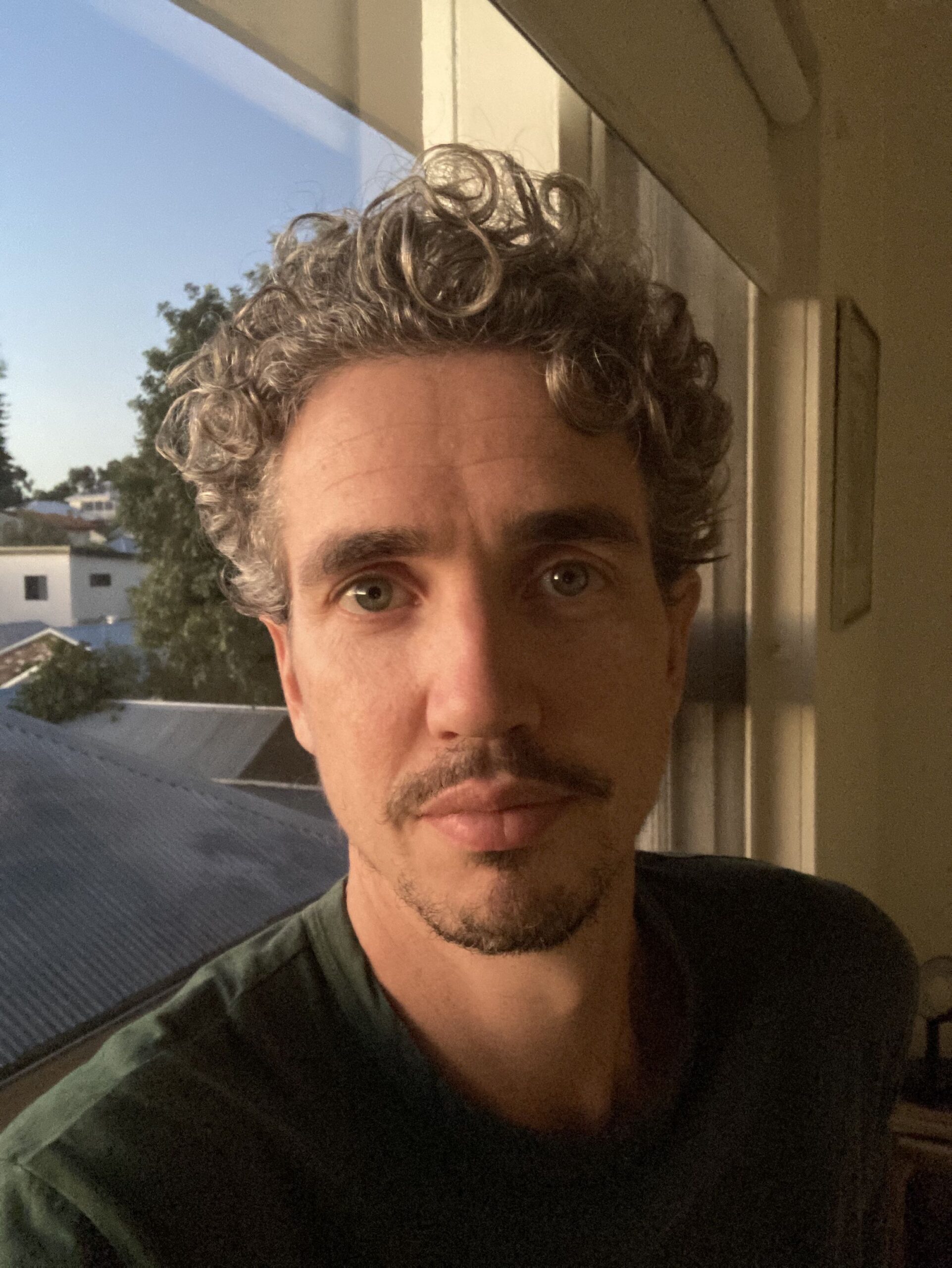
Selfie
My closest-to commune encounter was in a collective of fine art and architecture students who formed the Jacksue Gallery in Murray Street from 1995-1998.
We would have scorned the term Commune, but nonetheless we formed our own alternative world behind an opaque shopfront
I now work in the relentlessly mainstream world of state government planning, but there remains a commune-dweller part of me who can never fully believe that the way things are, is the way things have to be.
* Matt is an architect and urban designer working on the Metronet project at the Department of Planning, Lands and Heritage. Copies of Commune can be purchased at
The Fulcrum Press
, with all proceeds going towards projects within First Nations communities.
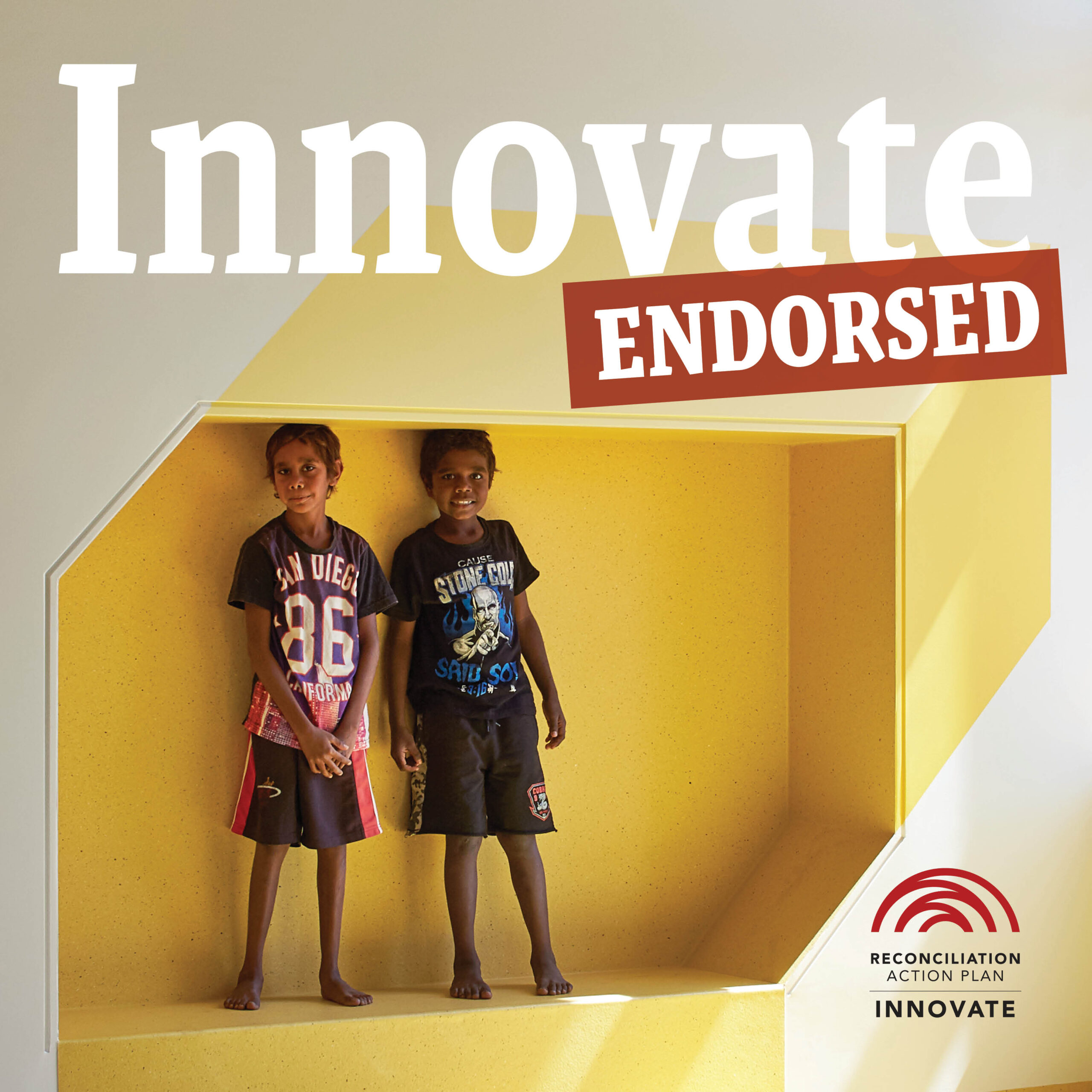
We are extremely proud to announce that our Innovate RAP has been endorsed by Reconciliation Australia!
The purpose of the Innovate RAP is to implement reconciliation initiatives, and from what we can tell, we are the only built environment design practice in Australia to be endorsed at this level.
Our Innovate RAP last for two years, and in that time, we have committed to the following major initiatives:
_Formalise cultural protocols we observe when visiting and working with First Nations communities. This document will be developed in such a way that it can be modified according to local context.
_Implement an education program that can be taught in remote schools to enhance students’ understanding of the built environment.
_Continue to offer pro or low-bono services to First Nations organisations for work of community benefit.
_Continue to contribute 1% of revenue to The Fulcrum Fund, which we established with the goal of funding projects in First Nations communities across Australia.
_Appoint a Cultural Governance Adviser to guide our approach to practice and project development.
In developing our Innovate RAP we had the opportunity to strengthen our Vision for Reconcilation:
TheFulcrum.Agency respects the diversity of Aboriginal and Torres Strait Islander peoples and acknowledges their long, continuous spiritual connection to their lands. We recognise that the taking of these lands has come at a significant cost to the culture and wellbeing of First Nations peoples and to an acceptance of our shared destiny
TheFulcrum.Agency is committed to using our skills in the built environment to build a reconciled Australia, where Aboriginal and Torres Strait Islander cultures are foundational to our national identity and embraced by our institutions.
Our vision for reconciliation in Australia is one in which Indigenous and non-Indigenous Australians live together as equals, enjoying the same benefits of health and well-being, the same opportunities for education and employment, and the same dignity of recognition and respect. It is vison for a country that acknowledges the pain of its colonial past while striving for a shared and optimistic future.
Our vision is led by all of our staff and is guided by the cultural authority of our clients and the communities with whom we are privileged to work. This shared work is motivated by a commitment to social justice and a desire to redress systemic racism and structural inequality.
Daily Practice
In our daily practice, we create opportunities for First Nations peoples to actively participate in the development of our cities and our regional and remote communities. We do this in several ways:
Strategy:
we provide strategic advice to Indigenous communities seeking to navigate local planning systems; and to non-Indigenous businesses looking to incorporate a First Nations perspective into their building initiatives.
Community Co-Production:
we insist that First Nations communities remain in control of the decisions that affect their lives and are at the forefront of the decision-making process.
Research:
we partner with First Nations researchers, communities and leaders to inform an evidence-based understanding of the relationship between the built environment and health and well-being.
Built Environment:
we draw on our skills in strategy, co-production and research to design places and spaces that care for Country on projects that directly improve the quality of the built environment in remote communities and our regional and metropolitan centres.
We are a small business that maintains an ambitious approach to employment practices. We foster a work environment that mentors emerging Indigenous creative practitioners and promotes ‘on Country’ cultural training for our staff. Our governance structure is overseen by First Nations experts in business and the built environment.
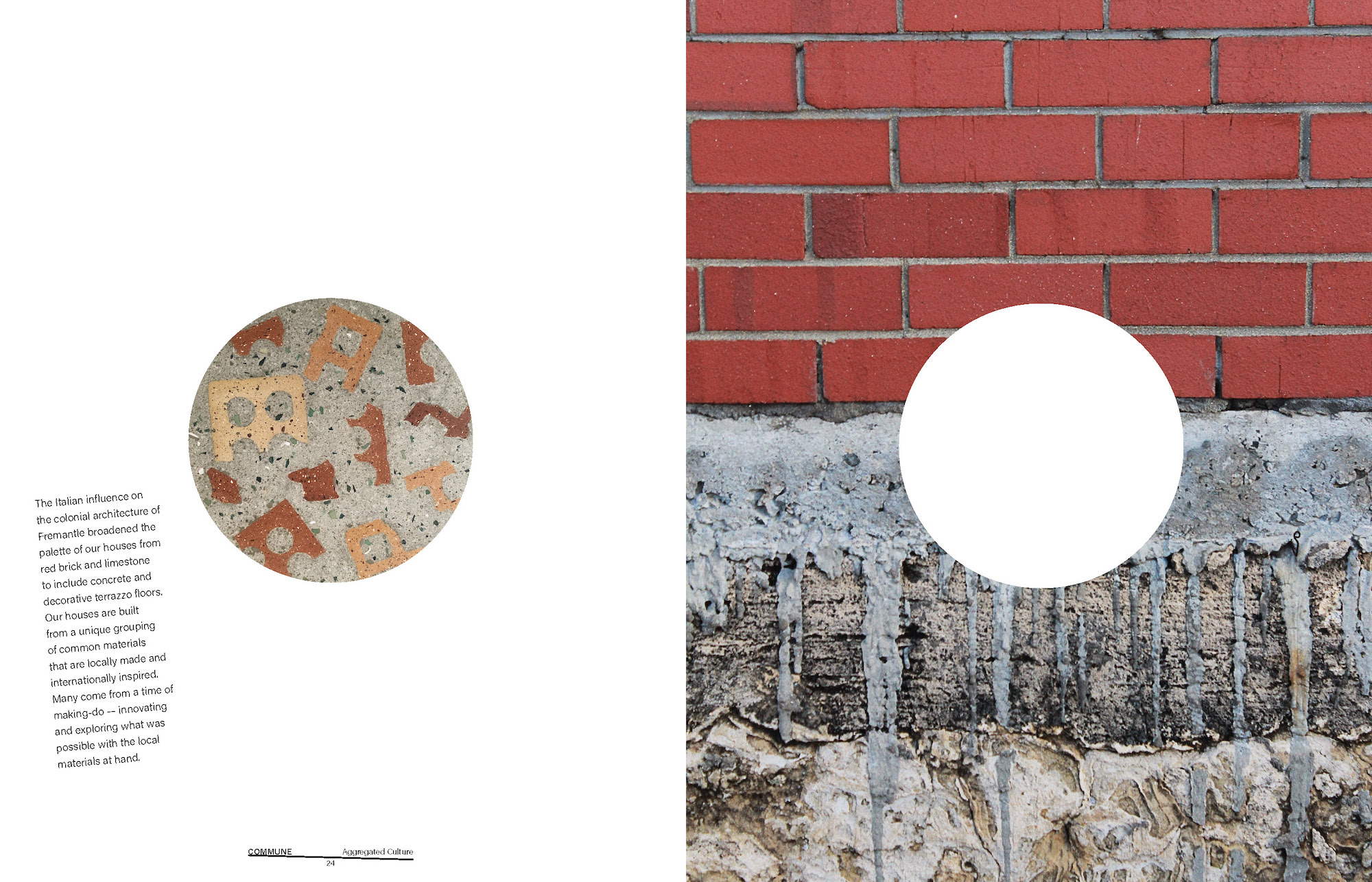
Fremantle, like port cities the world over, has always been a cultural melting pot. Terrazzo, which arrived in port with the wave of Italian immigrants, is the perfect metaphor for this rich communal mix. Focussing a contemporary eye on Freo and terrazzo, Gabrielle Howlett, Margaret Dillon and Jesse Lee created a series of functional objects for the home that were exhibited as part of the launch of Commune.
The Italian influence on the colonial architecture of Fremantle broadened the material palette of our houses from red brick and limestone to include arches, concrete and decorative terrazzo floors. Our houses are built from a unique grouping of common materials that are locally made and internationally inspired. Many come from a time of making do – innovating and exploring what was possible with the local materials at hand.
Graphic Design
The three of us have been particularly curious about terrazzo and its capacity to move between the decorative and functional, the local and international. Gabrielle Howlett from How Productive has long been fascinated by the story of the Scolaro terrazzo tiles made in Fremantle through the 50s and 60s at the Universal Tile Factory. Gabby approached Fremantle-based contemporary terrazzo makers Margaret Dillon from Concreto and Jesse Lee from The Terrazzo Tailor to create a functional product using their skills.
Together we have designed a limited series of terrazzo tableware revisiting the building palette of Fremantle and creating new connections to place and community. Bricks were salvaged from tips and verges, limestone and shells collected on walks around South Beach. Following tip offs from friends, there has even been the occasional raid on a loaded skip bin. These found materials are bound together in concrete allowing us to develop a unique terrazzo product that is very local, very Fremantle. Cast products produced in a traditional terrazzo method are polished to highlight the individual beauty of each material and equally expose the importance of unity. The grinding process reveals the delicateness of the most utilitarian materials, like fine sand and stone particles in brick clay.
Where materials such as brick are typically seen en masse as units of building, here we see only small parts, in section and polished. The humble brick moves from utility to beauty.
This project has been a collaboration inspired by the commune of Fremantle. It celebrates the role of the built and natural environments in creating a unique sense of place.
*Aggregated Culture was first published in Commune, issue o3 of our journal. Copies can be purchased through
TheFulcrum.Press
and all proceeds are directed to
The Fulcrum Fund
, a charitable fund that we established to support projects in First Nations communities.
Perth people, we cannot recommend this play enough. We went to see it last night (along with a handful of clients and connections) and each one of us came away in awe. The play deals with issues of domestic violence and is demanding of both the performers and audience. Despite heavy themes it’s totally engrossing. 60 minutes feels like 15. As our friend
Meri Fatin
said, ‘would watch again in a heartbeat.’
The show runs until the 11 December and only a handful of tickets remain.
Buy yours now!
In each edition of our journal*, we ask a handful of people to reflect on our chosen theme. This is Joseph London, the filmmaker behind the extraordinary documentary ‘The Beloved’**, on commune:
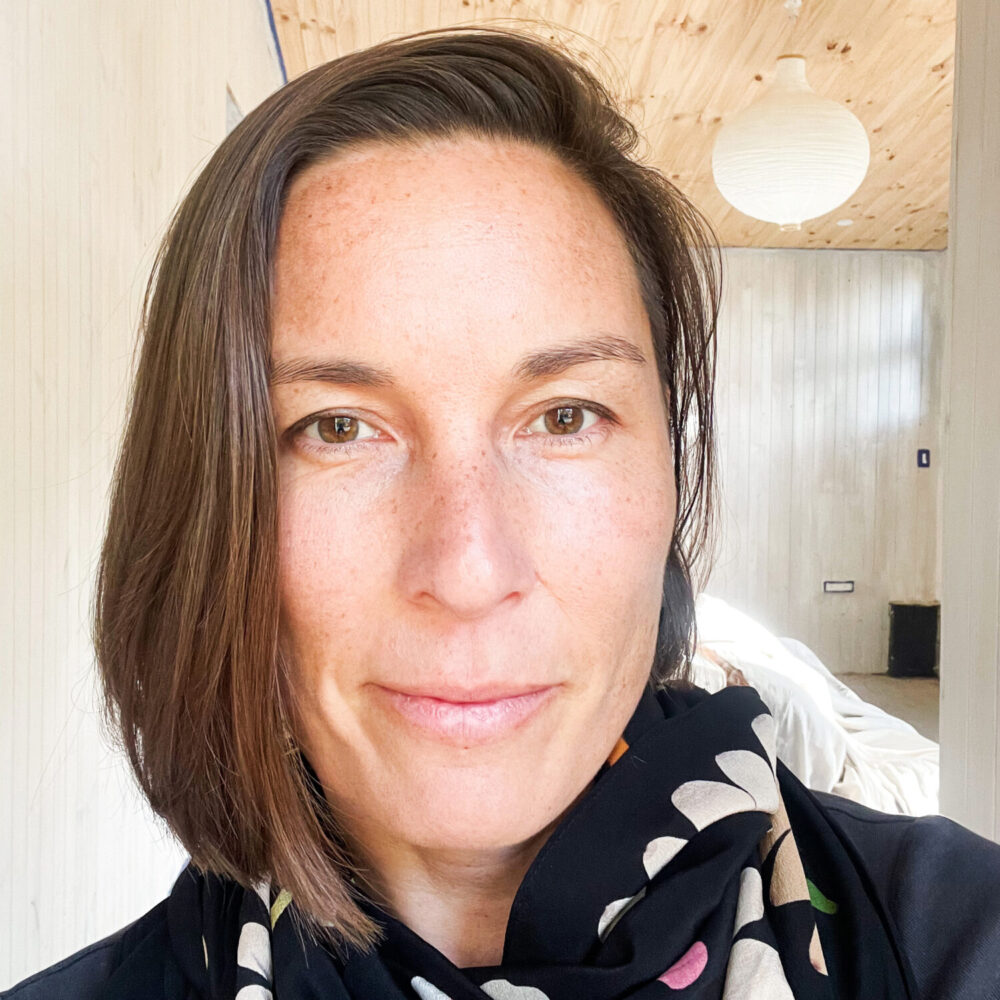
Selfie 2021
To me, the commune represents the promise of being relieved of the grinding effort to get big things up on your own, of joining forces and to be ambitious.
Current fiscal policies have lead to a chronic, and worsening, housing crisis. Here, TheFulcrum.Agency’s Kieran Wong argues that it’s time for radical new ideas that could allow ‘the market’ to heal itself.
It’s been over a decade since the release of the book
The Spirit Level: Why More Equal Societies Always Do Better
by Richard Wilkinson and Kate Pickett. In that time, the gap between the rich and poor in the developed world has grown wider. Despite the rhetoric of post-Third Wave social democrats, the grotesque disparities of the top 1% and everyone else seem to continue unabated. COVID-19 has only made it worse.
Why does inequality matter?
The language of inequality has started to change, with leaders like Boris Johnson now talking about ‘levelling up’ rather than ‘trickling down’ – but the underlying premises, systems and biases of neo-liberal economic management persist. The stellar trajectory of billionaires such as Bezos and Branson into space serve as direct metaphors for the rocketing differences between the rich and poor. And being poor is less uncommon than you think. In 2020, a study determined that 1 in 8 people (or 13.6%) in Australia were living below the poverty line – that’s over 3 million Australians (including 774,000 children under 15) below the median cost of living.
“The rich may fear the type of violence that characterizes highly unequal societies, but they are more likely to build bigger walls around their gated communities than raise the red flag of egalitarianism in response. It is the hard work of everyday politics – from community organizing to political education – that will bring about more equal societies.”
wrote Simon Black in the Canadian Dimension.
I am doubtful that we can wait in Australia for ‘everyday politics’ to make the changes necessary to really address the issues of inequality and disadvantage. Both major parties have walked off hand in hand from the battlefield for progressive tax policy. Disinformation and distrust characterise the relationships we now have with media, authority, and the rules of law. Meanwhile, governments are doing all they can to silence charitable organisations and welfare advocacy groups through legal and contractual means.
We know that access to safe, affordable, and permanent housing is a key determinant in social mobility, it drives economic productivity, improves health and education outcomes, and can break the cycle of disadvantage. Yet in Australia, the cost of housing is the biggest burden faced by the lowest quintile of income earners, whilst the highest have had their relative costs of housing reduced, thanks to record low-interest rates, ever increasing house prices and a regressive taxation system.
The Housing Challenge
Last year I accepted the role as Chair of Shelter WA, the peak body for an effective housing system and ending homelessness in WA. I started on the Board with what I thought was an understanding of both the drivers of, and some solutions to, housing inequities. The truth is I didn’t have much of either. It is not until you combine a working understanding of the cold, hard statistics with the lived experience of individuals, that you can start to grasp the effects that housing precariousness is having on our society, not just on those who cannot find shelter.
Over the past year, I have heard powerful testimony from our most vulnerable citizens and many facing housing stress for the first time in their lives. Working families who cannot find a rental home, people left behind in the COVID-19 pandemic – an ever-widening gulf between those with and those without in our society. This gulf is seen in many comparative statistics – mortgage stress, housing arrears, rental demand and demand for frontline services.
Across Australia, we have seen waves of housing booms making housing tenure precarious for many in the rental and private housing markets. The net effects of our taxation system, land delivery models, erosions of tenancy rights and the casualisation of labour is driving the gap between those who owned property before 2004 and those who came too late to the party.
Successive governments have failed to match supply with the demand for social and affordable housing.
Applications to public housing waitlists are increasing month by month. At the time of writing, around 30,000 West Australians are on it. Rental vacancies are at a historic low, with areas such as the regions at levels below 1%. The drivers are complex and intertwined but what is clear is that successive governments have failed to match supply with the demand for social and affordable housing. Despite a massive increase in demand and an ever-growing inequality gap in Western Australia, we have less public housing stock today than we did in 2016.
Of course, there is a simple political equation underpinning this. There are more people (voters) who own homes than those in the rental market or in public housing. As the often-primary mode of wealth creation, housing asset prices are fiercely protected by homeowners, and any move to make the housing system fairer, or more balanced, to open up affordable options, or change models of delivery is met by instant and vehement opposition. Governments do not have the political capital (or appetite) to consider a future without inequality.
And there is a philosophical belief underpinning this too – a belief in ‘the market’ as a system that is efficient, objective and can create greater outcomes through innovation. The market is often used a shield to describe why (or why not) certain opportunities may be possible. We are starting to see the pushing back of neo-liberalism ignited by Thatcher and Reagan and adopted here in Australia, but the power of its grasp means our institutions are still beholden to the notion of governments role being one to reduce red tape and let ‘the market’ get on with it. In the language of the market then, I wonder if it is possible to financialise and incentivise investment in affordable and social housing. Can we look to other invented markets that have done the same with other wicked problems?
What even is a market?
Markets are dynamic and challenging to pin down. Markets are not necessarily efficient or productive; they can be opaque, and often as a result of their complexity, can elude regulators from scrutiny. They can be seen as games played by people with a penchant for bending rules and betting on futures. From the entrepreneurial mind of Greek philosopher Thales betting on the future olive crop, to the Dutch futures market designed to hedge against losses from global shipping during the 1600’s, trading against a future event that is linked to tangle asset, underpinned the logic of futures trading until the 1980’s. I added a comma to the last part of the sentence but I’m not sure if it’s correct.
After the floodgates of financialization were opened in the mid 1980’s, some markets, such as futures trading, have become spectacularly decoupled from the tangible commodities that they were devised to hedge against. Like the wild daydreams of a ten-year-old boy, markets have emerged limited only by the imagination of the inventors, and at a speed that often eludes oversight. Futures markets trade (or bet) on changes to the weather, or the cost of shipping or other more bizarre possibilities. The ‘Policy Analysis Market’ was originally proposed by the US Defence Department to trade futures contracts based on political events or changes in the Middle East. “T
he theory was that the investment value of a futures contract on a particular political event reflected the probability that the event would actually occur – for example, the outcome of polls or elections. Some US officials claimed, however, that such offerings would encourage speculation on events such as coups d’état and terrorist events”
.
Although the market never made it to fruition, similar forms of political futures markets were proposed. After the Global Financial Crisis, US President Obama introduced a
“sweeping overhaul of the United States financial regulatory system, a transformation on a scale not seen since the reforms that followed the Great Depression”.
The resultant legislation (the Dodd-Frank Bill) sought to stabilise markets, protect consumers, and it also banned all futures trading based on events such as assassinations and terrorism.
So, could this wildly inventive market mechanism be used to address inequality? Perhaps our other shared societal challenge – the climate crisis – could provide a clue. For many decades the extent of the climate crisis failed to gain traction with politicians and policymakers using communication based on environmental science, economic logic, and social impact. Governments have sought to address the emergency through ‘market mechanisms’. A market was invented in response – carbon trading.
Hot Air?
Established as a result of the 1997 Kyoto Protocol, carbon emissions trading has had its successes and failures. Designed to limit carbon emissions (agreed to be driving global warming) market systems sought to offset high carbon emitters with innovative forms of emission reduction or carbon sequestration. Despite their rhetoric of ‘open markets’, governments have applied a political lens to regulations around emission trading, including the US withdrawal from Kyoto in 2001, and the changing nature of target settings for emissions to reach ‘net zero’. But for around fifteen years since 2000, the financialization of the carbon market created opportunities, leveraged funds for investment projects and delivered a mixed bag of results across the world. Importantly it imagined a financial market to address a human challenge and drive investment in assets and processes aligned to that goal.
What can we take from this as an idea to address inequality, or perhaps an element of its underpinning – housing? To develop a tradeable market, you need a system of measurement (ideally with a compelling counterfactual – i.e. if we don’t do something, this is what will happen) and you need agreements on targets to drive trading value.
Market inequality?
There are standardised measures, such as the Gini Coefficient, that track income distribution as a measure of inequality in society. More granular measures are taking form in the emerging system of Social Impact Measurement that seek to make a case for the long-term impacts of projects beyond their start-up and operational costs.
In the UK, measuring and reporting on social impact is now an essential component of taxpayer-funded projects, with business cases required to evaluate the long-term impacts of government’s capital expenditure. In Australia, this idea is gaining traction amongst funders who are now able to evaluate their investment in social services programs. The notions of a Social Return on Investment (SROI) require funders and developers to consider broader attributions of societal change through their projects. Measuring social impact is rapidly becoming better understood, more organised and more widely accepted as a method for determining project success. Accounting practices and consulting forms are expanding to meet the demand for such measures
Social Impact Bonds are another example of investment vehicle that can provide private financing into the social services sector. Investment is rewarded through evaluation of particular social metrics (such as lowering rates of imprisonments, or restoration of children to families) with the reduction in government costs in justice health education, etc used to provide financial returns to investors. Examples such as this have existed in Australia for almost a decade now. But Social Impact Bonds are long-term investment vehicles, reliant on stable government policy to ensure programs can be evaluated accurately. What is needed to address the housing crisis in Australia must deliver faster outcomes and be less prone to government policy mood—swings.
The response to the housing crisis must be able to deliver faster outcomes and be less prone to government policy mood-swings.
Credit where credits due
With secure housing becoming more precarious and the challenge of affordable housing now impacting the working poor, there has never been a more urgent time to address the crisis (sound familiar?). Delivering a mechanism that seeks to rebalance social inequality over the longer term through immediate investments in the drivers of disadvantage is critical. We must investigate models that can deliver responses at scale, that are market-led and that are lightly regulated by government to allow for agility, delivery, and value for money.
It could be possible to develop a Social Inequality (SI) Credit system – applied to a range of projects from infrastructure to financial products, to ‘offset’ outcomes that are currently driving the foundations of inequality. An example might be an infrastructure development project that includes residential accommodation, with developers required to provide through inclusionary zoning targets, a minimum number of these social and affordable housing projects?. If not fully incorporated into the development, a SI credit system could be utilised to offset this and aggregate housing funds to deliver projects at scale through other community housing providers.
Independent investment funds, such as a Social Housing Subsidy Fund, that seek to address the yield gap in rental costs and development costs for social housing could be the receivers of such offset credits, creating value for community housing providers to invest in the delivery of housing. Government-funded infrastructure would need to be evaluated for its social impact (using SROI) and could provide another form of offset funding, or seek credits, depending on its social impact and effectiveness in addressing inequality.
Governments have typically struggled to make the link between the burgeoning health costs of its citizens, and the supply of healthy, safe, and affordable housing. Despite decades of evidence that housing can reduce the costs on the health system, increase productivity and reduce inequality, governments seem caught in a market failure of their own making. Using SI Credits in the private market could correct this self-inflicted failure of bureaucracy by achieving societal impact through a range of market mechanisms, driven by ambitious targets to a net-zero inequality future.
An unequal Australia is to the detriment of us all, but as Simon Black noted, it will not be upturned by the wealthy (or political elite) through obligation or community spirit. A market that seeks to reduce inequality into the future should be part of the conversation. To recycle (pardon the pun) a line from the climate crisis – ‘if not for us, for our children and their children to follow’. A market designed and scaled to reduce inequality and deliver a more just world – imagine that future.
For me, a commune is an intentional community with shared values, resources, knowledge and responsibilities.
In each issue of our journal, we ask a handful of people to reflect on our chosen theme (and provide a selfie of themselves!). This is photographer, friend and Kieran’s sister, Bo Wong on commune:
When I was 16, I left Fremantle to live on a commune near Walpole. I ate a lot of lentils and magic mushrooms, so despite being an idealist with the values of self-sufficiency, I couldn’t offer the other elements that a successful commune needs – the resources, knowledge or responsibility.
My husband grew up on a commune in NSW and we met on a forest blockade in Tasmania in 2001. Blockades are essentially travelling communes that sprouted up all over Australia in the late 90’s and early 00’s. Living together without electricity or sanitation in every state of Australia, I got to know myself and others, really well. We navigated de-escalation strategies, rope tying, children, painting, politics and poo together. In hindsight, it set me up pretty darn well for my current commune, family life.
Copies of Commune are available for purchase via
TheFulcrum.Press
. Revenue generated through journal sales will be distributed to First Nations community projects through
TheFulcrum.Fund
.