ARCHITECTURAL WORK CULTURES: PROFESSIONAL IDENTITY, EDUCATION AND WELLBEING
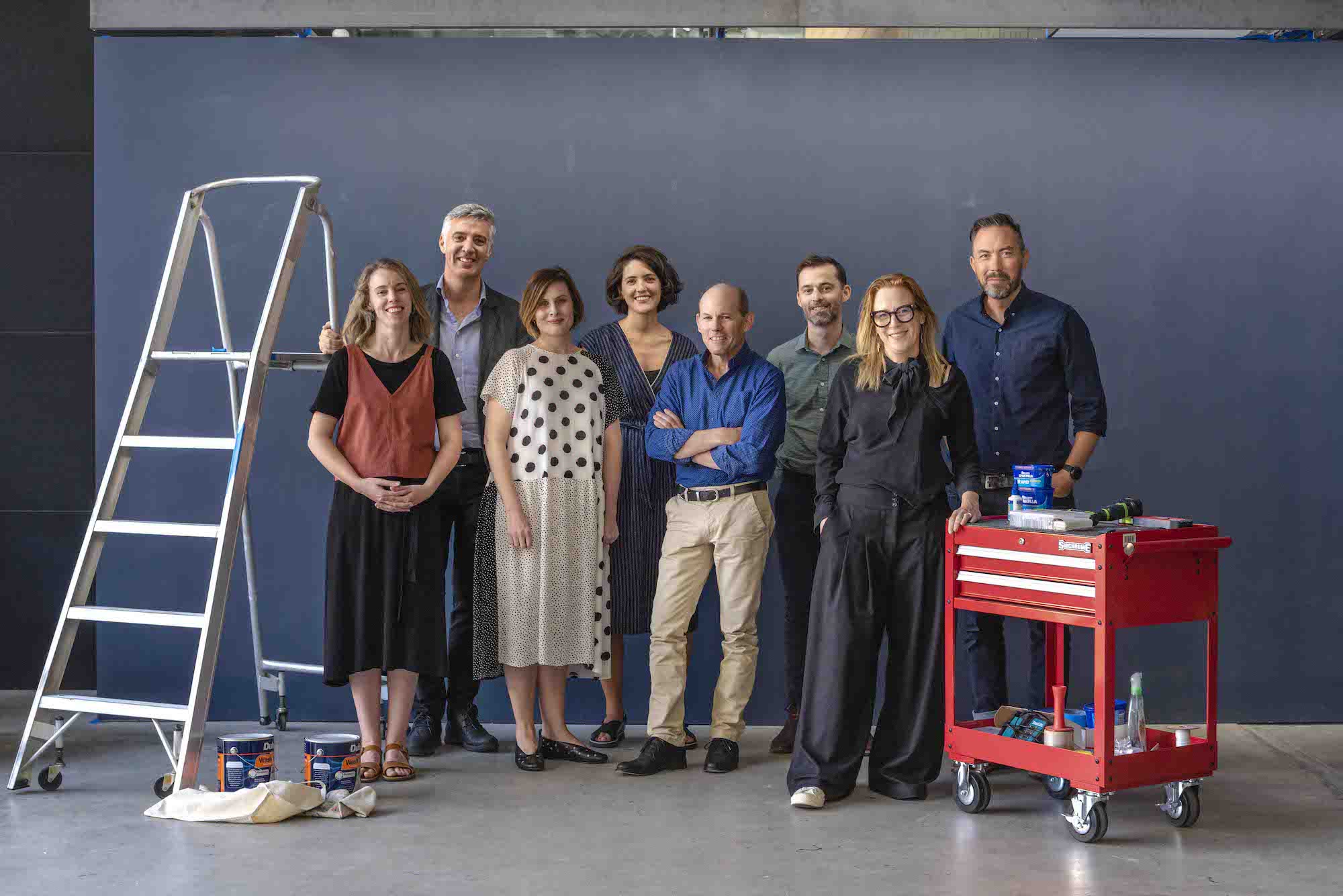
TheFulcrum.Agency is proud to join BVN, DesignInc, Elenberg Fraser, Hassell and SJB as a research partner in a new project addressing the link between workplace culture, identity and wellbeing in architecture. The project will be led by Professor Naomi Stead at Monash University and has recently received funding through the Australian Research Council’s Linkages Projects scheme.
The aim of the research is to determine exactly what effects – both positive and negative – result from work cultures and professional identity in architecture. More than this, it will go beyond knowledge to action in the profession. The intent is that it will lay the foundations for practical improvements in the future.
In an article first published on
Parlour
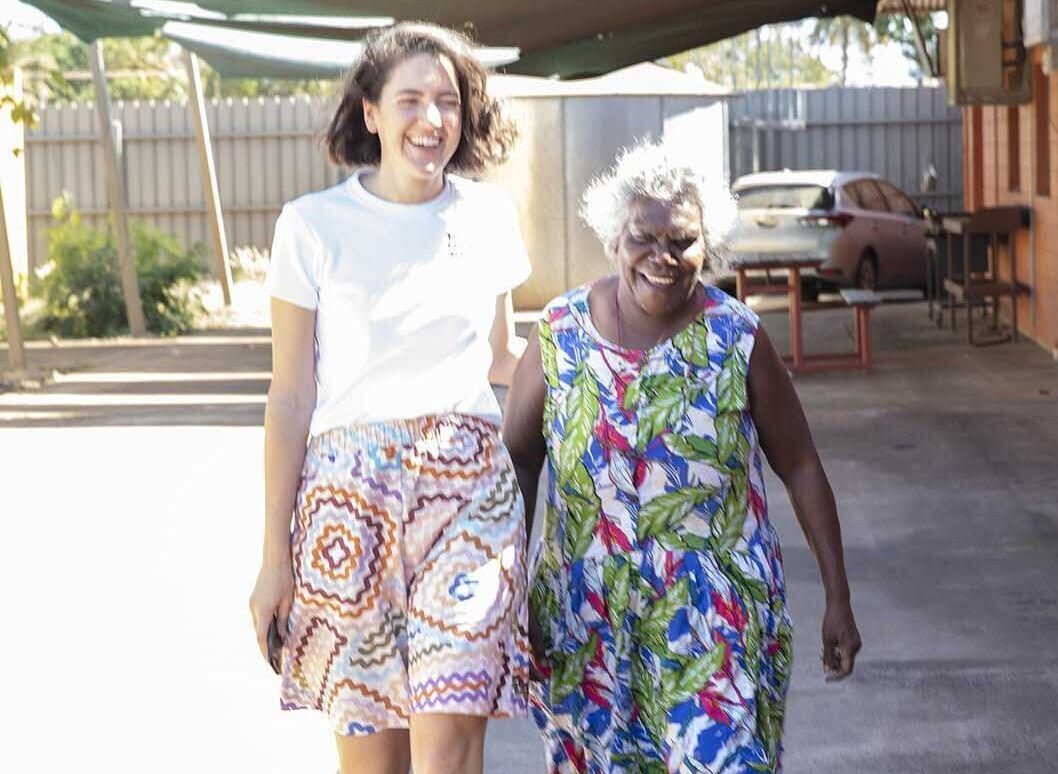
, TF.A Associate, Heather MacRae reflects on her work in Groote Eylandt, where she discovered unexpected strength and opportunity in being a woman architect in remote communities of far north Australia.
Image: Bo Wong
For the past five weeks, thanks to the COVID-19 crisis I have been working from home. While I miss the buzz of our lovely small studio, I have been able to reflect on my two and a half years working in remote communities in the Northern Territory. My experiences have ranged from facing some seriously sexist behaviour to finding and learning to honour the power of being a woman working as an architect. In the past, rather than share my experiences with colleagues, friends and family I have tended to keep them to myself as it was so far outside the reality of many in my network.
In 2017, I started work on a series of housing and community infrastructure projects in a number of remote communities in the Northern Territory, which saw me travelling monthly for over two years. All these places are incredibly complex social spaces with personalities and history that would take an age to fully comprehend. Communities are made up of fly-in fly-out workers, consultants, short (aka “they won’t last long”) and long-term resident workers. Most people are ‘from’ somewhere else and there tends to be a lot a “seagulls”: white folk who come in, make a mess and then fly away again.
Importantly, there is also the local Indigenous community – a complex, political layering of family and clan groups, Elders and Traditional Owners to name a few. Despite initial advice that many Indigenous communities are patriarchal and that I might need to take the back seat, the level of respect I felt was incredible and I never experienced an imbalance in the way I was treated. I came to learn about the different roles that men and women occupy within their community as a part of their culture. I saw how the ideas of family and gender were different to our western notion. I was continually amazed and inspired to see the sacrifices made for family, particularly in periods of grief or hardship.
I have spent my architectural career, both in education and practice, believing that my gender does not define me. I can say that for the majority of my professional career I have been very fortunate to not be significantly impacted by workplace bias or gender stereotypes. There have been occasions that my hand isn’t accepted as unreservedly for a handshake as my male colleagues, but I have always worked within teams that don’t accept that behaviour and have always been provided with support and encouragement.
Transitioning to a remote environment, I was suddenly faced with a series of new challenges as a young female architect working in a white ‘hypermasculine’ space.
I have had older white men ask me why I am not married and I have been faced with unsolicited feedback as to why this is the case! I have been repeatedly called sweetheart, love and darling and, on occasion, have been bypassed for information or input on projects that I am managing. All of this behaviour has been directed to me by older white men – most in positions of authority!
The gender imbalance in the construction industry is compounded in these locations and I often found myself being the only woman in the room. Sometimes I felt like I was not being taken seriously. It seemed to me that some men were just not used to working with a woman professionally and were unsure of how to manage or adapt their communication skills in a situation new to them.
There was also a general feeling of unease. When staying in accommodation generally used to house FIFO workers (known as ‘single men’s quarters’ for good reason) I had to get used to inquisitive stares. Nothing untoward – there was just a sense that you are of interest for the wrong reasons. I found myself retreating to a position of being on guard and having to sit with the reality that it was going to be extra hard to push through gender bias.
I stood my ground as firmly as I could, but there were so many other factors at play that made it difficult to properly address the sexism that I faced. The pressure of deadlines, compartmentalising the traumatic third world conditions I found myself working in, extreme cultural differences – not to mention the intense heat and humidity.
The first trip I did alone, without my male director, was an eye opener. I was on guard, fearful that this could be the moment where comments and prejudices could tip me over the edge. But, surprisingly, something else opened up. The trip involved significant consultation around community housing and many conversations with local Indigenous women. Suddenly, I was privy to an environment that I hadn’t been previously, because I had always been in the company of a man. In this all-female group, women spoke to me in a way they had never done before.
Image: Kieran Wong
The floodgates had opened. I felt incredibly humbled to be a part of their discussion; listening to their stories and sharing experiences. It was heartbreaking to hear their struggles and to realise I probably will never (hopefully and no doubt statistically) experience such adversity. It was not just the difficulties that came through but strength and compassion as well. For the first time, in this remote environment, I felt safe. I no longer had to be on guard or worry about not looking ‘professional’ or having to prove something or assertively stake my claim. As the background noises softened, I just had to be truthful and honour the mutual respect. It was refreshing.
I had been so used to striving towards a space where we can see beyond the gender roles in architecture – and then suddenly I am embracing them? This didn’t come naturally to me and I found myself resistant at first. There was a tension in thinking that I had to be a certain way to move past the sexism and bias to be recognised in my industry. This, of course, is a universal issue faced by many professional women striving to succeed in a male-dominated world.
It was only when I started to work in a space that required me to be so strongly connected to my gender, that I could clearly see the problems with this approach. I could see that in the process of gaining respect and professional standing in the male-dominated construction world, I was closing off opportunities and losing too much of myself. By learning to embrace my womanhood, opportunities opened up and my work improved. I acknowledged that it’s OK to be in a space where I am the person who needs to have a conversation with women about how their kitchen works, how they bathe babies, and what family life at home is like. If I couldn’t connect and gain the trust with the women I worked with, who would be there to listen to their stories and ensure designs respond accordingly?
Gender doesn’t define us but, as I have learnt, in certain environments there is strength and opportunity in being female. This experience has taught me that good relationships are founded on equity and mutual respect. Not just in the space of gender, but culture as well. My experience of working in remote communities has been both incredibly challenging and enriching. Despite all the sexist remarks and behaviour, I have developed some of the strongest relationships of my career. Working so closely with Indigenous communities has been personally fulfilling and gaining the respect of the non-Indigenous, predominantly male community has been a lesson in empowerment.
A word describing change through action, and with a growing importance in a world where there is an increasing awareness that our actions or inactions have real consequences…
…or an Ad Agency – and Don Draper ‘suaving’ through his day, with a whiskey before lunch.
Beyond my work at tF.A, where we are engaged in projects seeking to create enduring social returns, my ‘hobby’ as a volunteer presenter on Local Community Radio RTRFM connects me to an organisation dedicated to promoting a strong, diverse, and local voice in the Perth media landscape. Despite the early morning (‘Snoozebutton’ 4am!!), I enjoy contributing to the station and the important social impact that they create.
Demonstrating the value of design is an issue that plagues the architectural profession. As architects, we have a deep understanding and conviction that design matters, but how we demonstrate this to our clients and communities is less clear. TF.A Principal, Nick Juniper unpacks our new approach to quantifying the value of design.
Last year I attended a training course on Social Return on Investment (SROI). This is a methodology that describes the changes that result from the implementation of a project or service and then places value on those changes. It enables service providers to identify and value the outcomes of projects which would normally be overlooked in a typical return on investment or cost/benefit analysis.
Curiously, SROI is rarely used to describe built environment projects, the design process or design outcomes. At TF.A, we saw an opportunity to build on the principles of SROI and enhance the methodology with an emphasis on design. Our working title for this new way of thinking is ‘Social Return on
Design
Investment (SRODI)’. We are utilising an evidence-based approach to quantifying the value of the project design outcomes.
As design thinkers and practitioners, we are strident advocates of good design; of design that is consultative, iterative, and responsive. Utilising the principles of impact assessment analysis through a SRODI process, we believe that it is possible to answer the question – what is the value of good design? To demonstrate, we hope to apply this analysis to our work for the Anindilyakwa Housing Aboriginal Corporation (AHAC) in the Groote Eylandt Archipelago in the Northern Territory.
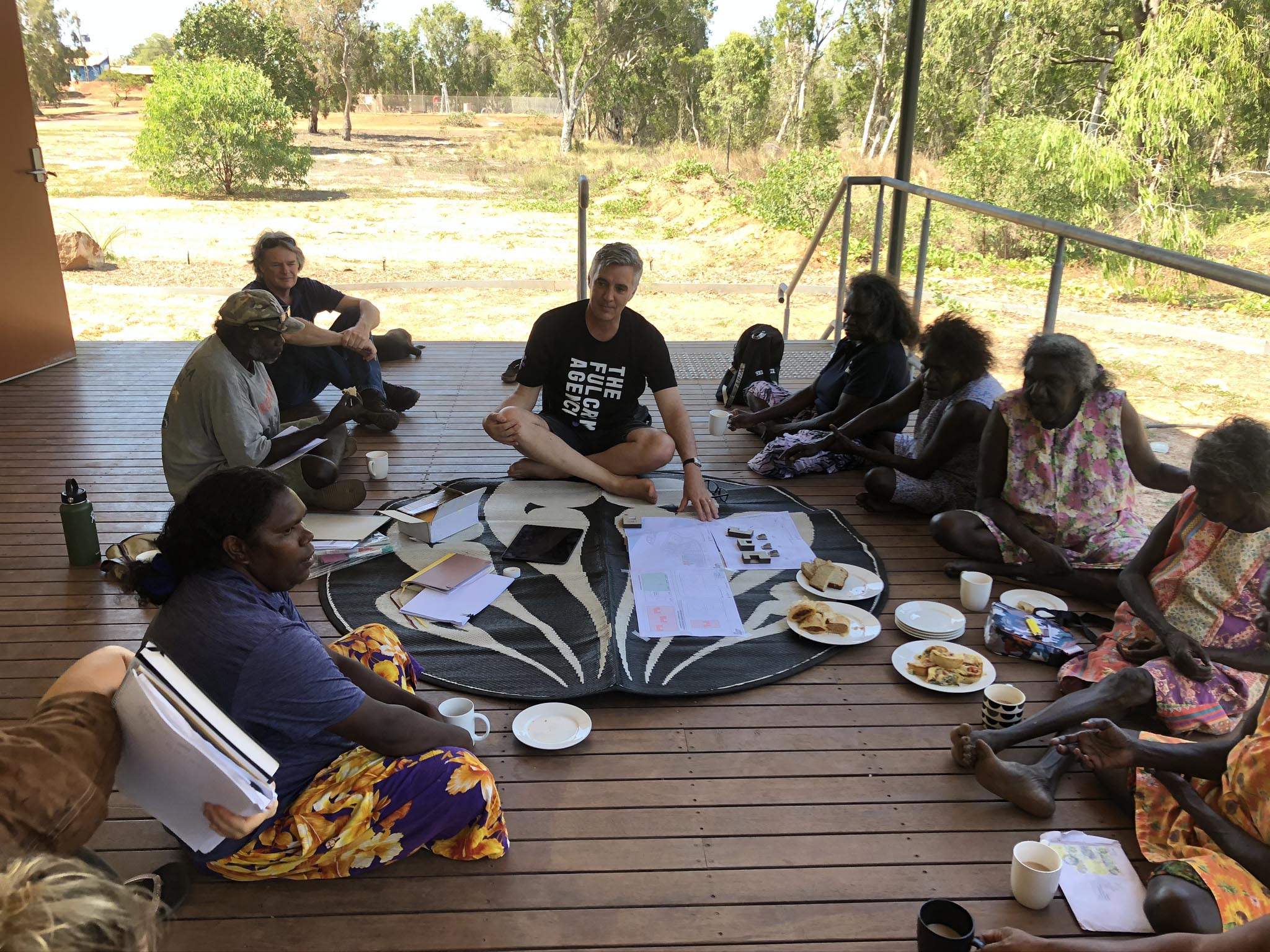
Nick Juniper in conversation with members of the Housing Reference Group and future tenants in Umbakumba, NT
Since 2016, we have been working with the Wanindilyakwa People on a
Housing Masterplan Study
that culminated in the design and construction of new series of houses. These houses have been designed in collaboration with local community housing reference groups and community members and respond directly to the problems surrounding existing housing stock. The new community residential subdivisions and house designs incorporate important aspects of culture and country, and the delivery of Stage 1 and Stage 2 was enthusiastically welcomed by community.
Over the next several months, as the tenants occupy and inhabit the houses, a series of carefully crafted surveys are proposed to gather feedback and understand what has changed for the residents. What are the material (relevant and significant) changes that they have experienced that can be attributed to the new house designs? Do the new houses mean that they are happier, healthier and able to lead a stronger cultural life, connected to family and respectful of cultural protocols?
There is also a financial value to conducting this sort of analysis. Utilising the principles of ‘Stated Preferences’ and ‘Financial Proxies’ found in a typical Social Return on Investment analysis, outcomes such as improved social connections, happier family relationships, or stronger cultural lives can be given a dollar value. Doing this provides our clients with valuable return on investment data and helps to build case for future capital works expenditure and project feasibility.
We are excited to have the opportunity capture and describe all the social and cultural outcomes that these new house designs have created. Through a rigorous application of the SRODI principles, we will be able to determine the value of these outcomes and establish where we have made the biggest impact through design.
In an article for the Association of Consulting Architects, TF.A Partner, Emma Williamson, explains how the consultancy is responding to COVID-19 and offers advice about how to proactively manage through a crisis while maintaining the cultural integrity of your practice:
https://aca.org.au/article/fulcrum-agency
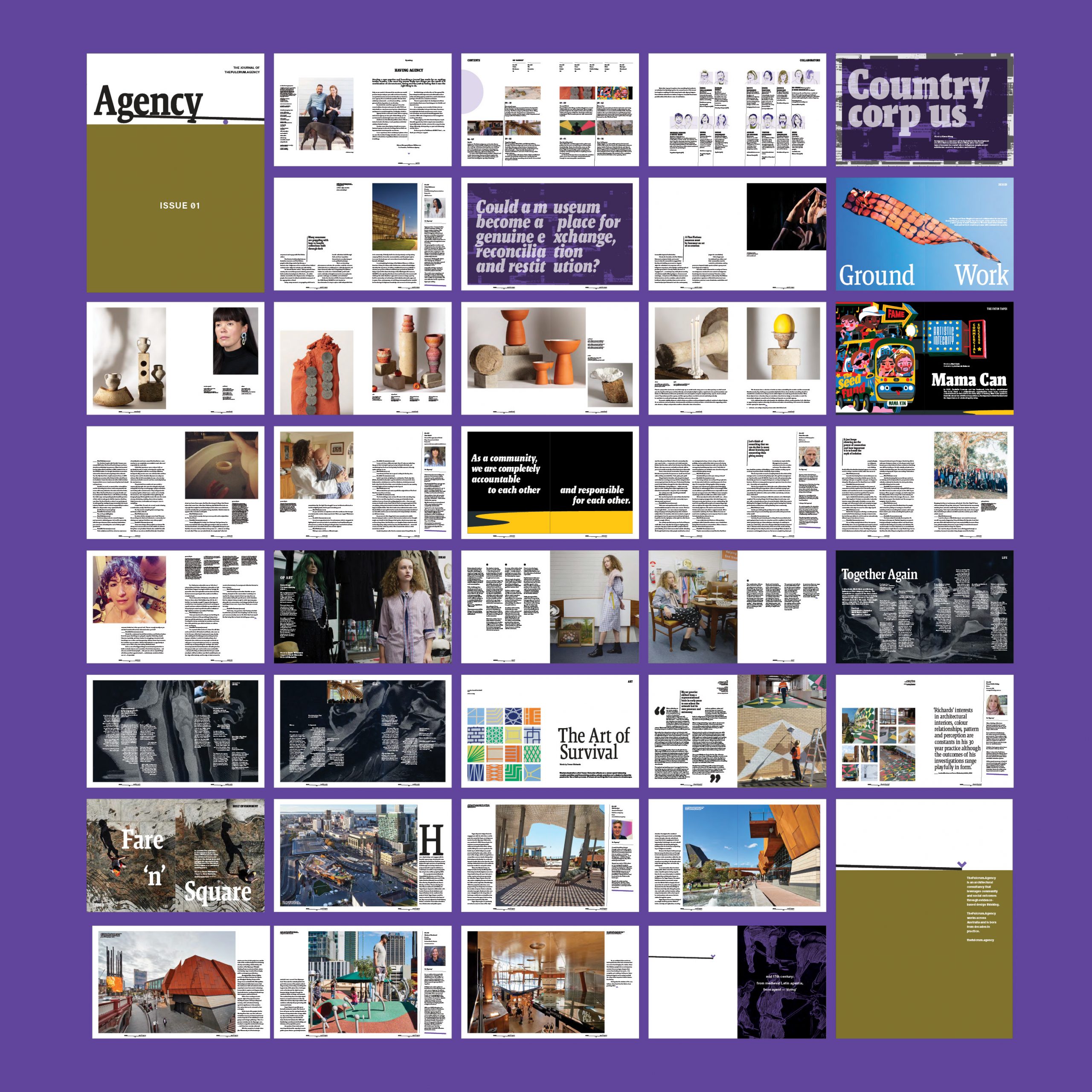
Starting a new practice and launching a journal has made for an exciting 12 months! Like most big moves these two things are the result of a combination of circumstance, timing and the (naïve) feeling that it was the right thing to do.
191216_Agency Journal_Overview_purple bg
Early on we created a framework for ourselves: we would produce two journals per year, with each issue focussing on a particular word, and we would describe our business as an agency. For an architecture practice this has been relatively controversial – or at least unsettling – and has generated lots of questions in our direction!
So, what better word than AGENCY to focus the second edition of our journal around. As with PIVOT, we started with our own loose meaning, have delved deeper and have learned so much through the contribution of others. AGENCY is both a noun and a verb. To be an agency and to have agency are two quite distinct things, yet for us we are interested in what it might mean to be and do both.
Architects are the ultimate problem solvers. We are trained to look to the future and to ask the question, ‘how can we build something that uses so many resources and so much money if it is redundant as soon as it is finished?’. It makes sense then, that we should use our professional agency to advocate for things that we think are important. In our experience, this is not always in places where we wear the ‘architect’ badge, but rather when we use our skills to seek solutions to problems that are not answered in buildings.
And this brings us to the allure of ‘the agency’. We have always loved the dynamic and collaborative nature of the advertising agency model. It is a world of structured pairings, of freelancers, networks and teams. There is a generosity in the development of ideas and a freedom that comes from being part of a flexible and dynamic team. As an Agency, we are creative thinkers, but we also make a declaration to be part of a team. Sometimes we might take the lead, sometimes we create a team and sometimes we are part of something greater than ourselves. With each arrangement, we find energy from working with others.
To have agency is to find a kernel of power, to pair this with opportunity, to find a way to move (sometimes by stealth) towards a better outcome. It is a way of seeing things differently, of interpreting our past and influencing a better future.
So far so good on The FULCRUM AGENCY front – we thank you all for your support.
We’ve just returned from our Christmas and New Year break which we spent watching the catastrophic bushfires in horror. Fires are burning in WA – Bluff Knoll was just closed indefinitely due to the extensive fire damage – but thus far, WA hasn’t been impacted to the unprecedented level of the east coast. These fires are a national disaster.
We are deeply saddened by the loss of human life, animal life and the destruction of so much incredible country and community.
Our Principals, Emma and Kieran, know through bitter experience the trauma of losing a home in a bush fire. The subsequent clean-up and restoration requires an effort akin to a marathon, and the emotional impact is felt for a very long time.
We are thinking through how to make the most impact using our financial and professional resources. At a micro level we’re going to start sewing wildlife rescue pouches using a template provided by the @animalrescuecraftguild.
What we do know is that the fires have taken over our minds and hearts, and that this tragedy has changed the direction of 2020. We are committed to giving and supporting the devastated communities and country in a meaningful way, with impact and dignity. We will let you know what we decide to do next.
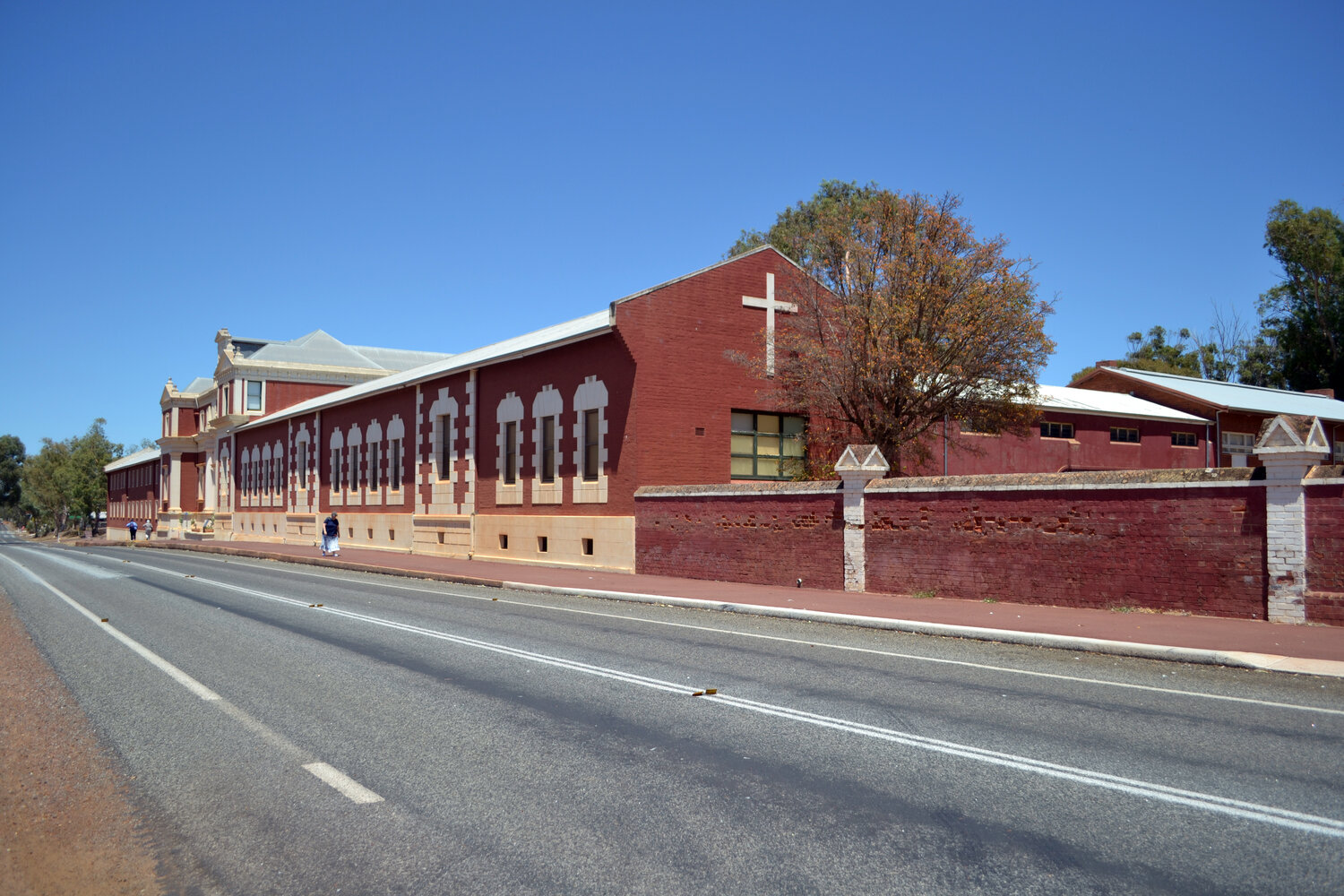
Late last year, TF.A Principal, Kieran Wong, was interview by Frances Silberstein for an article she was writing on the topic of architecture and reconciliation. Frances is a recent graduate from the Master of Architecture program at UWA, with an interest in the relationship between First Nations Australians and architecture. This article was written following her return from an extended period overseas.
St. Joseph’s College for Aboriginal Girls, New Norcia
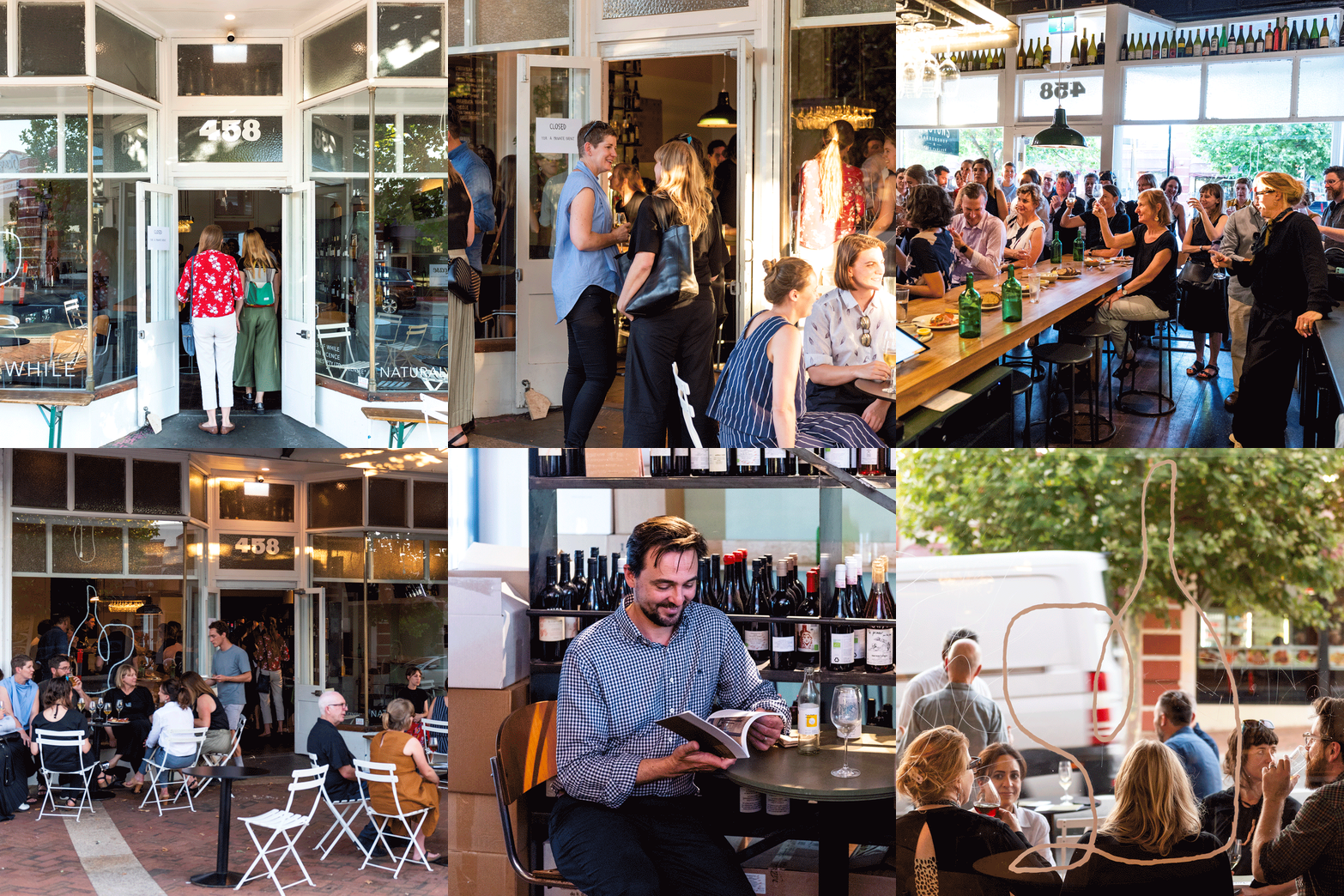
A couple of weeks ago we invited a few people to join us at
Wines of While
to celebrate the launch of AGENCY, issue 01 of our journal.
We’d had a big party to launch PIVOT and thought that a quiet glass of excellent wine might be a better approach as we head into the festive season.
TF.A Principal, Kieran Wong, said a few words on the night, which we’d like to share here:
I want to acknowledge that we are on Nyungar land, country that was never ceded, and that colonisation is an ongoing action which requires us to be wary, and always open to new counter-measures…
So, the Fulcrum Agency was officially launched on Monday December 3rd, 2018 – that’s actually 238 working days….and we’ve managed to pack quite a bit in…
We’ve been busy growing an incredible team, working on projects from the NMP in Perth, to QAMPI in Minjerribah, Qld and across the Northern Territory – from Elliot to Maningrida and of course, Groote Eylandt. We’re enjoying collaborating with partners such as Lyons Architecture in Melbourne, KPMG in the NT and locally here with Mt Eyk and Arcadia.
We were Founding Signatories to Architects Declare Australia – calling for recognition and action on the climate emergency that faces all of us. I recently joined a panel with Peter Newman on what we can do in WA to radically and immediately change our fundamental operating model in the built environment.
We established the Fulcrum Research business, with Dr Jen Lorrimar-Shanks leading the initiation and scoping study for us on a measurement tool to be used in public and social housing.
We conducted a community housing survey in language across major communities in Groote using local Traditional Owners and Indigenous participants.
We are Principal Investigators on a joint Research Pilot with the University of Queensland and Monash, researching best practice design models for quality of life indicators on the Room to Breathe program, funded by the Northern Territory Government. The RTB program is close to our hearts, having written the Program Guidelines.
We are partnering with Monash on an ARC Linkage Grant on a large scale study of Mental Health in the architectural schools and workplaces.
Emma and I are co-directors of next year’s National Architecture conference, to be held here in Perth – the theme is ‘
leverage’
(cute, I know, from us Fulcrum types) and we are excitedly connecting with activists, writers, politicians, designers and thinkers globally to bring some of the best minds to Perth next year.
So – onto the Journal – yet again, the making of the journal has highlighted the incredible creativity, ingenuity and generosity of our contributors – as always, we have looked outside of architecture to learn from people and projects that inspire us and create impact.
It’s called Agency – and of course we love this word…it’s a noun and verb – to BE an agency and to HAVE agency are two distinct things, yet we are interested in how we can BE and DO both!
Coming into the end of the year can be a blur, but we are trying hard to keep a longer view – about what we can do next – the Agency is committed to make positive impacts across our profession, and more importantly in communities in which we work.