An architect, a lawyer and an accountant walk into a bar. The bartender looks at the three women and says, so, who’s in charge here?
Reflecting on my pivoting career—as architect/educator/researcher/leader—I return to the opening lines of my recent book chapter in Visual Spatial Enquiry, (Creagh and McGann 2019). An important pivot-point for me has been to question who is ‘in charge’ of our built environment and where the role of responsible stewardship and strategic decision-making sits. I am convinced that building design, good and bad, has a causal effect on the social patterns of the people that live, work and occupy, or are excluded from, our built environments. Looking back, and projecting forward, the pivot upon which I rest and turn is the strategic agility and critical thinking first fostered in my architectural education and now employed in research and leadership.
*Prof. Sarah McGann is Dean, School of Arts & Sciences at Notre Dame University, Fremantle. Her musings on the word Pivot appeared in issue 00 of The Fulcrum Agency’s journal.
In July 2017, Scott Ludlam resigned from the Australian Senate after he was made aware that he held joint Australian and New Zealand citizenship, rendering him ineligible to hold elected Federal office.
In this article first published in our journal, PIVOT, Meri Fatin spoke to Scott about life since his very public career change and the potentials of contemporary activism.
Meri Fatin [00:00:00]
Scott, you’ve been away from Perth for well over a year. Where the bloody hell are you and what are you doing?
Scott Ludlam [00:00:10]
(laughs) At the moment I’m camped up in southern New South Wales in a really beautiful part of the world, working on a book. I left Perth in January 2018 so it has been a little while.
first light
Meri Fatin [00:00:23]
And tell me about the book.
Scott Ludlam [00:00:27]
Well it’s the first time I’ve ever tried to write anything longform and I spent nearly all of last year travelling around the world talking to social justice organisers, peace activists, architects, journalists, Greens MPs and candidates from global Greens parties and I’m trying to synthesize that together into something that hopefully will be useful… even if it’s just useful for me.
Meri Fatin [00:00:55]
So how did the book come about?
Scott Ludlam [00:01:04]
I was approached to write something and then I made a suggestion that it be something along these lines and they were like okay, sounds crazy, go do it.
Meri Fatin [00:01:12]
So how would you best summarize it then?
Scott Ludlam [00:01:25]
I guess what I’m most interested in is how social movements and political processes deliver change – or don’t. You know, we’re at a really important moment in history where, unless we’re able to unlock political power, the 21st century is going to be a very dark place. Unless we’re able to mobilise on a scale that we simply haven’t seen for a while then we’re going to cop the full force of climate change and all of the political and economic consequences of that. So, what I’m interested in, I suppose, are the kind of historical andcontemporary ways in which social movements and political machineries either deliver change or are used to prevent it.
Meri Fatin [00:02:18]
When you talk about mobilizing, what would you regard as sufficient mobilizing to actually generate some change now?
Scott Ludlam [00:02:28]
So, a mobilization that wasn’t successful was the campaign undertaken by millions of people in 2002 and 2003 to prevent the invasion of Iraq. That’s an example of a mobilization that was enormous, it gathered pace very fast. History has proven that we were absolutely right to do that and that we didn’t institutionalize any kind of outcome. The invasion still went ahead. It was clearly unlawful under international law and it cost hundreds of thousands of people their lives. And so, I’m interested in mobilizations that hit critical mass and are able to push over an outcome, whether it be the Arab Spring uprising in Tunisia where a dictator was toppled and now a democracy exists or, you know, the interesting kind of processes and success of the Occupy movement from 2011.
What can we learn from movements around the world? Oneinteresting expression at the moment are the children striking against climate change. They’ve read the paralysis and they’ve taken action without asking for permission and it’s a really, really interesting development.
Meri Fatin [00:03:41]
You’ve talked about how that kind of activism with kids involved is a new challenge for the establishment.
Scott Ludlam [00:03:50]
Well it clearly is. It’s caught the establishment completely wrong-footed and I mean in this countrythe establishment isn’t simply preventing climate action, it seems tobe trying to accelerate it (climate change). It’s trying to accelerate the worst kind of climate consequences imaginable in hanging onto coal, in accelerating onshore and offshore gas extraction. You know, mainstream politics has completely failed to deliver an outcome and so hundreds of thousands of kids from primary school, high school and uni students have just taken it upon themselves. I don’t think the establishment has any idea what to make of it.
this place is turning me into a morning person
Meri Fatin [00:04:40]
And also, the establishment is still, to some degree, trying to ask the general population to turn a blind eye to what these catastrophic consequences might be. Would you describe what you see transpiring that is so alarming? What you believe is an actual reality, say over the next 20 to 50 years?
Scott Ludlam [00:05:08]
I think unless we’re able to change course dramatically what we’re going to see over the next couple of decades is the age of climate disasters, super storms, droughts, fires, heatwaves and so on that we’re already seeing with less than one degree of average warming. And what that does, is it pushes people across borders. It accelerates the breakup of fragile states and ultimately it starts to inundate coastal sediments and destroy agricultural regions. There’s no real precedent for that on a global scale. We have no idea what that drives us into. Apart from that it’s unlikely to be very good.
Meri Fatin [00:06:11]
In these conversations that you spent last year recording, was there any solace where you felt there was some genuine progress being made? Some sort of genuine movement being created that might actually offer some hope?
Scott Ludlam [00:06:27]
Absolutely. Even in places where they’re really up against it, there’s hope. Not false or blind hope but hope with action and hope with a plan, all over the world. I was able to drop in on a conference of Young Greens from right across Europe, where these young people have grown up with climate change as a part of their lives, and the failure of political processes is also part of their lives. What they’re turning the green movement to in Europe is something incredibly exciting and very practical. Something that we can learn from. But then I’ve also spent some time in Jharkhand in the eastern part of India where campaigners are trying to prevent an expansion of uranium mining and the imposition of a huge steel smelter on their land and their stories of struggle were just as inspiring, you know, opposite sides of the world working very different ends of the problem but incredible resourcefulness, courage… and some success.
Meri Fatin [00:07:49]
Coming from the idea of mobilisation and asking you now with your activist hat on, what do you miss about being a parliamentarian?
Scott Ludlam [00:08:07]
I think what I miss the most is having access to the kind of machinery (of parliament) and particularly the team. It’s an incredibly talented and very motivated group of people that I’ve been privileged to work with. You have one foot inside the parliament building and then one foot in all the other campaigns and community groups and other kinds of things that you want to support or be able to provide some backup to. Being able to do that with a measure of resourcing and the levers and the machineries of Parliament is something that you can’t really place in other walks of life.
Meri Fatin [00:08:46]
Do you feel that you can still make a difference from the outside though? It’s known that changes, big changes don’t happen from inside government. They happen from agitation from the outside.
Scott Ludlam [00:09:01]
Yeah absolutely. And so that’s it. If I thought that the only way to make a difference in the world was in Parliament, we would be a very bad place indeed. There’s only 76 senators and 150 members of the House of Representatives. We know what happens if we leave it up to that building is that we end up in the kind of trouble that we’re in.
I think one really interesting recent example is the campaign for marriage equality where you saw very clearly the parliament being the last place in the country to “get it”. All of the hard work got done by campaigners working as part of broader social movements and the government was the absolute last ones to get the memo. And that campaign was bruising and much harder than it needed to be because of the tactics that Malcolm Turnbull chose. But to my mind, it’s a really interesting recent example of how change comes from outside the building and then you get your allies in there to actually knock it through.
Meri Fatin [00:10:01]
I want to go back again to these conversations that you’ve been having (for your book) because you mentioned that you’ve been talking to architects among the people that you’ve spoken to. What kinds of conversations were you having with architects?
Scott Ludlam [00:10:15]
I suppose in a way the work that we started in Western Australia with the WA 2.0 Project and with the Transforming Perth work that we were doing just before I finished up, I wanted to work out how to continue that conversation and how that’s being read elsewhere in the world. Whether there’s more that we could do in that area. It was one of the most rewarding times and some of the most rewarding projects that I did while I was in office. So (the interviews were about) being able to see how these kinds of conversations are being had in other parts of the world.
Meri Fatin [00:11:03]
And is there some agreement about the frustrations that architects and designers have in being able to be involved in these projects from the earliest possible stage?
Scott Ludlam [00:11:13]
I guess it’s really difficult to generalise as most of my experience and learning in that area has come from the work that we were doing in Western Australia. In other parts of the world, the pattern is similar in the sense that architects, or designers more broadly are often forced to compromise (based) on issues of cost and on issues of economics. What we were trying to do in W.A. was to really turn that on its head, turn that around. Not that we were ignoring the financial consequences of what was possible but that we were putting people and the planet at the centre of what we were talking about.
this coast
Meri Fatin [00:12:06]
That whole experience of creating the Transforming Perth report was really rewarding, as you say in the sense that you presented, based on stark choices, quite an ambitious vision and then asked for help in finding solutions. What are your recollections of that collaborative effort?
Scott Ludlam [00:12:28]
Really that everybody bought something very interesting and valuable to the conversation. So we (The Greens) were bringing a policy perspective but also advocacy perspectives to the conversation. But I’m not an architect. I don’t have a background in that kind of design work. I don’t know the financial background. I suppose what we wanted to do was throw our hats over the wall and say what we are called upon to do at the moment is dramatically change the energy basis of industrial societies but also change how we get around, building materials that we use, spatial layout of cities,… it’s an enormously ambitious agenda and we’re being asked to do it very rapidly.
Practically, how does that get done? You can’t just put a leaflet out and hope for the best and so that was why we found it really valuable to talk to people who do that kind of thing for a living and ask the question about what would happen if you got what you wanted? What would happen if we won? Not just the developers but the architects, the designers, the planners, homeless people, cycling advocates… people who actually have to live in these communities. What would it look like if we got it right? And the answers that we got back were really inspiring.
Meri Fatin [00:13:48]
And clearly everyone was energised in that conversation too.
Scott Ludlam [00:13:53]
Well I hope so. I mean WE certainly were. We got great response from it, not just in the media sense but also in a policy sense. The documents that we did, Design Perth (and Transforming Perth before it) we certainly used to inform our work, but I think, we found some of those reports ended up travelling quite widely.
Meri Fatin [00:14:13]
I was having a look at responses that had been received to Transforming Perth via social media and was really shocked at the amount of very nasty pushback on the Greens generally. I guess people use whatever forum they have to do that. Even now that the climate agenda is a mainstream understanding, the Greens seem to still have an image problem with what they’re bringing to the table. Is that how you see it?
Scott Ludlam [00:14:51]
I think when you take on really entrenched economic interests it’s going to make you unpopular. As we’re seeing over the last couple of weeks in the wake of the atrocities in Christchurch, that Government and some really extreme elements in the commercial press are trying to kind of weirdly point the finger back at the Greens and say that we are the real extremists here, which is incomprehensible until you realize why they’re doing it. If you’re a threat to the status quo, if you want to shake things up and if you’re directly challenging the industries that are driving us into this climate nightmare, then there’ll be pushback. I don’t know what you’ve seen on social media but it’s not surprising, in fact I think it’s part of the process.
Meri Fatin [00:15:40]
I want to ask you about cultural issues in governments that make them avoid including designers from the early stages in projects. I understand that in some parts of Australia, designers are considered one of the risk factors in being able to deliver a project within budget and on time. How do we turn that around? How do we change these attitudes?
Scott Ludlam [00:16:04]
Well I think we have processes of design backwards in that a particular project will be decided on and then it’s a case of kind of ramming it through. Whether it be planning permissions or your other certifications or whatever it may be. And that obviously runs the risk of stoking an oppositional response either from people living over the back fence or from neighbourhoods more broadly. And I suppose what we were doing (with Design Perth and Transforming Perth) was paying a bit of attention to processes of deliberative democracy and we worked with Janette Hartz-Karp a little bit on this as well, who ran the Dialogue with the City process for Minister Alannah MacTiernan going back quite a few years.
Meri Fatin [00:17:06]
Yeah early 2000s.
Scott Ludlam [00:17:08]
Yeah, which is to use the theory, I suppose, of the citizens jury. Use what’s good about the way that the criminal justice system uses the jury system, widen its scope to take on really difficult questions around planning because these laws are difficult. There are always going to be trade-offs and if you involve a really diverse cross-section of the community early, and if you provide them with whatever information they seek, make available architects, engineers, planners, technical people whatever it is that they are seeking, the design process that unfolds and the results that come out are the opposite of simply trying to drive headlong into a foregone conclusion.You get really nuanced, balanced, and to my eye, very compassionate design solutions come forth.
Meri Fatin [00:18:04]
Was there something that came directly out of Dialogue with the City that’s an example of that, that sticks in your mind?
Scott Ludlam [00:18:11]
Yeah there was… and this is something that happened quite a while back, I think around 2004. What came out of it was a planning concept for greater metropolitan Perth that was profoundly green. Small g, not party-affiliated but very people-centred. It proposed a dramatic increase in public transport, creating village-scale urban and suburban centres that would be linked together with public transport, a dramatic increase in green space. It wasn’t a Green initiative – it was a Labor initiative – but I think it’s one of the best examples of (what happens) when you turn your planning processes over to a broad cross-section of people. The documents and the planning proposals you get back are better than anything put together by a narrow cohort of experts or people with financial interests.
Meri Fatin [00:19:12]
And it is a difficult thing isn’t it, where people who are working in the design, architecture field are very much wanting to deliver high quality work and to put their name against something that they genuinely, passionately felt was the best that they could deliver, but are being hampered in the current process. Having been inside government how do you think that approach needs to change so that they’re in amongst it from the very beginning?
Scott Ludlam [00:19:51]
Well, I guess some of that you can do around election time and a lot of it (you) can’t. Some of it is simply about making sure that commercial interests don’t have a chokehold on the policy making process. One of the nice things about the work that we were doing for both those projects was that developers and finance people were at the table. We weren’t trying to invert gravity or force people to build stuff that they weren’t going to be able to finance, but they didn’t have a chokehold on the process.
I think one of the things that’s gone badly wrong with Australian democracy, not just in land planning and real estate but much more broadly, is that commercial interests have basically sabotaged democratic process and now have an outsized impact on policy making. What that looks like, is just an urban carpet of very low density suburbs with very poor amenity, rolling out across the horizon without public transport, without schools, without hospitals.We’re creating places that not only will be very difficult to live in, in an age of climate change, but are also going to be quite difficult to retrofit. So at a practical level a lot of the designs that people came up with in the Design Perth process couldn’t be done without networked rapid transit in the city of Perth, which successive governments have failed to deliver. And that’s a political question. It’s not that the technology isn’t there, it’s that budget decisions have gone into making tunnels and freeways and those are decisions that can change democratically.
Meri Fatin [00:21:43]
And it is interesting also that when you find yourself at the table with the people whose interests are around commercial and financial outcomes, that they’re still on Team Human.
Scott Ludlam [00:21:56]
Yeah. They’re not bad people. That was a pleasant surprise for us and hopefully for those folks too. When you sit around the table, they realised that we weren’t placard wielding lunatics and we realised that they weren’t voracious capitalists with no care for the world they were leaving their kids. Everybody ended up on Team Human and the designs that came forward were designed to be very human scale but, you know, it’s clear that something has gone deeply wrong not just in this country but around the world where we’re seeing these aggregations of very, very perverse outcomes leading to some pretty scary forecasts, if we don’t change direction quite soon.
Meri Fatin [00:22:46]
Is part of that direction change understanding that perhaps we might have to give up the idea of living in enormous houses and having a lot of space around us? That we need but go into high density living and actually accept THAT as being aspirational rather than the big show of wealth?
Scott Ludlam [00:23:09]
I think even that is probably more complicated than it looks and some of that is mythology spread by the real estate industry to make it look as though it wasn’t their idea all along. The Australian real estate market is structured around investors much more than it is structured around people on low incomes or people who might be renting for their entire lives or empty nesters who might want to move out of the suburbs and closer to amenity. I think it’s AHURI (Australian Housing and Urban Research Institute) who do a report every couple of years called “The Housing We Choose” that shows the dramatic mismatch between what the market is providing for investors and what regular people actually want to be able to live in. So, I don’t think it’s so much about giving up this Australian dream of a giant house fifty kilometres over the horizon with a lawn. I think what we’re going to have to give up is the idea that housing is simply another form of asset to be traded by people with nine other properties. It’s actually a human right and city building is a lot more complicated than just catering for land packaged up as an investment vehicle.
Meri Fatin [00:24:29]
What about regional and remote areas? What have you been involved in where you’ve seen some good planning outcomes for country dwellers?
Scott Ludlam [00:24:54]
Much less to be honest. The work that I was doing before was expressly for cities. My thoughts on the regional areas somewhat are that it can be actually easier to experiment. I’m living about six hours down the coast from Sydney at the moment. I’m not living in a big city for the first time in my life and the kind of stuff that people are doing out here is crazy great. There’s more space. There’s more opportunity to experiment. What always occurred to me was we can’t all live in an eco-village in a regional area. We need to somehow bring this technology back into the city. So, what I see happening, at least in this part of the world, is people with tremendous ideas that need to wash back into the city because cities are wonderful in their own way. And you know in regional areas it’s not simply the case of walking down to the end of the street catching a bus or putting a light rail line in. Their spatial problems are very different to what you come across in the city.
Meri Fatin [00:26:07]
So, what’s an idea that you think would be worth washing back into a city context?
Scott Ludlam [00:26:13]
I think we need to invite the natural world back into cities. Where I’m living at the moment is a really interesting example of that. Your body clock works differently. I think your sensorium is completely different, the soundscape is completely different, you know, clocks move at a different speed. Purely for the practical benefit of shading streets and dropping temperatures, one of the things that we had in the Design Perth and the WA 2.0 work that we were doing was re-weaving the urban forests and re-growing the urban forest canopy. So, some of it is really kind of basic, it’s not rocket science. It’s planting more trees as though our lives depend upon it.
Meri Fatin [00:26:56]
I want to go back to asking you about the “report” work that you’ve been involved in, the collaborations that you’ve been involved in, the civic engagement …and then how those reports then get treated. How the recommendations are then either ignored or delivered, because it seems to me that there must be a certain level of repetition in what those recommendations are. And yet we’re still making reports and we’re still making those same recommendations.
Scott Ludlam [00:27:24]
Yeah that’s true but progress is slow – it’s much too slow – but it’s also worth pausing to acknowledge progress where it does happen. Right at the beginning of 2017 there was a change of state government in Western Australia. Instead of building an incredibly costly and destructive urban freeway, the incoming state government ploughed some of that money (after they cancelled the Roe Highway extension) into new railway lines, to new rail corridors. And so slowly we do have some successes and the element of repetition, I guess, is just that stuff takes time. Not all these campaigns are spectacular. Some of them are pretty low key. The most important thing I guess is just to keep the pressure up because for some of those sustainability issues we’re running out of time.
Meri Fatin [00:28:28]
I was reading that you said that your political theory when you first joined the Senate was that “we should all just be nicer to each other” and that it was “dashed” before you even started in the Senate. But because I know that you’re a strong believer in the power of civic engagement, I’m curious to know what you believe the role of a cultural understanding and empathy is in getting design right for communities?
Scott Ludlam [00:29:27]
I guess I was being a bit tongue in cheek with that initial comment about “wouldn’t it be easier for us just to be nice to each other” but I believe that’s true. It was a recognition that power doesn’t concede anything without a fight. Concentrations of power here in this time or historically anywhere never concede anything without concerted effort. And so that almost builds confrontation rather than collaboration into your political makeup right from the beginning. Look at the way that refugee policy is unfolding, for example – a lack of empathy has been weaponized against an extremely helpless independent cohort of people who have managed to survive under these gruesome conditions for years and years. But empathy just keeps coming back to the fore. It keeps coming back into it. Human beings are empathetic creatures and I think you can only hold it off for so long. And part of our work politically has to be to mobilize that and to help people shape that into something that is politically effective so that change can happen.
Meri Fatin [00:31:41]
Do you see opportunities for people who are working in this urban planning space to make change? And what are the priorities?
Scott Ludlam [00:31:54]
I think to be honest the priorities need to focus around very short-term political change to at least make it politically impossible for climate change deniers to occupy any political office in this country. I think that’s a very urgent task because then that can unlocksome of policy machineries to be supportive of our work rather than in opposition to it. And then I think it’s a case of planting trees as though our lives depend upon it and getting new technologies into the ground where they exist, designing them where they don’t, and building cities that are climate ready.
Some of it is going to be about retrofitting and shock-proofing infrastructure that already exists. Some of it is going to be about making sure that new build is being designed for the climate it’s going exist in. The last piece of that puzzle – to pick up on where we started with empathy – is that if we’re not willing to take people on, you know from, further afield then it’s not worth building. We’re all going to be in this together. I imagined in one sense building a lifeboat and then being able to welcome people to it because there’s other parts of the world are going to be hit probably harder than here.
Meri Fatin [00:33:15]
You’ve alluded a couple of times in this conversation to our looming opportunity to make change in government as voters. I’m interested in the result that you’d like to see. I guess not so much on the macro level, although that’s interesting, but more on the finer makeup of parliament and what we can achieve as voters with some thoughtful pencil markings.
Scott Ludlam [00:33:38]
Well I think we’re fortunate that we’ve got an electoral system which is more responsive to the popular will than most people realize. Certainly, more responsive than what they suffer in the U.K. or the United States or some of the world’s older democracies. In the sense that with preferential voting you don’t have to be satisfied with voting for the lesser evil, because I think that the those days are done. So, you can vote for progressive minor parties, you can vote for progressive independents with your number one and then if that person doesn’t get elected, your number two vote, which might be for the lesser evil (let’s just put it politely). Not only does that build numbers in the Parliament but it also builds that impression that collectively we’re quite a powerful political movement.
I think there’s a mood for a change of government in Australia which should never be taken for granted but there’s also a mood for breaking up the monopoly of the two parties and we’re seeing that not just in Labor-held seats falling to the Greens but Liberal-held seats in the inner cities. I think what happened in Wentworth is quite an instructive example that maybe the days of the really brutal hard-line hard-right white male conservative just driving us down the drain are coming to an end.
Scott, Scoot and Rose
Meri Fatin [00:35:20]
Scott Ludlam It’s been a pleasure. Thank you so much for spending time with me today.
There are two ways to think of a pivot: both as a verb – an act; a change in direction – and a noun; a shaft (yes, or fulcrum) around which something spins.
I prefer the noun as a way of describing my own path through architecture because, what might seem to be abrupt leaps from practice (Public Works cadet, Lahz Nimmo, JPW, Hassell); to policy (advising a South Australia premier on design, planning and development); to regulation (policing professional standards from the Registrar’s seat); and now planning law (as a Commissioner of the Land and Environment Court), has felt more like regular oscillations around a fixation with the profession’s relationship with the external forces that give it shape.
But the initial push in to this different orbit was a mid-week phone call one morning in Adelaide in 2010 that went something like “It’s Wendy from the Premier’s office – will you take a call from the Premier?”. 24 hours later I’d resigned from Hassell and been appointed as a Commissioner. And while I haven’t returned to design practice since, everything that’s followed has been what we know as ‘strategic design’ at some level.
* Tim Horton is the current Commissioner, Land & Environment Court of NSW. His musings on the word Pivot appeared in issue 00 of The Fulcrum Agency’s journal.
Relic is the first in a series of images by Bo Wong and Rose Megirian, celebrating the creatives who are compelled to experiment, explore and pivot in their creative process, unbound by a particular medium.
Anchored by the central themes of their own unique practice, each artist exemplifies agility and defiance in their fearless explorations.
Relic
was first published in PIVOT, issue 001 of The Fulcrum Agency’s journal.
We’ve observed a cross-current at play in contemporary creative industries, a boundarylessness that does not identify with a particular medium or definitions and is instead, more interested in the intersections of design thinking and contemporary ‘making’ practice.
We are exploring this exciting boundary shift, along with the rise of traditionally feminine craft in the art of design landscapes through Relic, a series of images celebrating creatives who we feel reflect this crossover of craft, design and art in Western Australia right now.
Politics, bureaucracy and a misguided push for innovation inhibit empowerment and reconciliation in Indigenous communities. In this article, first published in Architecture Australia and then Pivot, TheFulcrum.Agency co-founder, Kieran Wong, explores the ‘seagull effect’ and the failings inherent in the procurement process for essential work in remote communities.
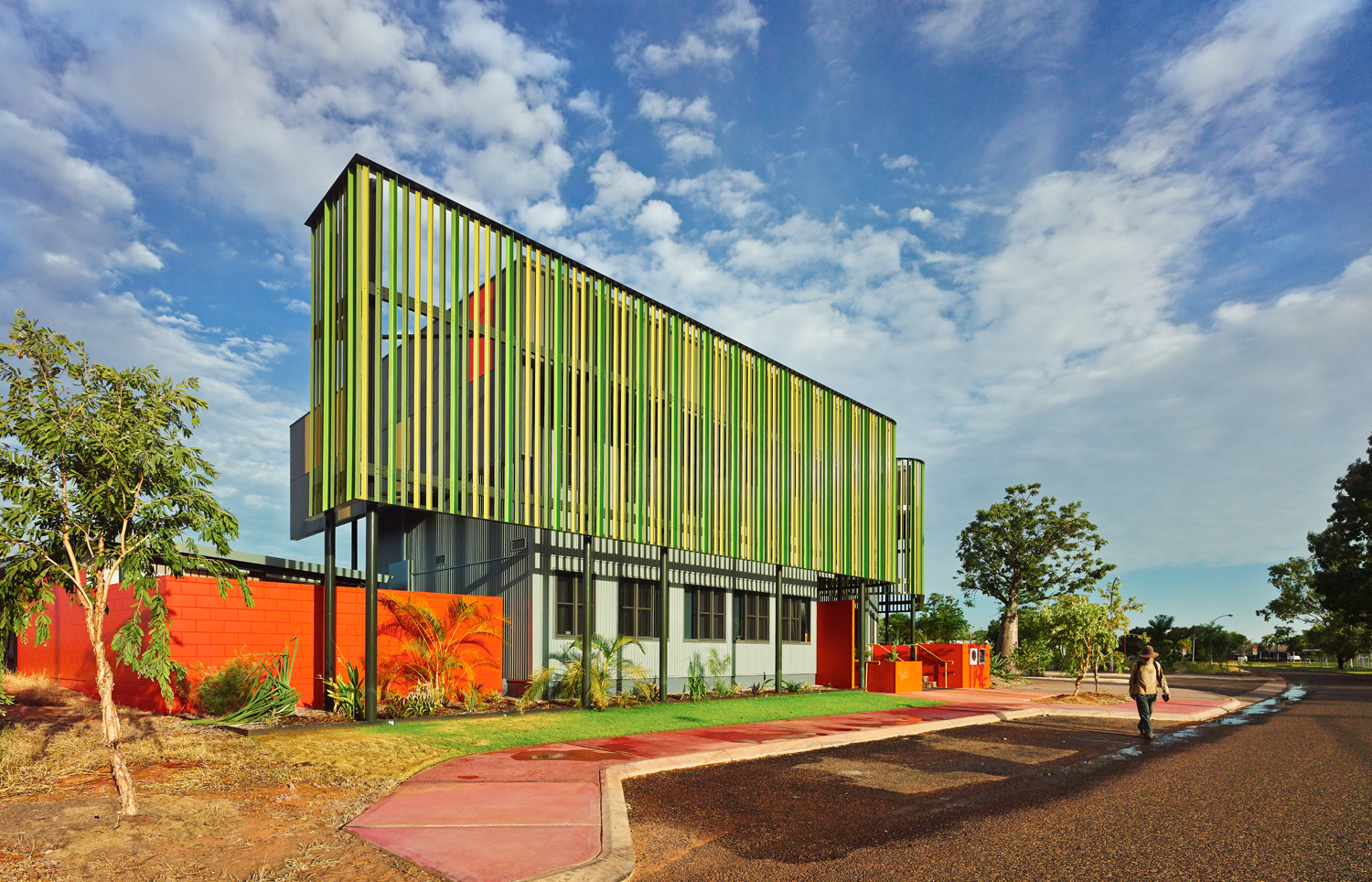
Just over ten years ago, at the height of the resources boom in Western Australia, CODA studio co-founder Emma Williamson and I started to work regionally and remotely across Western Australia. Our work focused on two areas – small community and health projects and the development of state government-sponsored design guides and handbooks. These handbooks aimed to identify and retain the character of townships, settlements and outstations in the face of the overwhelming onslaught of development that resulted from the resources boom. Through this work we began relationships with Indigenous organizations and communities, working collaboratively to deliver projects ranging from land subdivision to community buildings, offices and health clinics.
Since then we have worked with four different Indigenous communities in Queensland, Western Australia and the Northern Territory, each within two kilometres of a major tourism destination.[1] Incredibly, these “one-mile” communities are without access to running scheme water, sewerage treatment or reliable power. These conditions are the remnants and reserves of institutionalized racism that survive today.
Each community is adjacent to homes and tourist resorts in which visitors pay top dollar for a holiday “on Country” without realizing their nearest neighbours are living without basic amenity.
These communities are living in the Fourth World, a term coined by Canadian First Nations leader George Manuel in 1974 to describe Indigenous peoples who live in First World nations but are excluded and marginalized from mainstream advantage and opportunity.[2] We tread a challenging tightrope as First World consultants, working and walking alongside our clients in the Fourth.[3] This walk is more like a dance between two ways of seeing the world. The tensions and opportunities inherent in this dance have created much of the meaning our work has sought to explore. These challenges take many forms as our growing awareness and understanding of working in remote and regional Indigenous communities deepens.
I am not a seagull…
Working in communities post-native title determination, often with leaders who are key to maintaining ceremonial and sacred life, is a distinct challenge for us westernized middle-class professionals. How can we relate to the vast array of cultural and familial obligations, nationhoods, resettlement patterns, stolen generations and collective and intergenerational trauma? The paradox is one of striving to do good through a model of “community development” when we are labelled “seagulls”: white beings that fly in, make a lot of noise, shit on everything and fly away again. The contradiction of maintaining an anti-racist position while working within regimes, systems and procurement models that can only be considered colonising is exhausting to motivation. As author Kim Mahood has articulated it, “…the most highly skilled and scrupulous people are hollowed out by the effects of this contradiction.”[4]
Keeping clients alive
The reality of the unacceptable health gap between Indigenous and non-Indigenous Australians is keenly felt when working with communities that can have an average life expectancy as low as 52.[5] Not so many years ago I had the privilege of working with an articulate leader and traditional owner my own age. His untimely death at the age of 42 was tragic and profound. It created a leadership void, ongoing trauma in the community and significant disruptions to the delivery of his organization’s project. Our current work in the Groote Archipelago in the Northern Territory is punctuated with constant “sorry business” (social practices that follow the death of a community member) and the elastic responses required as relatives arrive and houses, cars and boats are vacated to await the smoking ceremony that helps spirits to be sung out and onwards.
The challenges of innovation
We have read dozens of auditor’s reports arguing (with eye-glazing similarity) that Indigenous projects, programs and partnerships have resulted in suboptimal outcomes because of poor design, delivery and review processes. Reports that assert recommendations to (yet again) improve local consultation, improve coordination between agencies, innovate in design and innovate in delivery. This innovate / neglect / crisis / rebuild / neglect cycle, which characterizes much housing policy and funding for Indigenous communities, is a key challenge. It is the flawed model that architects and health professionals seeking to improve the most basic of requirements for living, a healthy house, encounter again and again.[6] We must stop innovating through novelty as this supports a system that is essentially designed for failure.[7] Instead we must continue to advocatefor evidence-based models of quality design and delivery and robust maintenance practices, as championed through the work of Health Habitat, Tangentyere Design and many others.
MG/GT Administration Building
Of politics
These challenges are, at their heart, political. The rhetoric of “better design practices for healthy housing” slips easily off the tongues of politicians, but can so easily disappear in the complex and exhausting chains of middle-management tasked to deliver it.[8] Working within a political system designed to support and feed an ever-burgeoning bureaucracy places emphasis on the new, the quick and the initial cost, and diminishes the value of life cycles, incremental and evolutionary improvement and community-led feedback loops.
Of land, right?
In our work with the Quandamooka community onMinjerribah (North Stradbroke Island, Queensland) we’ve experienced the effects of recent native title determinations and the striking political strength of traditional owners, who have been bruised and pilloried by “locals” during the process. Native title and land title tension between third-generation holiday-makers and a culture built over millennia simply adds to the generational trauma. Rather than building bridges between community members, it can result in fractured opportunities to work together across boundary lines of freehold and reserve lands.
… and ‘action’!
One of the greatest challenges lies in procurement processes that are predicated on the rhetoric of the right “action” words, yet fail to deliver meaningful change or actual outcomes. The neoliberal development patterns, project management processes and de-risked delivery models espoused by governments and private consulting firms must be reimagined. Time and again we have seen Indigenous organizations struggle with “corporate knowledge” and the never-ending bureaucratic processes designed to “build capacity.”[9] We need a model that is the right fit culturally and commercially, and one that can be led by Indigenous communities.
It may be difficult to imagine this alternative model, given that the Uluru Statement from the Heart’s most basic proposition of a Makarrata Commission[10] can be neither understood nor supported by our government. For us, this is emphatic evidence that current systems are not geared to facilitate and celebrate Indigenous organizations, native title holders and owners of culture, story and country.
This is one of the reasons we seek to work directly with traditional owner groups, post-native title determination, on their own country and on their own projects. Unfortunately, though, this work is not always on their own terms. Why not? Because the strings tied to funding, land release and the “economic transition strategy” require the use of standardized bureaucratic processes and conventional project management and milestones. Government briefs set targets and outcomes that can be identified within electoral cycles. It is impossible to resist the colonising effects of these kinds of procurement processes.
Karratha Central Healthcare
What then of the future, the possibility inherent in community as more and more post-native title determination communities are recognized, formed, re-formed, imagined and projected?
Is there another way forward that doesn’t solely use the “rational,” Westernized economic development model to empower communities?
We are optimists – our work is always imagined in a (brighter) future. We imagine Australia as a Fourth World in which this is not a pejorative term denoting marginalization, disempowerment and despair, but rather one describing, as the Uluru Statement from the Heart states, “a fuller expression of our nationhood.” It is a country of empowerment and reconciliation, truthful and open to Indigenous voices. Getting there will require political maturity, genuine reconciliation and a collective re-casting and reimagining of the post-colonial, neoliberal malaise that got us here in the first place.
We dream of this place. Where our country, continuous narratives and human relationships intersect to create a new way – our Fourth World teaching us to walk together and transform the First.
[1]Goompi, Minjerribah, Queensland; Broome, West Kimberley, Western Australia; Kununurra, East Kimberley, Western Australia; and Malkala, Groote Eylandt, Northern Territory.
[2]George Manuel’s The Fourth Worldis a searing indictment of the mistreatment of marginalized Indigenous and state-less peoples around the world. This powerful work, by the leader of the National Indian Brotherhood (predecessor of the Assembly of First Nations) in Canada, laid the intellectual foundations for the establishment of the World Council of Indigenous Peoples in 1975. Manuel and his Indigenous colleagues from countries around the world brought a radically different perspective to international politics, one based on the shared experience of colonization, the often brutal suppression of Indigenous cultures and a passionate determination to assert control over their future.
[3]See also Nicolas Rothwell, Our Fourth World, The Australian, 30 May 2009, theaustralian.com.au/news/inquirer/our-fourth-world/news-story/5e9e55ddcafc0194a2933c92a5212651 (accessed 24 October 2018)
[4]Kim Mahood, White Stigma, The Monthly, August 2015, themonthly.com.au/issue/2015/august/1438351200/kim-mahood/white-stigma (accessed 24 October 2018).
[5]ABS data in 2014 revealed that people living in very remote parts of the Northern Territory were only expected to live until 52.2 years of age, while people living in remote areas had life expectancy of 62.6 years of age. The life expectancy for very remote Territorians was more than 10 years behind the Australian average of 63.9.Jill Poulsen, ABS stats show that life expectancy in Territory years behind rest of Australia, NT News, 17 November 2014, ntnews.com.au/news/northern-territory/abs-stats-show-that-life-expectancy-in-territory-years-behind-rest-of-australia/news-story/e5cc22869faf11ea9cadf989e620b6f4 (accessed 24 October 2018)
[6]See figure 9 in Tess Lea and Paul Pholeros, This is Not a Pipe: The Treacheries of Indigenous Housing, Public Culture22, March 2010. researchgate.net/publication/249879335_This_Is_Not_a_Pipe_The_Treacheries_of_Indigenous_Housing (accessed 24 October 2018)
[7]Kieran Wong, We need to stop innovating in Indigenous housing and get on with Closing the Gap, The Conversation website, 31 May 2018, theconversation.com/we-need-to-stop-innovating-in-indigenous-housing-and-get-on-with-closing-the-gap-96266(accessed 24 October 2018)
[8]Commonwealth of Australia, Department of the Prime Minister and Cabinet, Remote Housing Review: A review of the National Partnership Agreement on Remote Indigenous Housing and the Remote Housing Strategy (2008-2018), pmc.gov.au/sites/default/files/publications/review-of-remote-housing.pdf. See “Part 4.5: Over the course of the Strategy many lessons were learned (or re-learned)”
[9]These challenges and the self-fulfilling process is eloquently outlined by Tess Lea in Bureaucrats and Bleeding Hearts: Indigenous Health in Northern Australia, UNSW Press, August 2008.
[10]Uluru Statement from the Heart, presented at the First Nations National Constitutional Convention, May 2017. referendumcouncil.org.au/sites/default/files/2017-05/Uluru_Statement_From_The_Heart_0.pdf
Things have taken a bit of a turn with the development of TheFulcrum.Agency brand. As we thought about the launch and how we wanted to present ourselves to the world, it became increasingly apparent that the usual ‘website with pretty pictures of projects’ approach really didn’t make a lot of sense for a practise that’s not only concerned with the built outcome, but with an evidence-based approach to all it does.
PIVOT PAGINATION V32
With this in mind, it became clear that we needed to find a format that could give context to the aims of TheFulcrum.Agency. We wanted something that would have value beyond a marketing launch – and so was hatched the idea of TheFulcrum.Agency as content creator and curator. What if you could hold all that the Agency stood for in your hands – what would that look like?
190331 PIVOT 7×9 LAYOUT 2 WIP40
And so we have been scrambling over the last few weeks to answer that question and bring it to life. The result? TheFulcrum.Agency’s very own Journal, the first issue of which will be entitled ‘Pivot’ and deal with issues of ‘changing direction’ in the personal and professional realms, the artistic and the academic , the theoretical and the built.
190331 PIVOT 7×9 LAYOUT 2 WIP33
So, four weeks from idea to launch for a 80 page magazine. Sure, we can to do that.